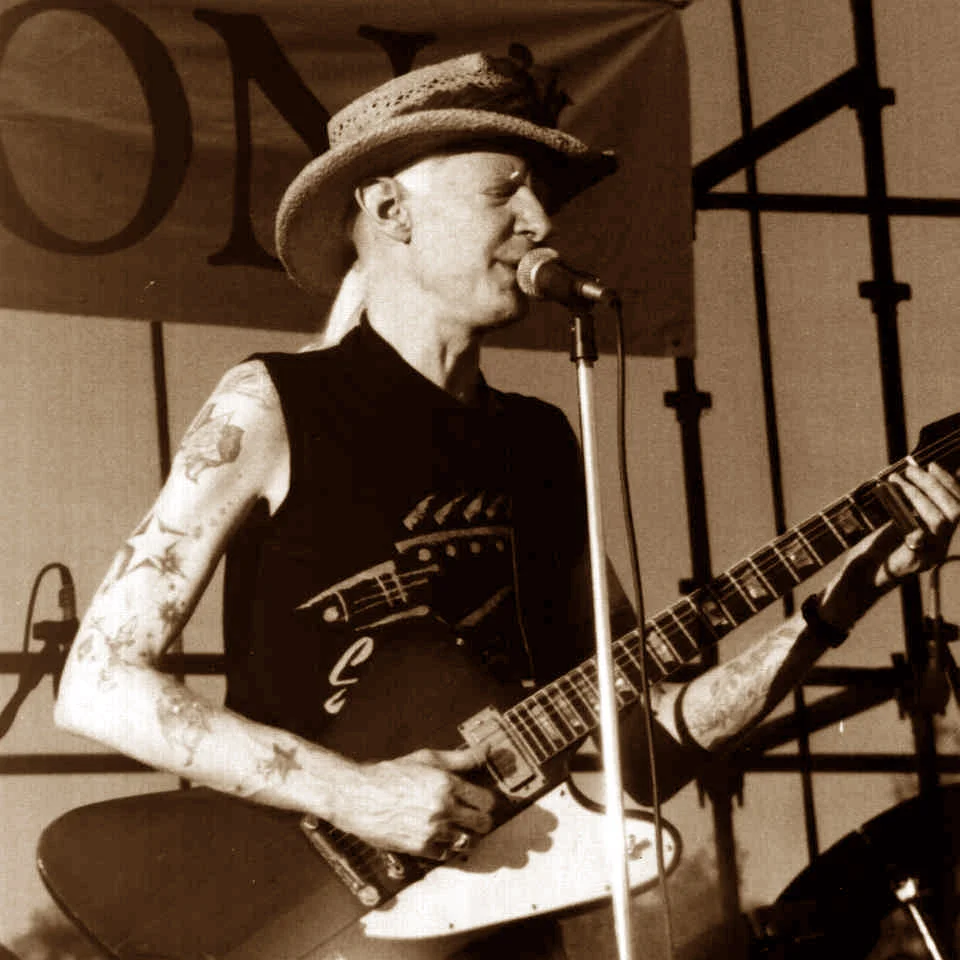
Johnny Winter
Johnny Winter was one of the most technically gifted and powerful blues guitarists of his generation — an albino Texan who bridged the rawness of authentic Delta and Texas blues with the volume and energy of late-1960s rock. He was discovered by Rolling Stone's John Wenner in 1968 and signed to Columbia Records for a then-enormous advance of $600,000, becoming one of the most anticipated debut artists of the era. His playing combined the slide technique of Robert Johnson's tradition with a ferocity of attack that anticipated hard rock and heavy metal. His 1969 self-titled debut and 'Second Winter' (1969) represent his peak; 'Still Alive and Well' (1973) is his most commercially successful studio recording. He was a devoted disciple of Muddy Waters and was instrumental in reviving Waters' recording career in the late 1970s.
Early 1960s Gibson Firebird through Marshall Super Lead at high volume — the Firebird's bright, articulate mini-humbucker combined with the Marshall's EL34 power stage produces a searing, aggressive lead tone unlike any other guitar-amp combination in blues-rock. The Firebird's neck-through construction contributes extraordinary sustain; the mini-humbuckers (smaller than full-size PAFs) produce a characteristic brightness with slightly less low-mid thickness than full-size humbuckers.
Signal Chain Order
Why Johnny Winter's Rig Works
The Firebird's mini-humbuckers are a genuinely different design from the full-size PAF-style humbuckers found in most blues-rock rigs — smaller magnets and coils produce less low-mid thickness but more brightness and articulation, closer in some respects to a hot single coil than a conventional humbucker. That's why Winter's tone through a cranked Marshall reads as searing and cutting rather than the warmer, rounder character a Les Paul or SG produces through the same amp.
The Firebird's neck-through-body construction (where the neck's wood extends the full length of the guitar rather than joining at a separate neck pocket) contributes meaningfully more sustain than a bolt-on or even standard set-neck design — that extra sustain matters directly for Winter's aggressive, extended bent notes, letting them ring and develop harmonic complexity for longer before naturally decaying.
Running the Marshall Super Lead at genuinely high gain (9 on the dial, not just loud) rather than the more moderate breakup settings favored by many blues players reflects Winter's specific fusion of Texas blues vocabulary with late-1960s rock aggression — he wasn't chasing a purely traditional blues tone but a harder-edged hybrid, and the mini-humbucker's brightness combined with genuinely high amp gain is what produces that searing, more rock-adjacent quality distinct from the more restrained tones of his direct blues predecessors.
Guitars
1963 Gibson Firebird V
1969–2014Winter's most iconic instrument — the reverse-body Firebird V with banjo-style tuners and mini-humbucker pickups. The neck-through construction and mini-humbuckers produce a sustain characteristic and tonal character unlike any other Gibson guitar. The bright, aggressive mini-humbucker through a Marshall at high volume is the defining sound of his Columbia Records period.
Gibson Firebird III
1973–1985A simpler Firebird model used during his later career — three mini-humbuckers (neck, middle, bridge) rather than two. Tonally similar to the Firebird V but with different pickup selection options.
Modified Telecaster
1967–1969Used during his early club period before the Columbia signing — the Telecaster through a small amp represents the pre-fame Texas club sound before his national exposure.
Amplifiers
Marshall Super Lead 100W
1969–2014Winter's primary amp throughout his career — the Super Lead at very high volume with the Firebird's mini-humbuckers produces a tonal character that no other guitar-amp combination has replicated. The EL34 power stage compressed differently than American power tubes, contributing to the aggressive attack character.
Fender Vibroverb
1967–1969Used during the pre-Columbia Texas period — the Vibroverb's clean sound with built-in tremolo and reverb represents the Texas-style clean platform that preceded his shift to Marshall-driven rock volumes.
Effects Pedals
MXR Phase 100
1975–1985Occasional phaser use during his rock period — adds the sweeping phase effect characteristic of mid-1970s studio recordings.
Pedal guide →Key Albums & Tone
"Mean Town Blues" and "Be Careful with a Fool" — the debut Columbia album. Raw, aggressive Texas blues-rock with the Firebird-Marshall combination in its most exposed form. The production is minimal, foregrounding the guitar tone.
Recorded immediately after the debut — double album featuring both electric and acoustic work. "Memory Pain" and "Miss Ann" represent his peak electric blues performances from this period.
"Rock and Roll, Hoochie Koo" cover and "Still Alive and Well" — his most commercially successful album. The production is more polished than the Columbia period but the Firebird tone is intact.
Blues-focused album — more stripped back and traditional than the rock-oriented work. The playing is more relaxed and less aggressive, emphasising feel over technique.
Frequently Asked Questions
What guitar does Johnny Winter use?
1963 Gibson Firebird V and Gibson Firebird III. Winter's most iconic instrument — the reverse-body Firebird V with banjo-style tuners and mini-humbucker pickups. The neck-through construction and mini-humbuckers produce a sustain characteristic and tonal character unlike any other Gibson guitar. The bright, aggressive mini-humbucker through a Marshall at high volume is the defining sound of his Columbia Records period.
What amp does Johnny Winter use?
Marshall Super Lead 100W and Fender Vibroverb. Winter's primary amp throughout his career — the Super Lead at very high volume with the Firebird's mini-humbuckers produces a tonal character that no other guitar-amp combination has replicated. The EL34 power stage compressed differently than American power tubes, contributing to the aggressive attack character.
What pedals does Johnny Winter use?
Johnny Winter uses MXR Phase 100.
What is Johnny Winter's signature sound?
Early 1960s Gibson Firebird through Marshall Super Lead at high volume — the Firebird's bright, articulate mini-humbucker combined with the Marshall's EL34 power stage produces a searing, aggressive lead tone unlike any other guitar-amp combination in blues-rock. The Firebird's neck-through construction contributes extraordinary sustain; the mini-humbuckers (smaller than full-size PAFs) produce a characteristic brightness with slightly less low-mid thickness than full-size humbuckers.
About This Data
Gear information for Johnny Winter is compiled from live performance footage, rig-rundown interviews, manufacturer and signature-model documentation, and cross-referenced guitar press coverage — not a single source. Where accounts conflict (a common issue with decades-old gear history), we favour the version corroborated by the most independent sources and note genuine ambiguity in the text rather than presenting a guess as settled fact.
This page is maintained by Alex Hall, last reviewed July 2026. Spotted something out of date or inaccurate? Let us know — corrections are usually made within a few days.