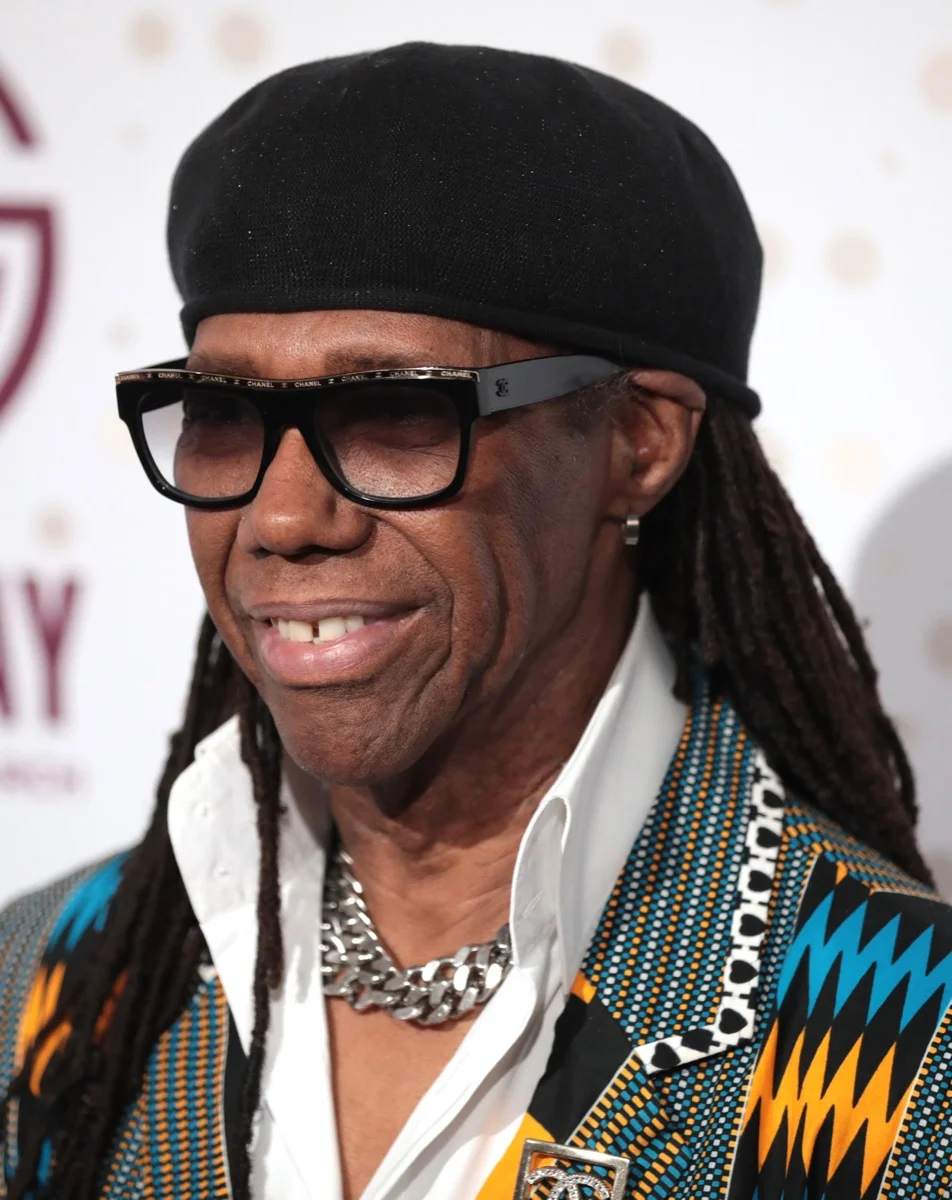
Nile Rodgers
Nile Rodgers is the most prolific hit-making guitarist in popular music — co-founder of Chic with Bernard Edwards, producer of records for David Bowie, Madonna, Diana Ross, Daft Punk, and Beyoncé, and one of the most sampled artists in hip-hop history. His guitar work is defined by a specific rhythmic technique: extremely tight, staccato muted chords played directly in the pocket of the groove, using a single 1959 Fender Stratocaster through almost no processing. He has played the same guitar on virtually every recording and live performance since the 1970s.
A single 1959 Fender Stratocaster ('The Hitmaker') in the neck or bridge position, run direct to the board or through a very clean, flat amp with no EQ colouration. The technique is the tone — incredibly tight, percussive chord muting where the left hand dampens immediately after each strum, creating a staccato click-chord that sits between the rhythm section beats rather than over them. No reverb, no delay, almost no effects.
Signal Chain Order
Why Nile Rodgers's Rig Works
Running direct to the mixing desk with essentially no processing is the single decision that makes Rodgers's rhythm technique audible in the first place. Funk rhythm guitar in a dense mix depends on the muted chord's percussive attack and immediate decay being crisp and clearly defined — any amp coloration, reverb, or gain stage would soften that attack and blur the sharp, staccato quality that lets the guitar sit precisely between the bass and drums rather than blending into either. The tone is deliberately unremarkable in isolation because its entire job is to lock into the groove, not to sound impressive on its own.
The technique itself — muting immediately after each strum with the fretting hand — is what actually creates the tone, and it's inseparable from why a completely clean, unprocessed signal works. Because there's no distortion or compression to add artificial sustain, every chord's length is controlled entirely by hand technique, giving Rodgers exact rhythmic control over how long each staccato hit rings before going silent — a control that's genuinely reduced once compression or distortion start extending or coloring the note's natural decay.
Sticking with a single guitar (the same 1959 Stratocaster) across five decades of sessions isn't sentimentality alone — a working session and production guitarist benefits enormously from knowing exactly how an instrument responds under his hands without variables, which matters more in a career built on serving other artists' songs quickly and consistently than in a career built around chasing new personal tones.
Guitars
Fender Stratocaster "The Hitmaker" (1959)
1973–presentThe primary instrument — a 1959 pre-CBS Fender Stratocaster purchased from a pawn shop for $200 in the early 1970s. Used on virtually every Nile Rodgers recording: "Le Freak", "Good Times", "Let's Dance", "Like a Virgin", "Get Lucky". Maintained in original condition. Has been insured for over $1 million.
Full specs & buy →Fender Stratocaster (backup)
Several period-correct backup Stratocasters maintained in case The Hitmaker requires service.
Full specs & buy →Amplifiers
Direct Input (DI)
Primary signal path — guitar straight to the mixing desk. No amp coloration, no processing, no reverb. The clean, direct character of the Strat pickups is the entire tone.
Fender Twin Reverb
Used for live performance where DI is impractical — run completely clean, flat EQ, reverb off. The Twin is as close to a transparent amplifier as a valved instrument allows.
Amp guide →Effects Pedals
MXR Dynacomp
Occasional mild compression for live performance consistency — keeps the staccato chord attacks even across the dynamic range of a live mix. Not present on most studio recordings.
Pedal guide →Key Albums & Tone
"Le Freak" — the riff that The Hitmaker was built for. Staccato muted Strat chord straight to board. The most precise funk rhythm guitar on a disco record.
"Let's Dance" and "Modern Love" — Rodgers produced and played rhythm guitar. The same Hitmaker Strat technique on a rock production.
"Material Girl" and title track — Rodgers produced both of Madonna's defining records. The rhythm guitar is mixed deep in the groove.
"Get Lucky" — the biggest demonstration of the Hitmaker technique to a new generation. A direct link between 1978 Chic disco and 2013 pop. 10+ million singles sold.
Frequently Asked Questions
What guitar does Nile Rodgers use?
Fender Stratocaster "The Hitmaker" (1959) and Fender Stratocaster (backup). The primary instrument — a 1959 pre-CBS Fender Stratocaster purchased from a pawn shop for $200 in the early 1970s. Used on virtually every Nile Rodgers recording: "Le Freak", "Good Times", "Let's Dance", "Like a Virgin", "Get Lucky". Maintained in original condition. Has been insured for over $1 million.
What amp does Nile Rodgers use?
Direct Input (DI) and Fender Twin Reverb. Primary signal path — guitar straight to the mixing desk. No amp coloration, no processing, no reverb. The clean, direct character of the Strat pickups is the entire tone.
What pedals does Nile Rodgers use?
Nile Rodgers uses MXR Dynacomp.
What is Nile Rodgers's signature sound?
A single 1959 Fender Stratocaster ('The Hitmaker') in the neck or bridge position, run direct to the board or through a very clean, flat amp with no EQ colouration. The technique is the tone — incredibly tight, percussive chord muting where the left hand dampens immediately after each strum, creating a staccato click-chord that sits between the rhythm section beats rather than over them. No reverb, no delay, almost no effects.
About This Data
Gear information for Nile Rodgers is compiled from live performance footage, rig-rundown interviews, manufacturer and signature-model documentation, and cross-referenced guitar press coverage — not a single source. Where accounts conflict (a common issue with decades-old gear history), we favour the version corroborated by the most independent sources and note genuine ambiguity in the text rather than presenting a guess as settled fact.
This page is maintained by Alex Hall, last reviewed July 2026. Spotted something out of date or inaccurate? Let us know — corrections are usually made within a few days.