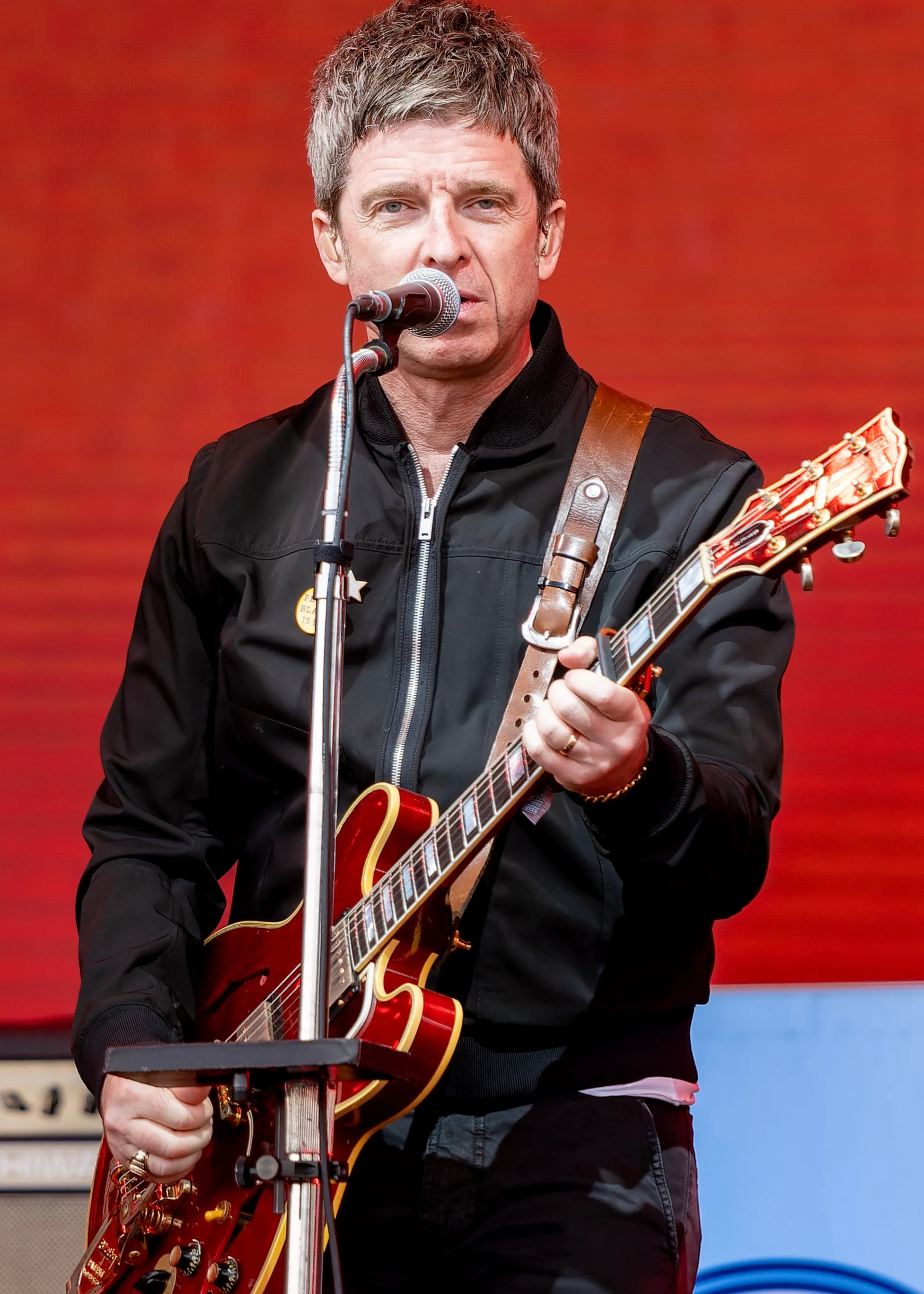
Noel Gallagher
Noel Gallagher is the songwriter, guitarist, and chief creative force behind Oasis — the band that dominated British music from 1994 to 2009 and sold over 75 million albums worldwide. His songwriting instinct for anthemic, emotionally direct chord progressions, combined with a working-class attitude toward gear and sound, produced some of the most iconic guitar tones in British rock: 'Wonderwall', 'Champagne Supernova', 'Don't Look Back in Anger'. He continues as Noel Gallagher's High Flying Birds.
Semi-hollow Epiphone Sheraton or Gibson ES-355 through a cranked Marshall — warm, full-bodied chord tone with a characteristic British crunch and subtle overdrive. Less about technical complexity and more about the right guitar in the right room through the right amp at the right volume. Understated and enormously effective.
Signal Chain Order
Why Noel Gallagher's Rig Works
Choosing semi-hollow guitars (the Epiphone Sheraton, Gibson ES-355) over the solid-body Les Pauls and Stratocasters more common in 1990s British rock is central to why Oasis's biggest anthems have the warmth they do. A semi-hollow body's resonant chambers add a natural acoustic complexity and roundness to the pickup's output before it even reaches the amp — layered under big, strummed open chords like those in "Wonderwall" or "Champagne Supernova," that extra harmonic fullness is part of what makes the chords feel larger and warmer than the same voicings on a solid-body guitar through an identical amp would.
Running the Marshall and Vox AC30 together in stereo, rather than choosing one, gives Gallagher two genuinely different amp characters simultaneously — the Marshall's warm, mid-forward crunch and the Vox's brighter, chimier British voicing — which widens and thickens the overall guitar sound in a way a single amp, however good, structurally can't. This is a similar additive-layering logic to Corgan's or Eric Johnson's multi-amp approaches, but applied as a live stereo rig rather than studio overdubs.
Keeping pedals to an essential minimum and relying on the amp's own gain for rhythm crunch reflects a specific songwriting priority: Oasis's guitar parts are built to serve big, direct, singable chord progressions rather than intricate technical playing, and a heavily pedal-processed tone would risk drawing attention to gear and texture at the expense of the anthemic simplicity the songs depend on.
Guitars
Epiphone Sheraton (1960s)
1994–2000The defining Oasis guitar — a vintage 1960s Epiphone Sheraton (made in America before the brand moved production) with a hollow body giving the warm, rounded tone of "Champagne Supernova" and "Wonderwall". Noel has spoken about finding these in Manchester pawn shops.
Full specs & buy →Gibson ES-355 (1960s)
1994–2009Noel's live workhorse throughout the Oasis years — the ES-355 with Bigsby provides the semi-hollow warmth with a vibrato tailpiece for subtle movement. Used across most of the major Oasis tours.
Full specs & buy →Gibson Les Paul Standard
2000–presentLes Paul used for harder rock passages on the later Oasis albums and High Flying Birds — warmer, fatter than the semi-hollows for specific sonic textures.
Full specs & buy →Fender Stratocaster
1994–present"Don't Look Back in Anger" piano aside, Noel has used Stratocasters for clean, brighter passages — but the Sheraton/ES-355 always returns as his primary.
Full specs & buy →Amplifiers
Marshall JCM800
1994–2009Primary amp throughout Oasis — cranked for natural tube breakup. No pedals needed for rhythm crunch. Volume around 7, gain moderate.
Vox AC30
1994–2009Running alongside the Marshall in stereo — the Vox provides chime and top-end sparkle that contrasts with the Marshall's warmth. The two-amp stereo rig is a signature Oasis live technique.
Amp guide →Supro 1690T Coronado
2015–presentUsed more frequently with High Flying Birds — smaller American vintage amp for recording and smaller venue touring.
Effects Pedals
Dallas Arbiter Fuzz Face
1994–1997Used on early Oasis recordings for extra grit — "Live Forever" has traces of Fuzz Face character in the rhythm layers.
Boss DD-3T Digital Delay
1994–present"Champagne Supernova" lead delay — set to a dotted-eighth rhythm that creates the signature melodic echo. Simple and effective.
Pedal guide →Dunlop Crybaby Wah
1994–2009Used sparingly on select Oasis recordings — not a core Noel sound but present on specific studio tracks.
Ibanez Tube Screamer TS9
2005–presentLater period — TS9 as a boost into the Marshall for lead tones on High Flying Birds material.
Pedal guide →Key Albums & Tone
"Supersonic" and "Cigarettes & Alcohol" — raw, cranked Marshall. Epiphone Sheraton through the back-line. The sound of a working band.
"Wonderwall" acoustic; "Champagne Supernova" defines the electric tone — ES-355 into Marshall at the perfect volume. The best-selling UK album of the 1990s.
Maximalist production — guitars layered 10+ times on each track. The overdone version of the Oasis guitar sound.
B-sides collection — "Acquiesce" and "Half the World Away" show Noel's acoustic songwriting equal to his electric playing.
Frequently Asked Questions
What guitar does Noel Gallagher use?
Epiphone Sheraton (1960s) and Gibson ES-355 (1960s). The defining Oasis guitar — a vintage 1960s Epiphone Sheraton (made in America before the brand moved production) with a hollow body giving the warm, rounded tone of "Champagne Supernova" and "Wonderwall". Noel has spoken about finding these in Manchester pawn shops.
What amp does Noel Gallagher use?
Marshall JCM800 and Vox AC30. Primary amp throughout Oasis — cranked for natural tube breakup. No pedals needed for rhythm crunch. Volume around 7, gain moderate.
What pedals does Noel Gallagher use?
Noel Gallagher uses Dallas Arbiter Fuzz Face, Boss DD-3T Digital Delay, Dunlop Crybaby Wah and more.
What is Noel Gallagher's signature sound?
Semi-hollow Epiphone Sheraton or Gibson ES-355 through a cranked Marshall — warm, full-bodied chord tone with a characteristic British crunch and subtle overdrive. Less about technical complexity and more about the right guitar in the right room through the right amp at the right volume. Understated and enormously effective.
About This Data
Gear information for Noel Gallagher is compiled from live performance footage, rig-rundown interviews, manufacturer and signature-model documentation, and cross-referenced guitar press coverage — not a single source. Where accounts conflict (a common issue with decades-old gear history), we favour the version corroborated by the most independent sources and note genuine ambiguity in the text rather than presenting a guess as settled fact.
This page is maintained by Alex Hall, last reviewed July 2026. Spotted something out of date or inaccurate? Let us know — corrections are usually made within a few days.