Tone Timeline
Billy Gibbons — Tone Evolution
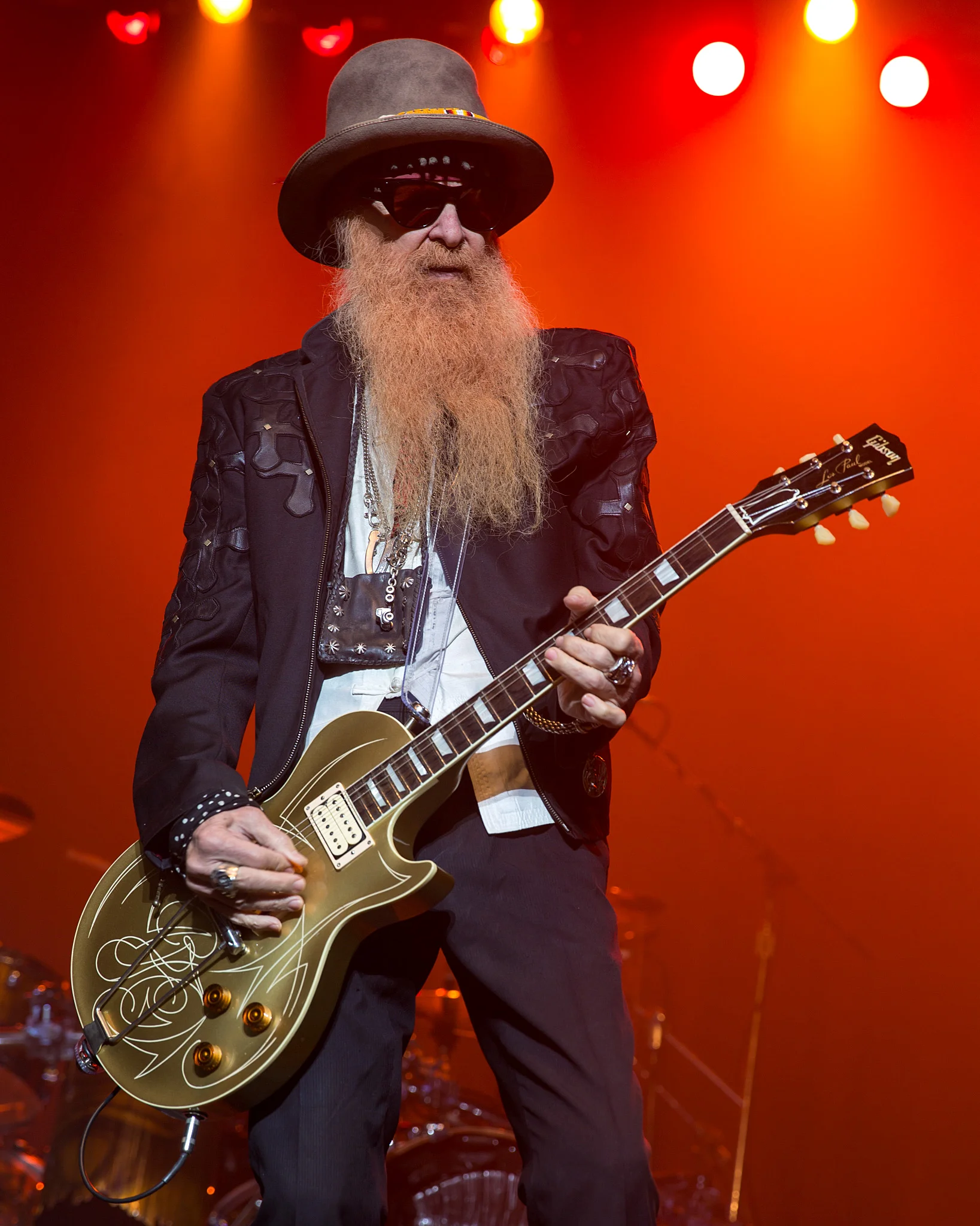
Billy Gibbons distilled Texas blues-rock into its purest commercial form — a 1959 Gibson Les Paul called Pearly Gates, a Marshall or Fender Bassman, and the thickest pick attack in rock. ZZ Top's arena success in the 1980s gave him a bigger stage but the core tone never changed: warm, singing humbucker sustain with a coin as a pick.
1966–1970: Moving Sidewalks / Early ZZ Top
Gibbons came up through the Moving Sidewalks — a Houston psychedelic rock band — before forming ZZ Top in 1969. Early ZZ Top (ZZ Top's First Album, 1971) showed a raw blues-rock sound through a 1959 Les Paul and various Marshalls. Gibbons was already using a quarter or peso as a pick — a technique he learned from a blues musician in Houston.
Signal Chain
1973–1979: Tres Hombres / Degüello
↑ "La Grange" became the Rosetta Stone of ZZ Top tone — boogie-blues built on a humbucker/Bassman foundation.
Tres Hombres (1973) put ZZ Top on the map and codified Gibbons' tone: Pearly Gates into a Fender Bassman or Marshall, played with a coin. "La Grange" showcased his boogie-blues riffing at its peak. Degüello (1979) showed broader range — cleaner tones, slide work, and a wider palette. The Vox Tone Bender fuzz appeared on various tracks.
Signal Chain
1983–present: Eliminator / Continuing
↑ Synthesisers surrounded the guitar but the guitar itself never softened — Gibbons' tone is a constant in ZZ Top's changing commercial palette.
Eliminator (1983) was a commercial explosion — synthesisers and drum machines sat beneath Gibbons' guitar, but the guitar tones were unchanged. Pearly Gates through a Marshall or Bassman, coin as a pick. If anything, Gibbons explored more gear in this era: PRS guitars, various one-offs, but always returning to the same core. His tone philosophy is about minimal processing and maximum attack from the right-hand coin.
Signal Chain