Tone Timeline
Chuck Berry — Tone Evolution
Chuck Berry invented the vocabulary of rock guitar — the double-stop licks, boogie rhythm patterns, and showmanship that every rock guitarist since has inherited. His Gibson ES-350T into a small amp produced a bright, cutting single-coil tone that cut through the mix and defined what an electric guitar was supposed to sound like in rock music.
1955–1964: Chess Records — Johnny B. Goode era
The Chess Records sessions (Maybellene, Johnny B. Goode, Roll Over Beethoven, Rock and Roll Music) used Berry's Gibson ES-350T semi-hollow through a small practice amp — a Fender Princeton or a similar small combo, recorded at Chess in Chicago with minimal signal chain. The tone was bright, slightly nasal, and completely unprocessed. The famous introduction to Johnny B. Goode was played on the bridge pickup, creating the cutting, percussive clarity that made the intro universally recognisable.
Signal Chain
Songs from this era
Chess Records single
The defining rock and roll guitar tone — Gibson ES-350 through a Gibson GA-40 amplifier at medium-hi…
Full rig →After School Session
Earlier and slightly rawer than Johnny B. Goode — the Chess studio captured the natural harmonic dis…
Full rig →Chess Records single
Berry's debut recording and the birth of the rock guitar vocabulary. The flat-picking country influe…
Full rig →St. Louis to Liverpool
A slightly harder-rocking Chuck Berry track — the same signature doubling technique (octave or sixth…
Full rig →1964–2017: Live performances / Hail! Hail! Rock 'n' Roll
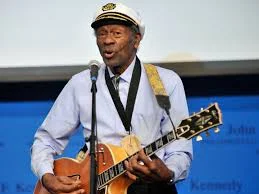
↑ ES-335 replaced ES-350T for live work — semi-hollow body with humbuckers gave more feedback resistance at live volumes while maintaining the bright, percussive character.
Berry's live approach from the 1960s onward was famously minimal — he arrived at venues with a single guitar and expected the local band to know his songs. The ES-335 replaced the ES-350T as his primary guitar through the 1970s and 1980s, still through modest Fender amplification. Hail! Hail! Rock 'n' Roll (1987 concert film) showed Berry at his best — the double-stop licks and boogie patterns completely unchanged from 30 years earlier, with a bright, percussive Fender amp tone.
Signal Chain