Tone Timeline
Frank Zappa — Tone Evolution
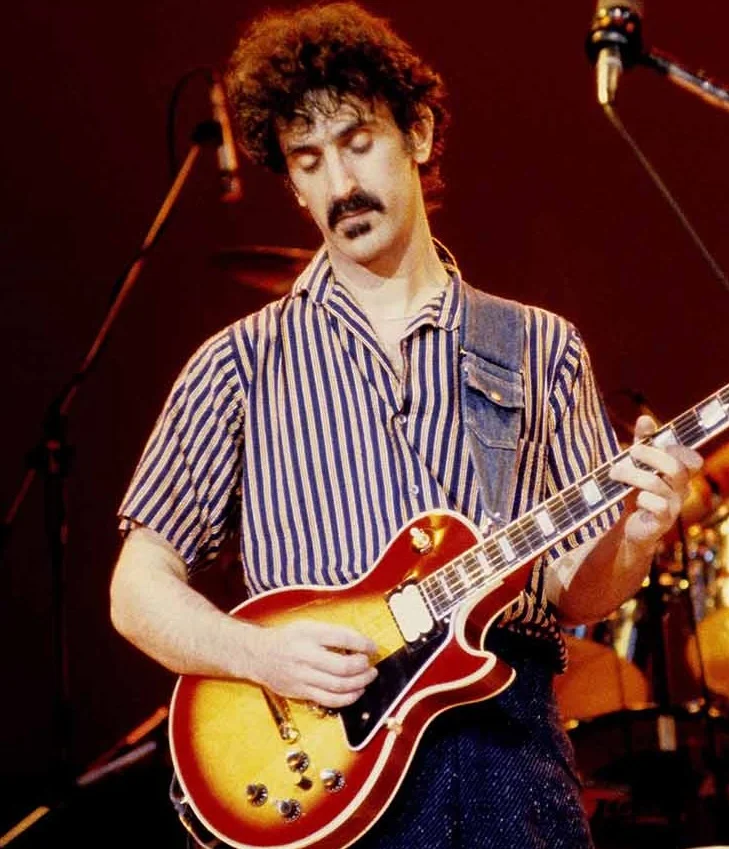
Frank Zappa's guitar work was secondary to his compositional output but deeply distinctive — he favoured a Les Paul Custom or SG through a Marshall or Acoustic 360, using the whammy bar aggressively and developing a vocabulary of bluesy pentatonic phrases combined with atonal passages. His tone was raw, slightly compressed, and unmistakably his own.
1966–1970: Freak Out! / Hot Rats
Early Zappa guitar on the Mothers of Invention records was deliberately anti-musical in the rock sense — noise, feedback, unconventional technique. Hot Rats (1969) was his first album where guitar playing was a primary focus: Peaches en Regalia and Willie the Pimp showed he could play bluesy, fluid lines when he chose to. He used a Gibson SG through a Fender amp for these sessions.
Signal Chain
1973–1982: Over-Nite Sensation / Shut Up 'N Play Yer Guitar
↑ Shut Up 'N Play Yer Guitar defined Zappa as a serious guitarist — the raw live recordings stripped away orchestration and revealed an eccentric but genuinely virtuosic improviser.
Shut Up 'N Play Yer Guitar (1981) was three albums of nothing but Zappa guitar solos from live recordings — raw, unedited, technically extraordinary. He used a 1963 Gibson SG Special and later a modified Les Paul Custom, run through a Fender amplifier with the volume cranked. His picking hand was tense and aggressive; long sustaining notes were achieved through finger vibrato at very high volume. He also used a custom-made guitar from luthier Steven Crisp.
Signal Chain
1982–1993: Jazz from Hell / Guitar
↑ Synclavier era Zappa moved away from guitar as primary creative tool — composition took over; live guitar work continued but the studio focus shifted dramatically.
Late Zappa used a Synclavier (digital audio workstation) for many compositions, but continued guitar work on touring albums. His live tone in the 1980s involved a more complex rig with multiple amps and effects. He was diagnosed with prostate cancer in 1990 and died in 1993. The guitar compilation Guitar (1988) is the most comprehensive document of his playing across decades.
Signal Chain