Tone Timeline
George Benson — Tone Evolution
George Benson bridges jazz guitar and R&B — his fluid, warm tone on Ibanez archtops achieved mainstream crossover success with Breezin' (1976) while maintaining genuine jazz credibility. His scatting-while-playing technique is unique and his tone is one of the warmest in the instrument's history.
1964–1971: Columbia / CTI Records
Early Benson used a Gibson ES-175 (the standard jazz guitar of the era) through small, clean amplifiers. His playing was bebop-fluent and technically brilliant but hadn't yet found the commercial hooks that would make him famous. White Rabbit (from a 1971 CTI session) showed his ability to bridge jazz and pop.
Signal Chain
1976–1985: Breezin' / Give Me the Night
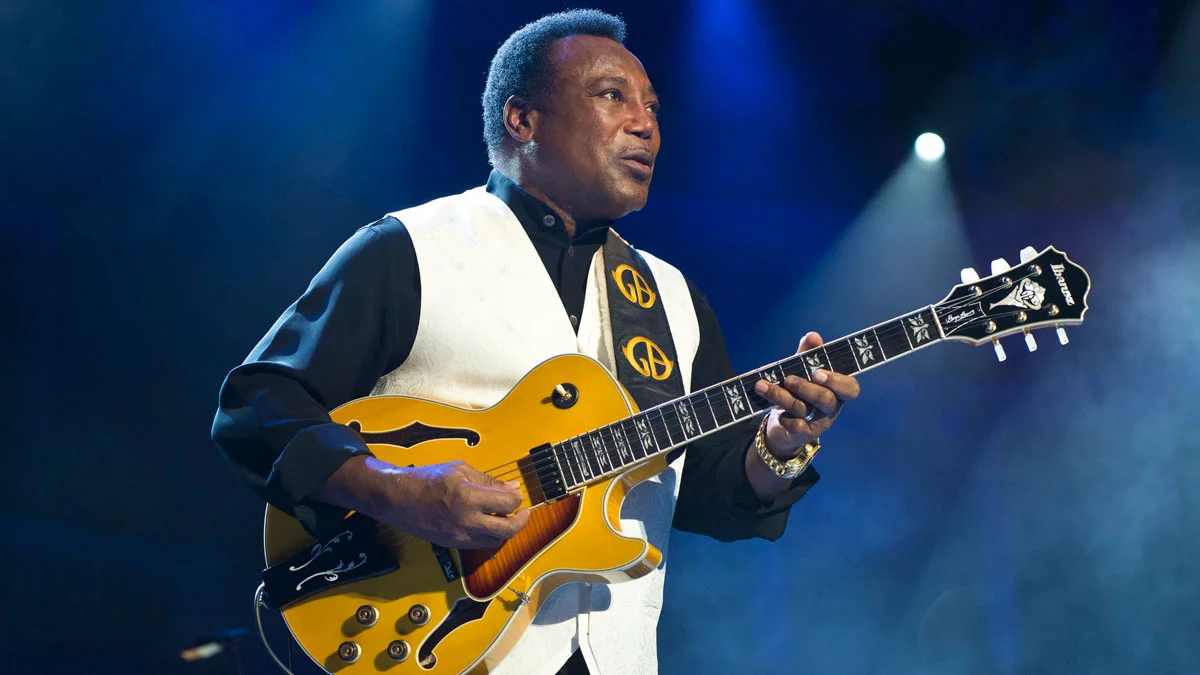
↑ The Ibanez GB10 was a perfect match — warmer and more commercial-friendly than the ES-175 while still a genuine jazz archtop; Breezin' made it one of the most copied jazz guitar sounds.
Breezin' (1976) was the best-selling jazz album of its time. Benson used a Ibanez GB10 (a signature model developed with Ibanez) — a semi-hollow thinline archtop with a warm, present midrange. Give Me the Night (1980, produced by Quincy Jones) pushed him into R&B territory. His tone on this era is defined by the GB10's warmth and a very clean, slightly compressed amplifier sound — Polytone or small Fender combos.
Signal Chain
1988–present: Tenderly / Guitar Man
↑ Late-period Benson tone is stripped back to the essential — warm archtop, clean amp, flatwound strings; any additional colour comes from his right hand, not his pedals.
Later Benson alternated between jazz standards albums (Tenderly, 1989) and R&B/pop crossover. His GB10 remained central with GB200 and GB100 models for different contexts. The tone became slightly warmer with age — more focused midrange, very little effects. Guitar Man (2011) was a straight guitar album that reasserted his instrumental identity.
Signal Chain