Rig Builder
Budget Rig Breakdown
Signal Chain
Essentials
Complete Your Rig
The accessories every serious guitarist needs — cables, strings, and the rest.
Ernie Ball Regular Slinky Strings (10-46)
The balance between bending ease and tone — standard gauge for blues and classic rock.
Dunlop Tortex Standard Pick 0.73mm (Pack of 12)
Medium-gauge picks used by blues and rock guitarists for attack and warmth.
Planet Waves American Stage Guitar Cable 10ft
Solderless ends and lifetime warranty. The cable most session guitarists trust.
Boss TU-3 Chromatic Tuner Pedal
The professional standard for live tuning. True bypass, powers other pedals, ultra-accurate.
Levy's M8 Guitar Strap
Quality leather strap used by touring guitarists. Genuine comfort for 3-hour sets.
Technique
Key Tone Tips
- Restriction is the creative tool — choose ONE amp and ONE guitar and commit
- Open A tuning (EAEAC#E) is White's standard — power chords become one-finger barres
- DigiTech Whammy on octave up blurs the line between guitar and bass in a two-piece band
- Big Muff gain at 9–10 for maximum sustain; tone at 6 to keep mid presence
- Slide on open A for the Delta-blues reference that runs throughout White Stripes material
- Cheap guitars often have higher action — embrace the physical resistance, it affects attack
- Detuned strings (Eb or open) give the looseness and saggy feel in the low notes
- Keep the amp slightly on the verge of feedback — threatening the edge is part of the sound
- Study "Seven Nation Army" (open A), "Ball and Biscuit" (slide blues) for the full range
- The minimalist ethos is not poverty of ideas — White deliberately removed options to force creative solutions; understanding this means the "restricted" tone is an artistic choice, not a compromise, and copying his approach requires committing to the same discipline of limitation
- Open A tuning requires re-learning chord shapes from scratch — every standard chord shape becomes a different chord in open A. Spend time building a vocabulary of open A chord voicings (major, minor, seventh, suspended) before attempting White Stripes chord progressions
- Amp feedback positioning is a learned skill — moving the guitar closer to or further from the amp, angling it at different positions, controls the pitch and intensity of the feedback. Practice controlling where feedback sustains rather than letting it be random noise
Background
About Jack White's Sound
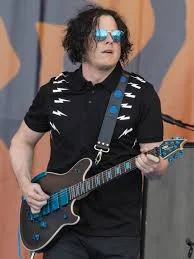
Jack White built the White Stripes' entire sound from deliberately limited, cheap equipment. His raw, confrontational tone proved that restriction creates creativity — a beaten-up Airline guitar through a detuned Silvertone amp, with an octave fuzz pushing the frequency extremes.
Tone History
Jack White's Tone Evolution
Jack White built a deliberately antagonistic guitar philosophy: cheap guitars, damaged tubes, maximum volume, minimum comfort. The Airline/Kay into a Sears Silvertone tube combo produced a fractured, garage-blues tone that influenced two decades of rock — proof that limitation is a creative tool.
Full timeline: 3 eras →Song Breakdowns
Jack White Song Rigs
Seven Nation Army
Elephant · 2003
The most recognisable guitar riff of the 2000s — performed on a semi-hollow…
Ball and Biscuit
Elephant · 2003
White's most extended blues showcase — a seven-minute slide and improvised …
Hotel Yorba
White Blood Cells · 2001
White at his most stripped — an acoustic guitar played aggressively with a …