Tone Timeline
Jim Hall — Tone Evolution
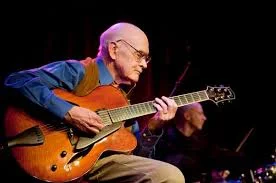
Jim Hall was one of the most harmonically sophisticated jazz guitarists — his understated, spacious approach influenced every subsequent jazz guitarist from Bill Frisell to Pat Metheny. He played with subtlety and intelligence rather than speed or flash.
1956–1966: Chico Hamilton / Sonny Rollins
Hall's recorded work with the Chico Hamilton Quintet and Sonny Rollins (The Bridge, 1962) showed a guitarist of exceptional musical intelligence. He used a Gibson ES-175 (the standard jazz guitar of the era) through a clean amplifier. The Bridge with Rollins is widely cited as one of the finest jazz guitar duo recordings — two improvising masters responding to each other without rhythm section.
Signal Chain
1969–1990: Jazz Guitar / Bill Evans Duo
↑ Evans duet era defined Hall's harmonic language — the interaction with Evans's piano pushed him toward increasingly sophisticated voicings and a lighter, more transparent touch.
Hall's duet recordings with Bill Evans (Undercurrent, 1962; Intermodulation, 1966) are among the most revered in jazz. His own albums on CTI, Concord, and Horizon showed his harmonic thinking evolving — more open voicings, more space, increasing influence from classical and impressionist music. He used a Guild guitar for much of this period rather than the Gibson archtop.
Signal Chain
1990–2013: Concerts By the Sea / Arrangements
↑ Late Hall tone was the most refined statement of his approach — maximum space, minimum decoration; each note chosen with complete harmonic intentionality.
Hall's final decades were filled with duo recordings, trios, and teaching. He died in 2013 at age 83. His influence on younger jazz guitarists was enormous and consciously acknowledged — Bill Frisell, John Scofield, Pat Metheny all cited him as essential. His tone in his last years retained the warm ES-175 character with more digital reverb and spatial processing.
Signal Chain