Tone Timeline
Joe Pass — Tone Evolution
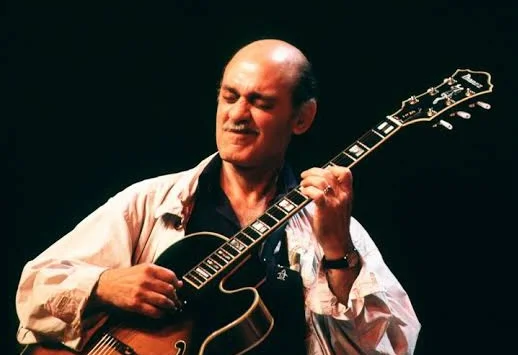
Joe Pass was the supreme solo jazz guitarist — his ability to simultaneously maintain bass lines, chord accompaniment, and melodic lines on a single guitar is the benchmark against which all subsequent solo jazz guitar is measured. His Virtuoso solo guitar recordings on Pablo Records are canonical.
1960–1973: Synanon / For Django
Pass overcame heroin addiction through the Synanon treatment programme in the early 1960s and recorded Sounds of Synanon (1962) upon leaving. For Django (1964) established his mature approach: a Gibson ES-175 through a clean amplifier, playing sophisticated chord-melody arrangements of standards. His fingering approach — using the thumb for bass notes and fingers for melody — allowed simultaneous bass/melody playing.
Signal Chain
1973–1992: Virtuoso Albums / Ella & Oscar
↑ Virtuoso defined the benchmark — after 1973, every solo jazz guitarist was compared to Pass's standard; the tone was irrelevant because the musical content was so overwhelming.
Virtuoso (1973) on Pablo Records changed the landscape for solo jazz guitar — the recording of Pass alone, playing standards with impossible simultaneous bass/chord/melody, showed what was possible. He recorded prolifically for Pablo: duets with Ella Fitzgerald, Oscar Peterson, Count Basie. His tone in this era was unchanged from the '60s — ES-175, Polytone amp, flatwounds. The music was everything; gear was secondary.
Signal Chain
1992–1994: Unforgettable
↑ Pass achieved total tonal consistency — the same guitar and amp from the early '60s to 1994; proof that in jazz guitar, the voice is in the hands and head, not the rig.
Pass continued recording and touring until shortly before his death from liver cancer in 1994 at age 65. Unforgettable (1992) is among his final solo recordings — the technique remained intact, the musicianship undiminished. He taught at the Guitar Institute of Technology in Hollywood and influenced an entire generation of jazz guitar teachers.
Signal Chain