Tone Timeline
John Lee Hooker — Tone Evolution
John Lee Hooker's blues was not about gear — it was about a rhythmic, hypnotic approach rooted in Delta blues but adapted for electric guitar. His one-chord boogie and unique timing were idiosyncratic enough that musicians who backed him struggled to lock in.
1948–1955: Modern / Specialty Records
Hooker recorded Boogie Chillen in 1948 — it went to #1 on the R&B chart. He used a small-body semi-hollow guitar (Kay or Silvertone) through whatever amplifier the studio had. The tone was raw and mid-heavy, with Hooker stomping his foot on a wooden board for rhythm. He recorded simultaneously for multiple labels under different names (Texas Slim, Delta John) — the gear and tone varied slightly but the approach was identical.
Signal Chain
1956–1970: Vee-Jay / Chess Records
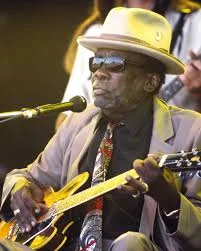
↑ ES-335 era tone was warmer and more polished than early recordings — Vee-Jay's better production brought his approach to a wider audience without fundamentally changing it.
Vee-Jay gave Hooker a proper band and better production — Boom Boom (1962) was his breakthrough pop crossover. He acquired a Gibson ES-335 and used it through Fender amplifiers. The tone became warmer and more sustained than his early raw recordings, but the approach — one-chord hypnotic boogie, unique timing — remained the same. The British Invasion bands (Animals, Rolling Stones, Doors) covered his songs and cited him as a primary influence.
Signal Chain
1989–2001: The Healer / Don't Look Back
↑ Late-career Hooker was unchanged tonally — the collaborators on The Healer adapted to him; he didn't adapt to them.
The Healer (1989) was a remarkable late-career album with guest appearances from Carlos Santana, Bonnie Raitt, and Robert Cray — a commercial and critical comeback for Hooker at age 71. The collaborations showed how his approach was genuinely unique; guest guitarists played around him rather than with him because his timing was his own. He died in 2001 at age 83.
Signal Chain