Tone Timeline
John McLaughlin — Tone Evolution
John McLaughlin is the definitive jazz-fusion guitarist — his Mahavishnu Orchestra work combined jazz improvisation vocabulary with rock volume and aggression. His tone shifted dramatically across career phases: from Les Paul fusion to acoustic flamenco to clean jazz-electric.
1970–1975: Mahavishnu Orchestra / Birds of Fire
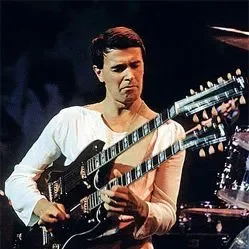
The Inner Mounting Flame (1971) and Birds of Fire (1973) are the essential Mahavishnu documents. McLaughlin used a custom double-neck guitar (Gibson EDS-1275) and various single-neck instruments through a Marshall stack. The tone was aggressive, heavily distorted for jazz standards, with virtuosic speed in odd time signatures. His right-hand technique was relentless — constant eighth-note streams at very high tempos.
Signal Chain
1975–1980: Shakti / Electric Dreams
↑ The Shakti break was radical — abandoning electric entirely for Indian classical acoustic music represented a complete reset of his musical identity.
McLaughlin abandoned electric guitar entirely for Shakti (1975-77) — an acoustic Indian classical fusion project with L. Shankar and Zakir Hussain. He played an acoustic guitar with scalloped fretboard to enable the microtonal bends of Carnatic music. Electric Dreams (1979) reunited him with electric guitar but in a more mainstream fusion context.
Signal Chain
1984–present: Mahavishnu 2 / Trio / NOW Here This
↑ Post-Shakti McLaughlin moved toward cleaner, more acoustically-aware electric tones — the Godin hybrid guitar was the physical embodiment of his between-worlds approach.
Later McLaughlin used Godin guitars (acoustic-electric hybrids designed for fusion) and Ibanez signature models. The tone became cleaner and more jazz-inflected than the Mahavishnu aggression — Roland guitar synthesizer was incorporated for orchestral textures. His current work is with the JMT Trio: clean electric, sophisticated harmony, still technically extraordinary.
Signal Chain