Tone Timeline
John Scofield — Tone Evolution
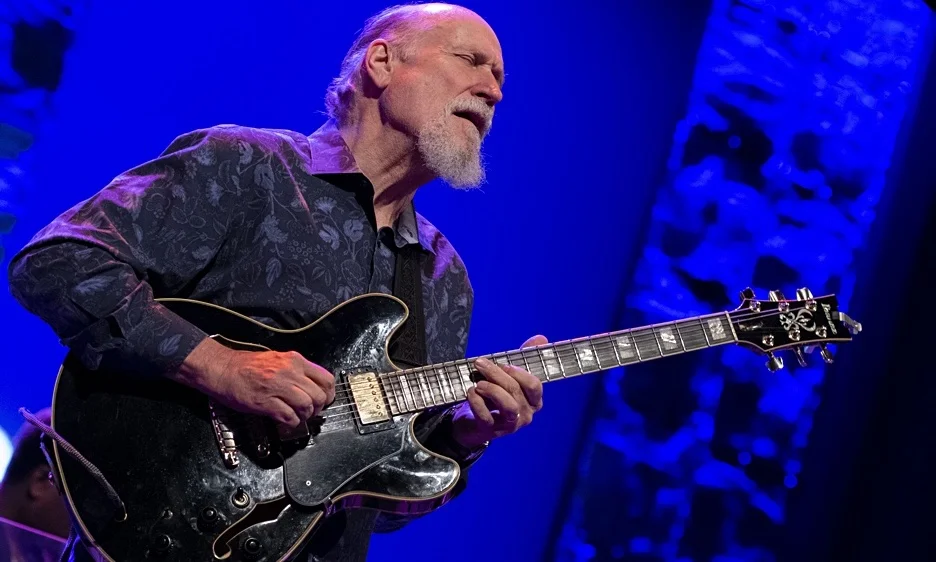
John Scofield occupies a unique position between jazz, blues, funk, and rock — his tone is warm, slightly dirty, and immediately recognisable. His Ibanez AS200 (or similar semi-hollow) through a Mesa/Boogie Mark I became one of the most distinctive electric jazz tones of the past 40 years.
1975–1984: Miles Davis / Still Warm
Scofield spent 1982-85 in Miles Davis's band — the most important endorsement in jazz. His tone in this period was already distinctive: Ibanez semi-hollow, Mesa/Boogie Mark I (clean to slightly crunchy), DiMarzio pickups, and a slightly nasal midrange quality. He played with a plastic pick and used his fingers for warmth variations. Still Warm (1986) was his post-Miles debut and showed his approach fully formed.
Signal Chain
1990–2003: Meant to Be / Up All Night
↑ A Go Go era Sco added envelope filter for funk context — the same core rig adapted to Medeski Martin & Wood's organ-trio groove.
Scofield's Blue Note and Verve albums of the '90s-2000s cemented his commercial reputation while maintaining artistic quality — Grace Under Pressure, Meant to Be, A Go Go (with Medeski Martin & Wood). A Go Go brought him to a jam band audience. His tone evolved slightly toward more funk — Boss envelope filter, lighter touch, Lexicon delay more prominent.
Signal Chain
2005–present: That's What I Say / Country for Old Men
↑ Late Scofield is the definition of tonal consistency — same guitar, same amp, 40+ years; the consistency is a conscious artistic statement about prioritising vocabulary over tone.
Later Scofield albums explored country (Country for Old Men), Ray Charles tribute (That's What I Say), and various stylistic investigations — always with the same core rig. The Ibanez AS200 has been his primary guitar for over 40 years. He began using a Fractal Axe-Fx for some touring applications but the Mesa/Boogie Mark I — the same unit — remains his studio reference.
Signal Chain