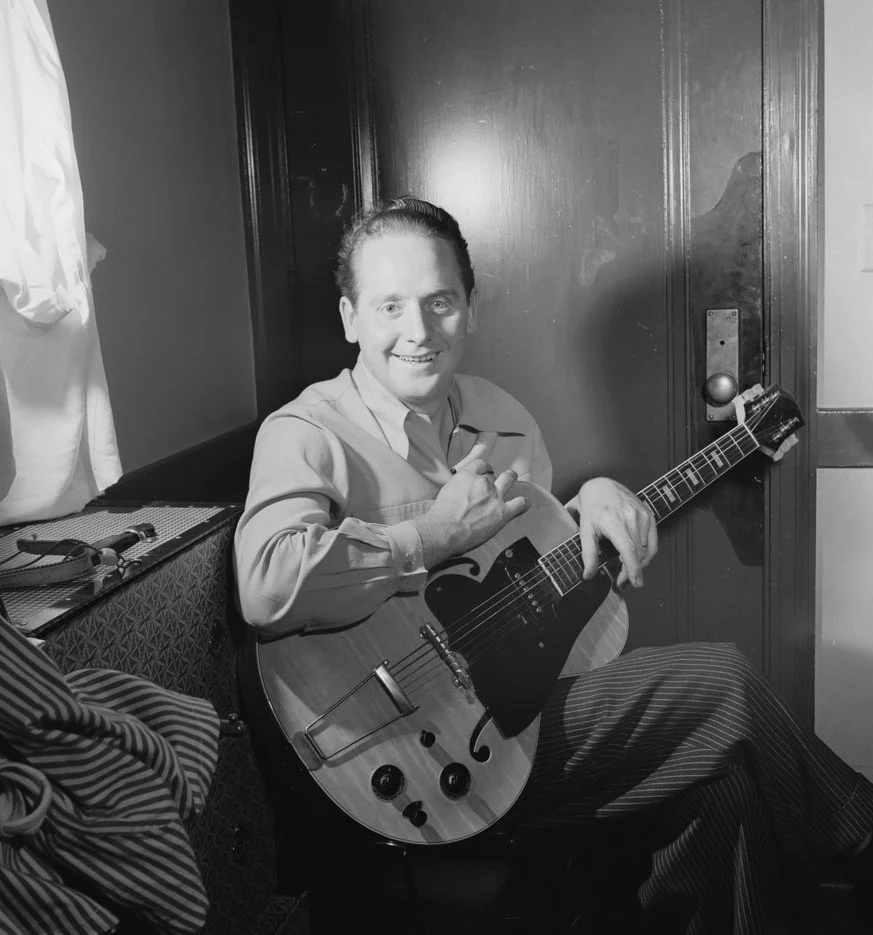
Tone Timeline
Les Paul — Tone Evolution
Les Paul was simultaneously the inventor of the solid-body electric guitar, the developer of multitrack recording, and a virtuosic guitarist — three contributions any one of which would have made him historically significant. His jazz-pop recordings with Mary Ford in the 1950s demonstrated what multitrack technology made possible.
1945–1955: The Log / Multitracks / How High the Moon
Paul built "The Log" — a solid 4×4 pine block with a neck and pickups — in 1941, demonstrating that solid wood eliminated acoustic feedback. He presented it to Gibson who rejected the idea; they reconsidered when Fender's Broadcaster showed market viability, and the Gibson Les Paul launched in 1952. His Capitol Records recordings with Mary Ford (How High the Moon, 1951; Vaya con Dios, 1953) used his own multitrack studio to record multiple guitar and vocal overdubs — sounds impossible in 1951, made possible by Paul's own engineering innovations.
Signal Chain
1956–1970s: Hiatus and Return
↑ Post-Capitol Paul was a jazz player in a rock world — his tone remained sophisticated jazz-pop while the guitar instrument he invented was taken in very different directions by others.
Paul and Ford's musical partnership ended with their divorce in 1964. His commercial peak had passed as rock and roll replaced pop. He continued performing and recording sporadically — a car accident in 1948 had required his right elbow to be set at a guitar-playing angle, affecting his life-long physicality. He began residency at Fat Tuesday's jazz club in New York in the late 1970s.
Signal Chain
1984–2009: Iridium Residency
↑ Iridium residency showed Paul as jazz elder — the technology-focused career gave way to pure musicianship; intimate settings rather than studio invention.
Les Paul's Monday-night residency at the Iridium Jazz Club in New York ran from the mid-1980s until his death in 2009. Musicians from all over the world attended — Slash, Eddie Van Halen, Steve Miller, Paul McCartney all sat in. He played until the week before he died at age 94. His playing in his final years was diminished in speed but not in warmth or intelligence.
Signal Chain