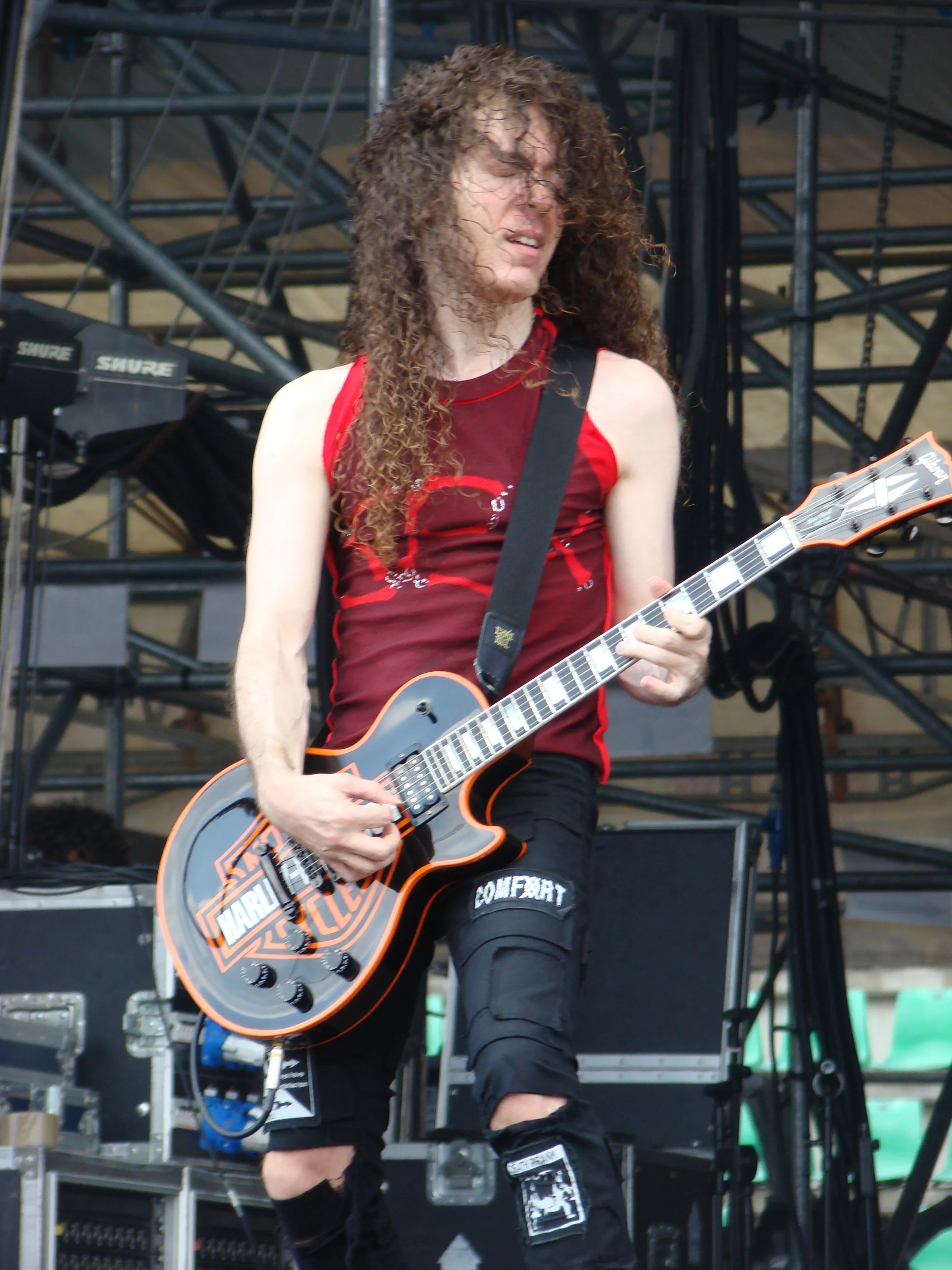
Tone Timeline
Marty Friedman — Tone Evolution
Marty Friedman built a solo vocabulary unlike any other metal guitarist — exotic Eastern scales, unconventional string-bending techniques, and a picking attack that prioritises tone over pure speed. His Megadeth partnership with Mustaine produced some of the most musically sophisticated thrash solos on record, and his Japan-based solo career developed his Eastern influences into a full compositional identity.
1987–1989: Hawaii / Dragon's Kiss
Dragon's Kiss established Friedman as a unique voice before Megadeth. The guitars were Jackson and BC Rich through a modded Marshall, with an unusual picking angle — Friedman picks from the side of the pick rather than the tip, creating a rounder attack. The exotic scale choices on Dragon's Kiss (pentatonic scales inflected with Phrygian and Lydian Dominant patterns from Middle Eastern music) were immediately distinctive.
Signal Chain
1989–1999: Megadeth — Rust in Peace / Countdown
↑ Soldano SLO-100 adopted for live touring — more consistent high-gain output than the vintage Marshall at extreme volume levels, better suited to Megadeth's precise ensemble playing.
The Megadeth partnership refined Friedman's technique for a mainstream metal context. His solos on Tornado of Souls, Holy Wars, and Symphony of Destruction used the Jackson through a Marshall-influenced preamp in the studio. Friedman's exotic scale choices fitted Mustaine's complex arrangements — the Eastern intervals weren't random, they served the song's narrative arc. His live rig used a Soldano SLO-100 for tonal consistency across touring.
Signal Chain
2003–present: Loudspeaker / Wall of Sound (Japan solo)
↑ ENGL Invader replaced Soldano — tighter low end and more modern high-gain response suited the intricate J-pop arrangements Friedman was scoring.
Friedman's Japan-based career from 2003 onward moved away from metal toward a fusion of J-pop, anime themes, and his Eastern-influenced shred style. The signature ESP Marty Friedman guitars replaced Jackson — custom designs with his preferred pickup configuration. Amplification shifted toward a ENGL Invader 150 for the modern high-gain sound. His solo records in Japan demonstrate full compositional use of maqam scales, gamelan-influenced rhythmic patterns, and Japanese modal pentatonics.
Signal Chain