Rig Builder
Budget Rig Breakdown
Signal Chain

Essentials
Complete Your Rig
The accessories every serious guitarist needs — cables, strings, and the rest.
D'Addario Chromes Flatwound Strings 11-50
Flatwound strings eliminate string noise and produce the warm, smooth tone jazz requires.
Dunlop Ultex Standard Pick 0.60mm
Thin picks produce the softer, warmer jazz attack — less attack = more warmth.
Planet Waves American Stage Guitar Cable 10ft
Solderless ends and lifetime warranty. The cable most session guitarists trust.
Boss TU-3 Chromatic Tuner Pedal
The professional standard for live tuning. True bypass, powers other pedals, ultra-accurate.
Levy's M8 Guitar Strap
Quality leather strap used by touring guitarists. Genuine comfort for 3-hour sets.
Technique
Key Tone Tips
- Use the bridge humbucker for leads with amp gain at 6–7 — Lukather lets the amp do the saturating rather than stacking heavy pedal distortion, keeping notes clear
- Add a Tube Screamer (TS9) in front of the amp with Drive at 9–10 o'clock, Level at 1–2 o'clock to tighten the low end and push sustain without adding fizz
- Set the EQ midrange-forward — push mids to 6–7 so leads cut through dense layered mixes, a hallmark of his session work
- Run a stereo delay around 350–450ms with 2–3 repeats and low feedback for the spacious 80s lead sound on tracks like 'Rosanna'
- Dial in a subtle chorus (Boss CE-2 style) with slow rate and shallow depth on clean parts — it widens the tone without sounding seasick
- Use a light compressor on clean and rhythm passages for even attack and that smooth, sustained 'studio' feel
- Roll back the guitar volume to 7–8 for crunch rhythm and back up to 10 for solos — Lukather controls dynamics from the guitar, not the pedalboard
- For pinch harmonics and vibrato, attack near the bridge pickup and use a wide, controlled finger vibrato — his phrasing is vocal, never frantic
- Keep reverb to a small plate/hall setting at 15–20% mix — enough air to sit in a mix without washing out the attack
Background
About Lukather's Sound
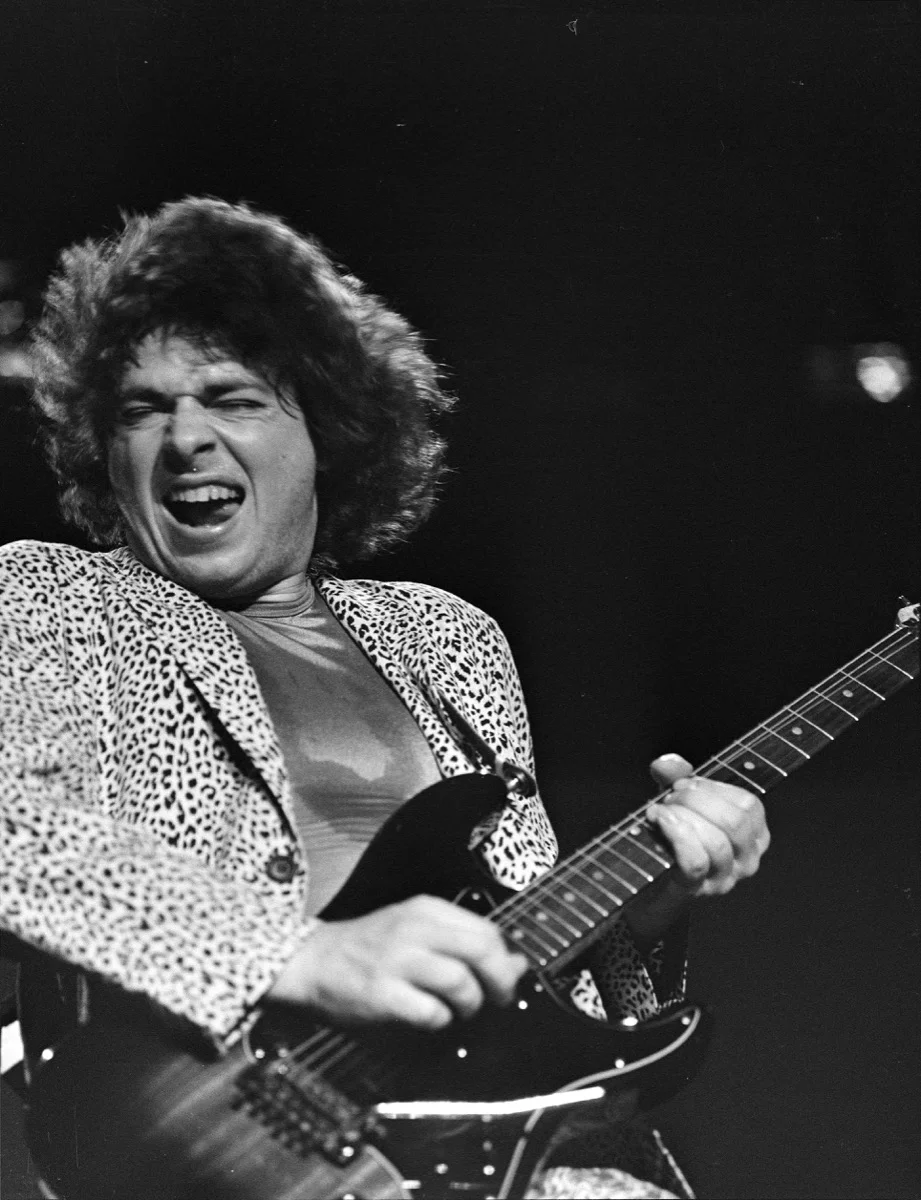
As Toto's lead guitarist and one of the most-recorded session players in history, Steve Lukather built a tone that's polished yet ferocious — equally at home on a slick pop ballad or a screaming rock solo. His sound is defined by a smooth, vocal-like sustain, articulate phrasing and a creamy distortion that never loses note clarity. Lukather's playing balances technical precision with genuine soul, making him a benchmark for studio-grade rock tone.
Tone History
Lukather's Tone Evolution
Steve Lukather is the most heard guitarist in pop history — his session credits include Michael Jackson's Thriller, Paul McCartney, Elton John, Boz Scaggs, and thousands of others. With Toto he got to solo, and his tone — a Music Man Lukather signature into a Dumble or Mesa Boogie — is one of the most polished in rock-fusion.
Full timeline: 2 eras →