Tone Timeline
T-Bone Walker — Tone Evolution
T-Bone Walker invented electric blues guitar — his sophisticated single-string technique, jazz-influenced chord voicings, and showmanship (playing guitar behind his head, doing the splits) created the template that B.B. King, Chuck Berry, and virtually every subsequent electric blues player built on.
1929–1945: Early Blues / Les Hite Band
Walker recorded with Blind Lemon Jefferson in 1929 as a teenager. His transition to electric guitar — one of the first blues musicians to make this switch, around 1935-38 — was transformative. He used a Gibson ES-250 or similar early electric archtop through a small amplifier. His playing was already jazz-influenced: chord-based single-note lines, sophisticated intervals, vibrato from the wrist rather than the finger.
Signal Chain
1945–1960: Black & White Records / T-Bone Blues
↑ Stormy Monday era was Walker at full maturity — the ES-5's three-pickup switching and warm archtop tone gave him tonal range that contemporaries couldn't access.
Call It Stormy Monday (1947) is Walker's masterpiece — one of the most covered blues songs ever written and a perfect display of his technique. He used a Gibson ES-5 Switchmaster or similar quality electric archtop. His tone was warm, his vibrato wide, and his phrases influenced by Charlie Christian (his contemporary). T-Bone Blues (1959) compiled his Atlantic sessions and brought him to a wider audience.
Signal Chain
1960–1975: Blues Festival / Good Feelin'
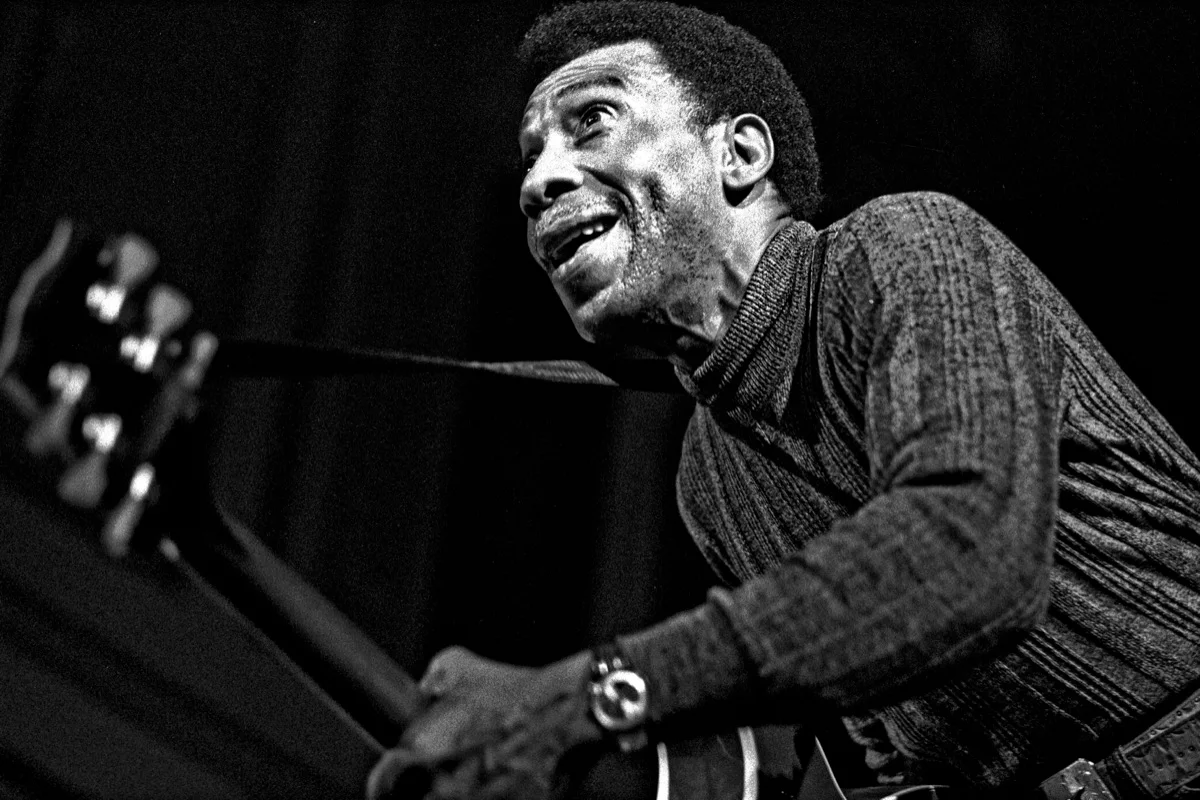
↑ Late Walker showed the originator watching his innovations be transformed by disciples — B.B. King, Chuck Berry, and others took his template in directions he hadn't imagined.
Walker continued touring and recording through the 1960s-70s, appearing at European blues festivals and playing with younger musicians who revered him. His Grammy award (1970) for Good Feelin' recognised a lifetime of innovation. He died of pneumonia in 1975 at age 64. His influence is immeasurable — without T-Bone Walker, electric blues guitar simply wouldn't exist in the form that shaped rock and roll.
Signal Chain