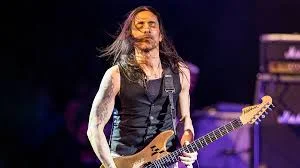
Hard RockRock1990s–present
Nuno Bettencourt — £1,000 · Pro-Level Rig
Washburn N4 (with DiMarzio pickups) into a Roland JC-120 Jazz Chorus for clean tones and a Marshall Plexi for crunch. The clean tone is pristine and bell-like; the crunch is vintage Marshall at medium gain — not modern high gain. A Boss DD-3 adds slapback delay on solos.
Signal Path
Signal Chain
Full signal path
GuitarIbanez RG421
ChorusBoss CE-5
AmpDSL20
DelayBoss DD-3T
Full Gear List
£1,000 · Pro-Level — Complete Rig

●● Mid-Range$443
●● Mid-Range$418

● Budget$126
Tone Tips
Getting the Sound Right
- Rhythm precision is more important than lead technique — "Get the Funk Out" is built on right-hand precision that most players underestimate
- The JC-120 clean tone requires no pedal overdrive — the amp's pristine clean is the foundation for the funk-influenced playing
- The N4's pickups are active-style hot DiMarzios — a standard Strat or Les Paul will not produce the same output level and character
- Funky rhythms require strict upstroke emphasis on the upbeat — the "chuck" sound comes from a clean downstroke mute followed by the upstroke chord
- "More Than Words" is played entirely with the right-hand fingers, no pick — position the thumb on the bass strings and fingers on treble
- For the hard rock tone, the Marshall runs at moderate gain — Nuno's crunch is vintage and natural, not modern high gain
- The guitar volume knob is a constant tool — roll to 6-7 for rhythm cleans, open fully for leads
- Pentatonic and chromatic passing tones combine in his solos — he does not stay purely inside the pentatonic box
Avoid These Pitfalls
Common Mistakes When Chasing This Tone
- Not exploring the Marshall Super Lead alone before adding pedals — a Les Paul or humbucker guitar into a British amp is already a near-complete overdrive system. Adding drive pedals on top is often unnecessary and muddies the amp's natural character
- Leaving the wah pedal engaged but stationary between rocking it — a cocked wah (fixed position, not moving) acts as a midrange filter that changes the core tone. Either rock it expressively or bypass it completely; a cocked wah changes the sound in ways that are often unintended
- Setting amp gain to maximum — superstrats with high-output humbuckers already drive the amp aggressively. Gain at 8-9 into a high-gain channel gives muddy intermodulation, not more power.
- Scooping the mids on a Marshall-style amp — the upper midrange emphasis is what makes British amps cut through. Mid-scoop EQ sounds good alone but disappears in a band mix.
- Using a distortion pedal to replace amp saturation — amp-driven tone has a specific feel (dynamics, touch sensitivity, natural compression) that pedal distortion cannot replicate. The source of gain matters.
- Leaving the wah in a fixed position (cocked) between uses — a cocked wah acts as a midrange filter and changes the tone. If not using the wah expressively, take it out of the chain.
- Too many repeats at high mix — more than 3 repeats makes the delay effect accumulate and overwhelm the dry guitar signal. Keep it to 2-3 repeats at a subtle mix level.
- Forgetting to dial the tone at band volume — EQ settings that work in a quiet room often need adjustment when competing with drums and bass. Mid frequencies in particular need upward adjustment.
Tone Profile
Nuno Bettencourt's Sound
Washburn N4 (with DiMarzio pickups) into a Roland JC-120 Jazz Chorus for clean tones and a Marshall Plexi for crunch. The clean tone is pristine and bell-like; the crunch is vintage Marshall at medium gain — not modern high gain. A Boss DD-3 adds slapback delay on solos.