Buckethead
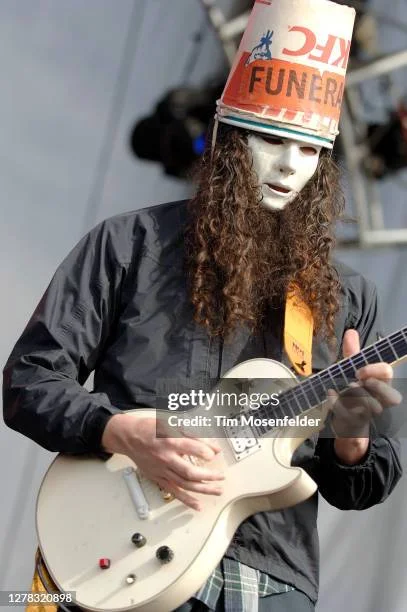
Buckethead (Brian Patrick Carroll) is the most prolific recording guitarist in history — over 300 solo albums released under the Buckethead name, with an output that covers heavy metal shred, ambient guitar, funk, blues, and avant-garde noise. He performs with a KFC bucket on his head and a white mask, maintaining a performance persona that has become inseparable from his music. He briefly joined Guns N' Roses for the Chinese Democracy sessions (2000–2004) and has collaborated with Les Claypool, Bootsy Collins, and Mike Patton. His technical guitar playing includes two-handed tapping, extreme alternate picking speed, and an ability to navigate diverse genres with equal technical command.
White Gibson Les Paul Custom (later Epiphone Les Paul Custom) through a Mesa Triple Rectifier or Marshall JCM800 — a massive, compressed high-gain wall of sound that underpins extremely fast single-note runs and two-handed tapping passages. Buckethead's clean tone is equally important: crystal-clear, glassy, and precise, used for melody and ambient sections that contrast sharply with the high-gain passages.
Signal Chain Order
Why Buckethead's Rig Works
The Mesa Triple Rectifier's scooped midrange and extended low end were chosen specifically because they avoid the British-amp midrange "honk" that a JCM800 or similar amp introduces at high gain — for Buckethead's genuinely theatrical, maximalist heavy metal material, that scoop creates a more massive, wall-of-sound low end that supports extreme two-handed tapping without a competing midrange presence fighting the fast, dense note runs for space.
Active EMG pickups are close to a necessity, not a preference, for the specific technique Buckethead relies on — two-handed tapping generates lower output and less pick-attack energy than conventional picking, and an active pickup's consistent, boosted output keeps tapped notes at usable volume and clarity even without a hard pick strike, where a passive pickup would produce noticeably quieter, less defined tapped notes by comparison.
Using the DigiTech Whammy expressively — real-time, gestural pitch shifts rather than fixed intervals — connects to the same broader principle found in Tom Morello's and Steve Vai's use of the same pedal: it functions as a live performance tool for spontaneous melodic and textural variation rather than a studio effect applied identically every time, which suits Buckethead's improvisational, performance-driven approach and the sheer scale of his catalog, where reusing identical effect settings across hundreds of releases would quickly become predictable.
Guitars
Gibson Les Paul Custom (White)
1995–2010Buckethead's signature instrument — a white Gibson Les Paul Custom with EMG active humbuckers. The Les Paul Custom's three-pickup configuration and multi-ply binding create his visual signature alongside the bucket and mask. EMG 81/85 active pickups provide the high-output, noise-free signal required for the extreme gain levels and fast passages.
Epiphone Les Paul Custom (White)
2000–presentFor touring, Buckethead uses Epiphone Les Paul Customs rather than the Gibson originals — identical visual appearance with more practical touring durability. Custom-fitted with EMG active pickups matching the Gibson configuration.
Vigier Guitars
2010–presentFrench-made through-neck guitars used in later periods — Vigier's carbon-fibre-reinforced neck provides extreme stability under temperature and humidity variation, practical for an artist who tours year-round.
Amplifiers
Mesa Boogie Triple Rectifier
1995–presentBuckethead's primary high-gain amp — the Triple Rectifier's three rectifier tubes and 150 watts of 6L6 power produce the massive, compressed wall of sound that underlies his heaviest material. The scooped midrange and extended low-end of the Rectifier series suits the theatrical heavy metal approach without the midrange honk of British EL34 amps.
Amp guide →Marshall JCM800 2203
1992–2000Used earlier in his career for a more British, midrange-present high-gain character. The JCM800 produces a tighter, more aggressive sound than the Triple Rectifier with less low-end weight — suitable for the faster, more technical passages.
Amp guide →Effects Pedals
DigiTech Whammy
1993–presentOne of Buckethead's most recognisable sound signatures — the Whammy is used for real-time pitch shifting one and two octaves up and down, creating the screaming, dive-bombing pitch effects associated with his live performance. The Whammy is used expressively rather than as a fixed-pitch effect.
Boss DD-6 Digital Delay
2000–presentA transparent delay for adding space and depth to fast runs and sustained leads — Buckethead uses delay at a subtle level to thicken individual notes and extend phrase sustain rather than as a prominent rhythmic effect.
Dunlop Cry Baby Wah
1993–presentStandard Cry Baby used for wah-infused funk and blues passages — Buckethead's style crosses metal with funk influences from Bootsy Collins and Sly Stone, and the wah pedal appears on the funk-oriented material throughout his catalogue.
Pedal guide →Key Albums & Tone
Early Buckethead establishing the white-mask-and-bucket performance character and the musical contrast between extreme metal and melodic ambient passages.
"Soothsayer" — one of his most celebrated pieces. A slow-building blues-influenced instrumental that demonstrates his melodic and emotional range beyond the speed and technical display of the metal material. The tone is the Mesa Triple Rectifier in its most vocal, least-compressed mode.
Buckethead contributes to several tracks on the Guns N'Roses album recorded between 2000–2004. His contribution demonstrates the ability to work within a commercial hard rock framework while retaining his characteristic playing vocabulary.
An acoustic-influenced ambient album that represents the opposite of his heavy metal output — gentle, melodic, and introspective. The same composer as the extreme metal material, demonstrating the full range of his musical identity.
Frequently Asked Questions
What guitar does Buckethead use?
Gibson Les Paul Custom (White) and Epiphone Les Paul Custom (White). Buckethead's signature instrument — a white Gibson Les Paul Custom with EMG active humbuckers. The Les Paul Custom's three-pickup configuration and multi-ply binding create his visual signature alongside the bucket and mask. EMG 81/85 active pickups provide the high-output, noise-free signal required for the extreme gain levels and fast passages.
What amp does Buckethead use?
Mesa Boogie Triple Rectifier and Marshall JCM800 2203. Buckethead's primary high-gain amp — the Triple Rectifier's three rectifier tubes and 150 watts of 6L6 power produce the massive, compressed wall of sound that underlies his heaviest material. The scooped midrange and extended low-end of the Rectifier series suits the theatrical heavy metal approach without the midrange honk of British EL34 amps.
What pedals does Buckethead use?
Buckethead uses DigiTech Whammy, Boss DD-6 Digital Delay, Dunlop Cry Baby Wah.
What is Buckethead's signature sound?
White Gibson Les Paul Custom (later Epiphone Les Paul Custom) through a Mesa Triple Rectifier or Marshall JCM800 — a massive, compressed high-gain wall of sound that underpins extremely fast single-note runs and two-handed tapping passages. Buckethead's clean tone is equally important: crystal-clear, glassy, and precise, used for melody and ambient sections that contrast sharply with the high-gain passages.
About This Data
Gear information for Buckethead is compiled from live performance footage, rig-rundown interviews, manufacturer and signature-model documentation, and cross-referenced guitar press coverage — not a single source. Where accounts conflict (a common issue with decades-old gear history), we favour the version corroborated by the most independent sources and note genuine ambiguity in the text rather than presenting a guess as settled fact.
This page is maintained by Alex Hall, last reviewed July 2026. Spotted something out of date or inaccurate? Let us know — corrections are usually made within a few days.