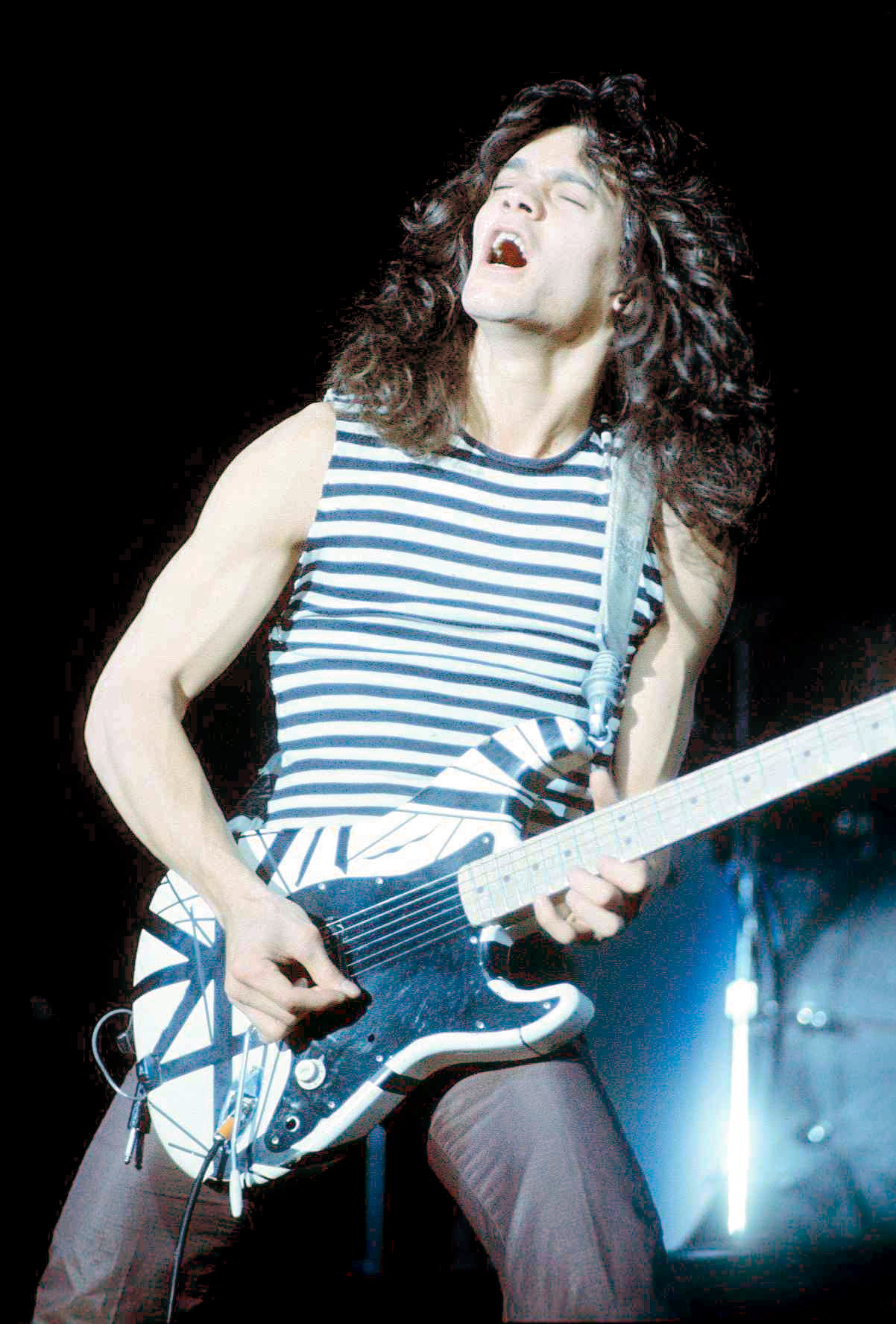
Eddie Van Halen
Eddie Van Halen single-handedly redefined rock guitar technique when 'Eruption' appeared on Van Halen's debut album in 1978. His home-built 'Frankenstein' guitar, two-handed tapping, and unprecedented legato speed created a new language that every rock guitarist since has had to reckon with. He was also a masterful rhythm player and songwriter.
Home-built 'Frankenstein' superstrat with a PAF humbucker into a drilled-out Marshall Super Lead — bright, scooped upper-mids, almost nasal quality, with insane speed and clarity. The MXR Phase 90 adds subtle movement; the Echoplex creates natural slapback.
Guitars
"Frankenstrat" (Homemade)
1974–1991Ash body with routing cavities for weight reduction. Single Humbucker (PAF). Floyd Rose tremolo. Striped finish — most replicated guitar in rock history.
Kramer 5150
1984–1990Production version during 1984 era. EVH/Kramer collaboration.
EVH Wolfgang
Current signature guitar — Floyd Rose, EVH-designed humbucker, compound radius neck.
Peavey Wolfgang
1996–2004First mass-produced signature guitar — exceptional quality and underrated.
Amplifiers
Marshall Super Lead 100W "Plexi" (Modified)
1974–1985Drilled extra holes for cooling. Variac transformer reduces voltage to ~89V — key to his unique tone. Cascaded input jacks for extra gain.
Peavey 5150
1992–2004His designed amp — two channels, massive high-gain. Defined 1990s metal tone.
EVH 5150 III 100W
2007–presentThree-channel evolution — Green (clean), Blue (crunch), Red (high-gain).
Effects Pedals
MXR Phase 90
Subtle phaser always on for a slight movement in the tone. "Eruption" uses it prominently.
Maestro Echoplex EP-3
1974–1985Used for subtle slapback delay, and to boost the signal into the Marshall input.
MXR Flanger
1980–1985Used on "Unchained" and 1984-era material.
Electro-Harmonix Big Muff Pi
1974–1978Early fuzz used before relying solely on the modified Marshall.
Boss OC-2 Octave
1982–1988Octave pedal for synth-bass effects.
Key Albums & Tone
"Eruption" — Frankenstrat into modified Plexi — the most influential 102 seconds in rock guitar history.
"Dance the Night Away" shows his equally innovative rhythm playing.
"Panama", "Hot for Teacher", "Jump" — peak Peavey-era production value.
Peavey 5150 era begins — heavier, tighter, more aggressive.
Frequently Asked Questions
What guitar does Eddie Van Halen use?
"Frankenstrat" (Homemade) and Kramer 5150. Ash body with routing cavities for weight reduction. Single Humbucker (PAF). Floyd Rose tremolo. Striped finish — most replicated guitar in rock history.
What amp does Eddie Van Halen use?
Marshall Super Lead 100W "Plexi" (Modified) and Peavey 5150. Drilled extra holes for cooling. Variac transformer reduces voltage to ~89V — key to his unique tone. Cascaded input jacks for extra gain.
What pedals does Eddie Van Halen use?
Eddie Van Halen uses MXR Phase 90, Maestro Echoplex EP-3, MXR Flanger and more.
What is EVH's signature sound?
Home-built 'Frankenstein' superstrat with a PAF humbucker into a drilled-out Marshall Super Lead — bright, scooped upper-mids, almost nasal quality, with insane speed and clarity. The MXR Phase 90 adds subtle movement; the Echoplex creates natural slapback.