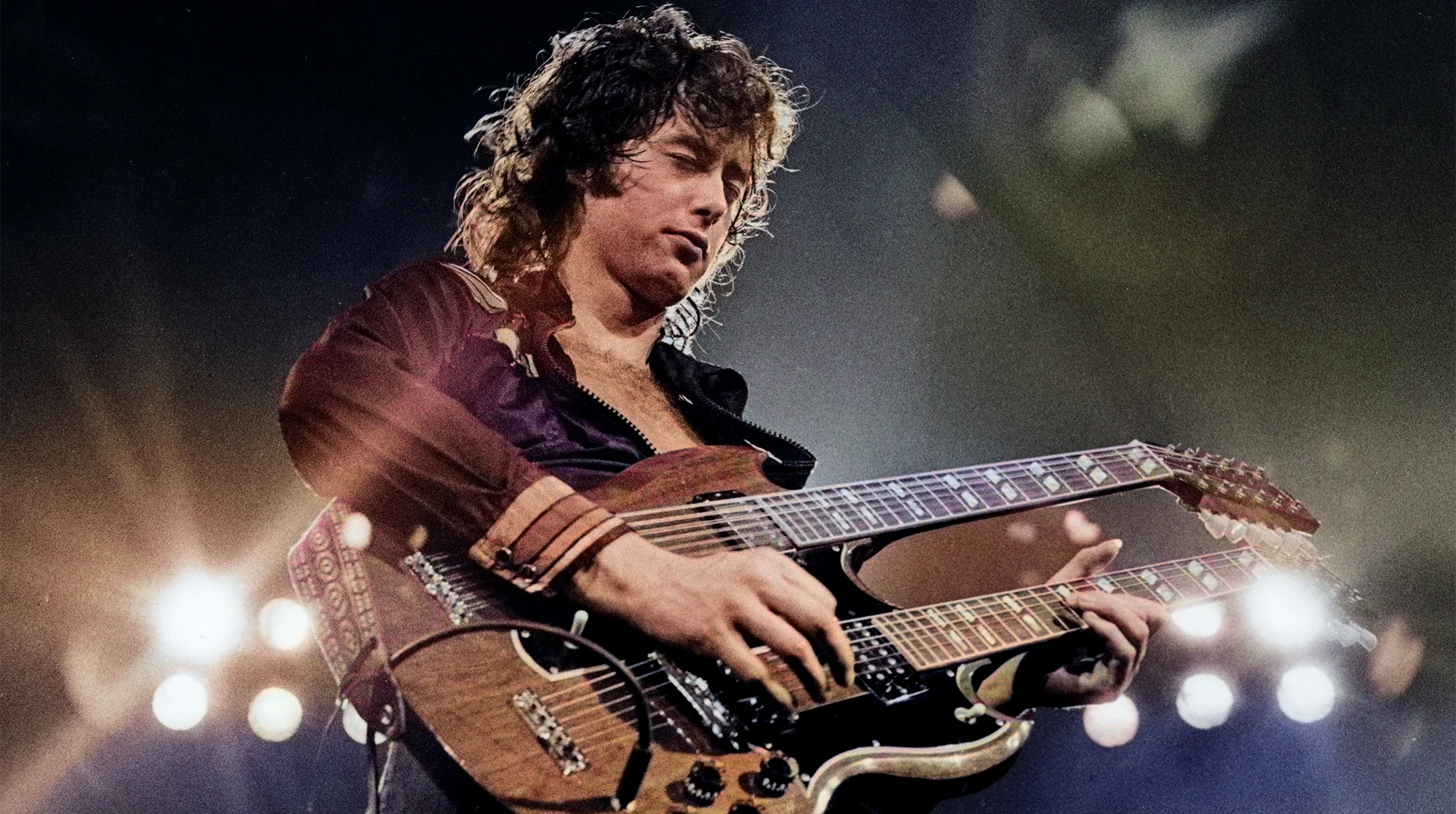
Jimmy Page
Jimmy Page built Led Zeppelin from the ruins of The Yardbirds and created the template for hard rock guitar. His studio production work — recording live rooms with distant microphones, backwards tape effects, violin bows on guitar — was as revolutionary as his playing. His use of acoustic guitar, alternate tunings and Eastern influences gave him a breadth no contemporary matched.
Vintage Les Paul Standard into a Marshall Super Lead — massive, mid-forward rock tone with singing sustain. On acoustic: open tunings and DADGAD for 'Kashmir' and 'Bron-Y-Aur Stomp'. Legendary for crunching up a Vox AC30 on early Zeppelin and Supro amps on the debut album.
Why Jimmy Page's Rig Works
Page's choice of amp per recording is a masterclass in matching an amp's power stage to the room and the mic technique, not just picking a favorite. The small Supro Coronado used on the first Led Zeppelin album has a much lower headroom ceiling than a 100W Marshall — cranked in a stairwell and mic'd at a distance, it breaks up at a manageable volume that a Marshall stack simply can't reach without becoming unworkable in a small space. That's specifically why the debut album's tone is rawer and more compressed-sounding than the Marshall-driven tracks on Led Zeppelin II.
The Maestro Echoplex EP-3 does double duty that's easy to miss: it's a tape delay, but the tape-driven preamp stage ahead of the echo circuit adds its own subtle saturation and compression even when the wet/dry mix is set low or the repeats are barely audible. Page used it as much for that preamp coloration and as a boost into the front of the amp as for the delay effect itself — which is part of why some of his tones sound subtly "pushed" even on passages with no audible echo.
Running the Les Paul's bridge pickup with the tone knob rolled back to around 7, rather than wide open, takes some of the harshest top-end off a pickup position that's naturally bright and aggressive — letting the humbucker's output still drive the Marshall hard while keeping the overall tone from becoming shrill at the high gain levels his cranked-Marshall setup produces.
Guitars
Gibson Les Paul Standard "Number One"
1969–present1959 Gibson Les Paul Standard — the primary studio guitar from 1969 onwards.
Full specs & buy →Gibson Les Paul Custom "Black Beauty"
1966–19693-pickup 1960 Les Paul Custom — "Whole Lotta Love" era recording guitar.
Full specs & buy →Fender Telecaster (Dragon)
1966–1972Paisley and Dragon-painted Telecasters used in Yardbirds and early Zeppelin.
Gibson EDS-1275 Double-Neck
1972–1975Used for "Stairway to Heaven" live — 6-string and 12-string.
Martin D-28
1969–presentAcoustic for "Bron-Y-Aur Stomp" and "Going to California".
Amplifiers
Marshall Super Lead 100W "Plexi"
1968–1980Primary touring amp. Stacked pairs. Played at full volume — the distortion came from the output stage, not the preamp.
Supro Coronado
1968"Whole Lotta Love" tone — small Supro combo cranked. The first Zeppelin album was recorded with this amp.
Orange OR120
1972–1975Used during the Physical Graffiti-era live recordings alongside Marshalls.
Effects Pedals
Roger Mayer Tone Bender MkII
1966–1969Primary fuzz during Yardbirds and early Zeppelin.
Maestro Echoplex EP-3
1968–1975Tape echo for "Whole Lotta Love" theremin section, "Heartbreaker" solos.
Key Albums & Tone
Supro amp captured in a stairwell — raw, live blues tone.
Marshalls cranked — "Whole Lotta Love" and "Heartbreaker" are the essential tracks.
"Black Dog", "Rock and Roll" and "Stairway to Heaven" show the full range of his playing and tone.
"Kashmir" — DADGAD tuning and Eastern-influenced tone. Timeless.
Frequently Asked Questions
What guitar does Jimmy Page use?
Gibson Les Paul Standard "Number One" and Gibson Les Paul Custom "Black Beauty". 1959 Gibson Les Paul Standard — the primary studio guitar from 1969 onwards.
What amp does Jimmy Page use?
Marshall Super Lead 100W "Plexi" and Supro Coronado. Primary touring amp. Stacked pairs. Played at full volume — the distortion came from the output stage, not the preamp.
What pedals does Jimmy Page use?
Jimmy Page uses Dunlop Cry Baby Wah, Roger Mayer Tone Bender MkII, Maestro Echoplex EP-3 and more.
What is Jimmy Page's signature sound?
Vintage Les Paul Standard into a Marshall Super Lead — massive, mid-forward rock tone with singing sustain. On acoustic: open tunings and DADGAD for 'Kashmir' and 'Bron-Y-Aur Stomp'. Legendary for crunching up a Vox AC30 on early Zeppelin and Supro amps on the debut album.
About This Data
Gear information for Jimmy Page is compiled from live performance footage, rig-rundown interviews, manufacturer and signature-model documentation, and cross-referenced guitar press coverage — not a single source. Where accounts conflict (a common issue with decades-old gear history), we favour the version corroborated by the most independent sources and note genuine ambiguity in the text rather than presenting a guess as settled fact.
This page is maintained by Alex Hall, last reviewed July 2026. Spotted something out of date or inaccurate? Let us know — corrections are usually made within a few days.