Rig Builder
Budget Rig Breakdown
Signal Chain

Essentials
Complete Your Rig
The accessories every serious guitarist needs — cables, strings, and the rest.
Ernie Ball Power Slinky Strings (11-48)
Heavier gauge for drop tunings and tighter pick attack — standard for modern metal.
ISP Decimator II Noise Gate
Essential for high-gain amps and extended-range guitars. No noise gate — no clean metal tone.
Planet Waves American Stage Guitar Cable 10ft
Solderless ends and lifetime warranty. The cable most session guitarists trust.
Boss TU-3 Chromatic Tuner Pedal
The professional standard for live tuning. True bypass, powers other pedals, ultra-accurate.
Levy's M8 Guitar Strap
Quality leather strap used by touring guitarists. Genuine comfort for 3-hour sets.
Technique
Key Tone Tips
- Use the Les Paul bridge pickup for crunch; neck pickup for singing, sustained leads
- Control clean-to-dirty with the guitar volume knob, not the amp
- Marshall gain comes from cranked amp volume — the Les Paul humbucker provides the saturation
- Tune down a half step (Eb) for that slightly loose, saggy string feel
- Palm muting with varied pressure creates Page's rhythmic texture
- Slapback delay (80–120ms) adds the live, roomy depth of his studio recordings
- Use a bow on strings for textural sounds — hold it at a 90° angle near the nut
- Open DADGAD tuning for Kashmir-style riffs on acoustic or clean electric
- Wah pedal parked at mid-position adds a vocal mid-boost to lead tones
- Roll the guitar's tone control back to around 6 for heavy rhythm parts — the Les Paul's full-open tone can be too bright through a cranked Marshall; the tone knob tames the harshness and adds thickness to the rhythm crunch
- Study "Stairway to Heaven" not for the solo but for the layered guitar orchestration — Page recorded multiple acoustic and electric parts playing different roles, which is why the recording sounds so full; no single guitar part is meant to stand alone
- Use a lighter pick (0.6–0.73mm) for fingerpicking-style passages and switch to a heavier pick (1mm+) for heavy riffing — Page switched picks within songs depending on the playing style, which explains the wide tonal range across a single track
Background
About Jimmy Page's Sound
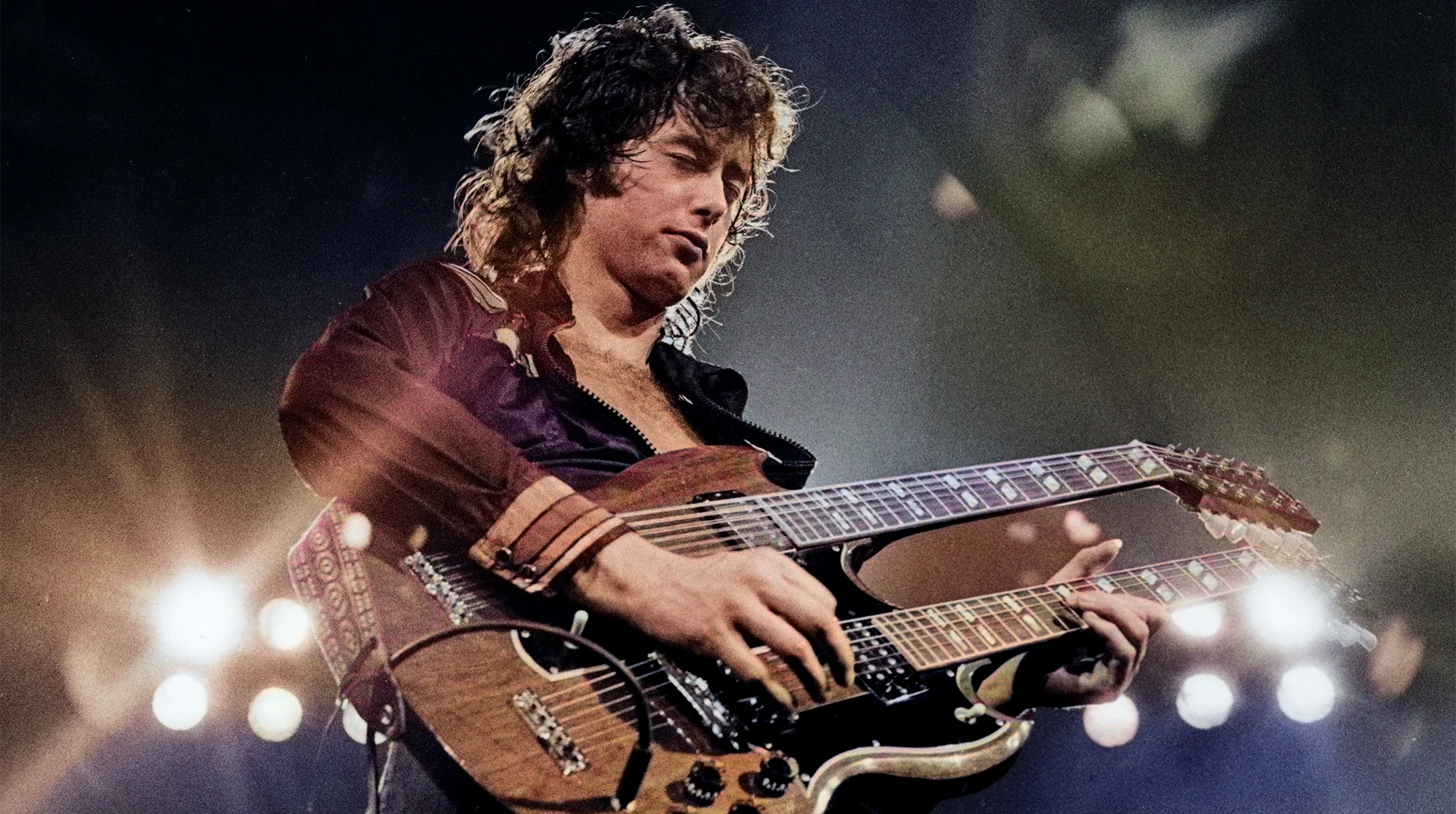
Jimmy Page harnessed the full dynamic range of a Gibson Les Paul through a Marshall stack — from gentle, acoustic-influenced picking to howling feedback and studio-layered orchestration. His tone captured both raw power and deliberate delicacy.
Tone History
Jimmy Page's Tone Evolution
Page assembled one of the most studied rigs in rock history — Les Paul through a Marshall, with studio layering techniques that made Zeppelin recordings impossible to fully decode. His tone shifted from the Telecaster rawness of the first album to the full Les Paul/Marshall/wah complexity of Houses of the Holy.
Full timeline: 3 eras →Song Breakdowns
Jimmy Page Song Rigs
Whole Lotta Love
Led Zeppelin II · 1969
Thick, powerful Les Paul tone through a Supro amp — less Marshall-saturated…
Stairway to Heaven
Led Zeppelin IV · 1971
Three distinct tones in one song: clean acoustic intro, clean electric midd…
Kashmir
Physical Graffiti · 1975
Hypnotic, droning riff in DADGAD tuning — a completely different sonic char…