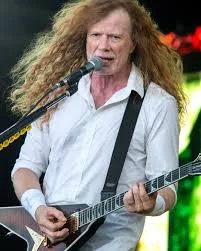
Dave Mustaine
Dave Mustaine founded Megadeth in 1983 after his dismissal from Metallica and proceeded to build one of the most technically demanding and melodically sophisticated bodies of work in thrash metal. Where Metallica favoured heavy rhythm density, Megadeth under Mustaine favoured complex, rapidly modulating riff structures that incorporate classical composition techniques — his riffs often modulate through multiple keys within a single passage. Albums from 'Peace Sells' (1986) through 'Rust in Peace' (1990) are considered the peak of his compositional craft; 'Rust in Peace' in particular features a level of composed complexity that rivals anything in the genre.
Jackson guitars with high-output humbuckers through Mesa/Boogie amplifiers — the primary Megadeth tone for most of their peak period. His rhythm tone is extremely tight, with compressed attack and controlled bass to avoid low-end muddiness at speed. His lead tone is slightly warmer and more singing than the rhythm channel, using the amp's lead channel or a dedicated lead-boost pedal. The signature characteristic is clarity at speed — at 220+ BPM the individual notes of a riff must remain distinct.
Signal Chain Order
Why Dave Mustaine's Rig Works
Mustaine's compositions frequently modulate rapidly through multiple keys within a single riff, which places an unusual demand on tone that most thrash rigs aren't optimized for: every note needs to stay individually clear even as the harmonic context shifts quickly underneath it. The Dual Rectifier's tight, scooped, high-gain character is chosen specifically because it preserves that note-to-note clarity at speed, where a looser or more compressed amp voicing would blur the rapid key changes into an indistinct wash.
The selectable tube-versus-diode rectifier option on the Dual Rectifier is a genuinely meaningful choice, not a cosmetic one — a tube rectifier introduces a small amount of natural power sag under heavy playing, while a diode rectifier responds instantly with no sag at all. Mustaine's precise, technically demanding riff structures generally favor the diode setting's maximum tightness, since even small amounts of sag can blur the rhythmic precision his complex compositions depend on.
The Rocktron Hush noise gate is described as essential rather than optional for good reason: at the gain levels required for this tone, and specifically given how frequently Megadeth's arrangements move between dense riffing and near-silence for compositional effect, uncontrolled hiss during quiet sections would undermine the same precision and clarity the rest of the rig is built to deliver.
Guitars
Jackson King V / Flying V
1986–presentMustaine's signature instrument — Jackson V-shape guitars with his own signature pickups (DiMarzio D-Activator or Seymour Duncan signatures). The V body shape is partly practical (better strap balance for his playing position) and partly aesthetic (visual identity with the thrash metal genre). Later models are the Dean VMNT (Dave Mustaine Naturalistic Terror) signature.
Dean V (VMNT)
2004–presentThe Dean signature replaces Jackson guitars after his endorsement change. Similar V body shape with comparable high-output pickup configuration; the tone is slightly warmer than the Jackson models.
Amplifiers
Mesa/Boogie Dual Rectifier
1992–2010The primary Megadeth amp from "Countdown to Extinction" onward — the Dual Rectifier's high-gain, scooped character suits the precision riffing of Mustaine's writing style. The rectifier section (tube or diode selectable) affects the attack characteristic: tube rectifier for a slightly softer attack, diode for maximum tightness.
Amp guide →Marshall JCM900 / JCM800
1986–1992"Peace Sells" and "So Far, So Good... So What" era — Marshalls before the Mesa/Boogie era. The JCM800 and JCM900 produce a different character than the Mesa/Boogie — more midrange presence, slightly less low-end tightness. The "Peace Sells" guitar tone reflects this Marshall period.
Effects Pedals
Rocktron Hush Noise Gate
1988–presentEssential to the high-gain Megadeth sound — the Hush system gates the signal between riffs to eliminate amp hiss and bleeding notes. At extreme gain levels, a noise gate is not optional for professional studio or stage use.
Boss DS-1 Distortion
1986–1991Used during early Megadeth — the DS-1 in front of the amp adds a harder, more compressed attack characteristic to the Marshall or early Mesa rigs.
Pedal guide →Key Albums & Tone
"Peace Sells" and "Devil's Island" — Marshall JCM800-era tone, faster and more aggressive than "Killing is My Business". The guitar tone is raw, with prominent mids and less low-end compression than the later Mesa/Boogie period.
"Hangar 18" and "Holy Wars...The Punishment Due" — the compositional peak. The guitar tone is tighter and more precisely defined than the Marshall era; Mesa/Boogie entry beginning.
Most commercially successful Megadeth album — Mesa/Boogie Dual Rectifier fully established. The production is more polished, the guitar tone more refined and separated in the mix.
Return after hiatus — Dean guitar introduction. The tone is darker and heavier than the Countdown period.
Frequently Asked Questions
What guitar does Dave Mustaine use?
Jackson King V / Flying V and Dean V (VMNT). Mustaine's signature instrument — Jackson V-shape guitars with his own signature pickups (DiMarzio D-Activator or Seymour Duncan signatures). The V body shape is partly practical (better strap balance for his playing position) and partly aesthetic (visual identity with the thrash metal genre). Later models are the Dean VMNT (Dave Mustaine Naturalistic Terror) signature.
What amp does Dave Mustaine use?
Mesa/Boogie Dual Rectifier and Marshall JCM900 / JCM800. The primary Megadeth amp from "Countdown to Extinction" onward — the Dual Rectifier's high-gain, scooped character suits the precision riffing of Mustaine's writing style. The rectifier section (tube or diode selectable) affects the attack characteristic: tube rectifier for a slightly softer attack, diode for maximum tightness.
What pedals does Dave Mustaine use?
Dave Mustaine uses Rocktron Hush Noise Gate, Boss DS-1 Distortion.
What is Dave Mustaine's signature sound?
Jackson guitars with high-output humbuckers through Mesa/Boogie amplifiers — the primary Megadeth tone for most of their peak period. His rhythm tone is extremely tight, with compressed attack and controlled bass to avoid low-end muddiness at speed. His lead tone is slightly warmer and more singing than the rhythm channel, using the amp's lead channel or a dedicated lead-boost pedal. The signature characteristic is clarity at speed — at 220+ BPM the individual notes of a riff must remain distinct.
About This Data
Gear information for Dave Mustaine is compiled from live performance footage, rig-rundown interviews, manufacturer and signature-model documentation, and cross-referenced guitar press coverage — not a single source. Where accounts conflict (a common issue with decades-old gear history), we favour the version corroborated by the most independent sources and note genuine ambiguity in the text rather than presenting a guess as settled fact.
This page is maintained by Alex Hall, last reviewed July 2026. Spotted something out of date or inaccurate? Let us know — corrections are usually made within a few days.