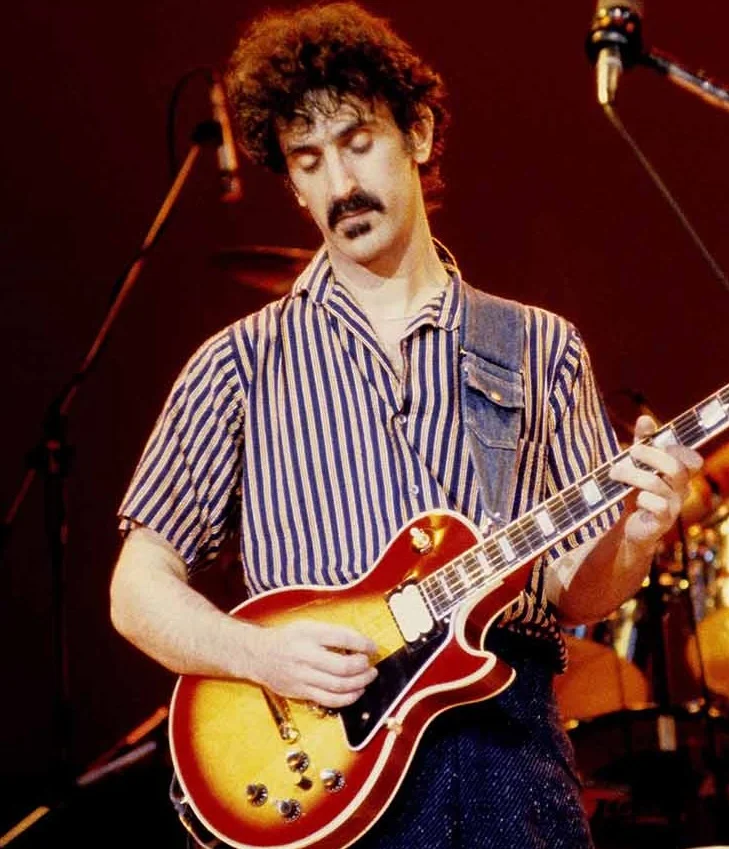
Frank Zappa
Frank Zappa was one of the most technically demanding and compositionally original guitarist-composers in American music history. He led the Mothers of Invention from 1966 and released over 60 albums across rock, jazz fusion, orchestral composition, and electronic music. His guitar solos were improvised but transcribed note-for-note — he considered them compositions rather than demonstrations of technique, and his command of chromatic language, unusual rhythmic phrasing, and emotional dynamics set him apart from the blues-based vocabulary dominant in rock guitar. He was an early adopter of the Synclavier for orchestral work and used MIDI guitar for live performance from the mid-1980s.
Unconventional lead guitar that refuses genre classification — chromatic runs through blues patterns, unexpected rhythmic displacement, and tonal extremes from clean jazz to scorching overdrive within a single solo. The '54 Strat ('Jimi') produces a characteristically bright, cutting tone through the Marshall, and Zappa exploits every frequency range. Solos are longer than typical rock convention and follow melodic logic more than genre pattern.
Signal Chain Order
Why Frank Zappa's Rig Works
Running the Marshall at moderate rather than maximum gain, deliberately preserving note articulation, directly serves Zappa's compositional priorities — his solos are built from rapid, chromatic runs that move through unconventional intervals and rhythmic displacement, and heavy saturation would blur the precise pitch relationships that make those chromatic passages legible as composed ideas rather than just noise. Keeping the gain controlled is what lets a listener actually follow the harmonic logic of what would otherwise sound like abstract fast playing.
Using the wah as a mid-solo tonal filter rather than a conventional rhythmic or vowel-shaping expression tool is a genuinely unusual application — Zappa treats it as a sound-design device, dropping it into unexpected points within a solo to reshape the tone's frequency content on the fly, which fits his broader treatment of guitar solos as composed pieces with internal structure rather than simply extended blues-based expression.
The bright, detailed 1954 Stratocaster's single-coil pickups are essential to keeping his dense chromatic vocabulary intelligible at the volumes his solos were performed at — a darker, more compressed humbucker-loaded guitar would smear the fine pitch detail between closely-spaced chromatic notes together, while the Strat's clarity keeps each note in a rapid run distinct even during his most harmonically adventurous passages.
Guitars
1954 Fender Stratocaster ("Jimi")
1970–1988Zappa's primary lead guitar — a 1954 Stratocaster he nicknamed 'Jimi'. The original single-coil pickups produce the bright, detailed tone characteristic of his lead work. He used it throughout the Apostrophe, Over-Nite Sensation, and Roxy eras.
Gibson SG
1966–1970Primary guitar through the Mothers of Invention early period — the SG with P-90 or humbuckers provides a warmer, darker base for the early psychedelic and experimental material.
Valley Arts Custom
1988–1993Custom shop Valley Arts guitar used through the later touring years and MIDI guitar integration — fitted with Roland GK pickup for MIDI output to the Synclavier system.
Gibson ES-5 Switchmaster
1969–1972Used on several early recordings — the three-pickup ES-5 provides tonal variety through its three independent volume controls.
Amplifiers
Marshall Super Lead 100W
1970–1988The Marshall Super Lead is Zappa's consistent amplifier choice for his lead guitar work — the bright, cutting gain character of the Plexi at high volume suits the single-coil Strat attack. He uses the amp at moderate gain rather than full saturation, preserving note articulation for complex chromatic runs.
Music Man HD-130
1975–1982Music Man combo used for some studio and live work — the HD-130's cleaner, American character provides a different tonal reference point from the Marshall for specific applications.
Effects Pedals
Dunlop Cry Baby
1970–1988One of Zappa's most deployed pedals — he uses wah as a filter for mid-solo tonal shaping rather than the rhythmic patterns of funk playing. The wah appears in unexpected positions within solos, functioning as a tone modifier rather than a conventional expression effect.
Univox Uni-Vibe
1970–1975Uni-Vibe for the swirling, photocell-based modulation on sustained notes — less prominent than in Hendrix's use but present on several Apostrophe-era lead passages.
Maestro Fuzz-Tone
1966–1972Fuzz-Tone on early Mothers material for the vintage fuzz saturation — the Maestro circuit produces a gated, sputtering quality different from more recent fuzz designs.
Mu-Tron III
1974–1980Envelope filter for specific funk-influenced passages — Zappa is not a funk guitarist but the Mu-Tron appears on several mid-1970s recordings for its auto-wah texture.
Key Albums & Tone
"Don't Eat the Yellow Snow", "Cosmik Debris", "Apostrophe" — his best-selling album. The 1954 Strat through the Marshall produces a bright, singing lead tone. "Cosmik Debris" is a complete demonstration of Zappa's guitar vocabulary: chromatic runs, wah-filtered passages, rhythmic displacement.
Live double album capturing the mid-1970s band at its tightest. The 'Strat/Marshall combination at full touring volume — 'Penguin in Bondage' and 'Montana' feature extended solos demonstrating his chromatic approach at full intensity.
"Watermelon in Easter Hay" — arguably the most beautiful guitar solo Zappa ever recorded. Lyrical, unhurried, and emotionally direct in a way that few of his compositions attempt. The tone is warm and sustaining — the Marshall at moderate gain.
Compilation of live guitar solos with edited rhythm section — the closest thing to a Zappa guitar overview. The Strat/Marshall combination is consistent throughout; the variation comes entirely from his improvisational vocabulary.
Frequently Asked Questions
What guitar does Frank Zappa use?
1954 Fender Stratocaster ("Jimi") and Gibson SG. Zappa's primary lead guitar — a 1954 Stratocaster he nicknamed 'Jimi'. The original single-coil pickups produce the bright, detailed tone characteristic of his lead work. He used it throughout the Apostrophe, Over-Nite Sensation, and Roxy eras.
What amp does Frank Zappa use?
Marshall Super Lead 100W and Music Man HD-130. The Marshall Super Lead is Zappa's consistent amplifier choice for his lead guitar work — the bright, cutting gain character of the Plexi at high volume suits the single-coil Strat attack. He uses the amp at moderate gain rather than full saturation, preserving note articulation for complex chromatic runs.
What pedals does Frank Zappa use?
Frank Zappa uses Dunlop Cry Baby, Univox Uni-Vibe, Maestro Fuzz-Tone and more.
What is Frank Zappa's signature sound?
Unconventional lead guitar that refuses genre classification — chromatic runs through blues patterns, unexpected rhythmic displacement, and tonal extremes from clean jazz to scorching overdrive within a single solo. The '54 Strat ('Jimi') produces a characteristically bright, cutting tone through the Marshall, and Zappa exploits every frequency range. Solos are longer than typical rock convention and follow melodic logic more than genre pattern.
About This Data
Gear information for Frank Zappa is compiled from live performance footage, rig-rundown interviews, manufacturer and signature-model documentation, and cross-referenced guitar press coverage — not a single source. Where accounts conflict (a common issue with decades-old gear history), we favour the version corroborated by the most independent sources and note genuine ambiguity in the text rather than presenting a guess as settled fact.
This page is maintained by Alex Hall, last reviewed July 2026. Spotted something out of date or inaccurate? Let us know — corrections are usually made within a few days.