Tone Timeline
Albert King — Tone Evolution
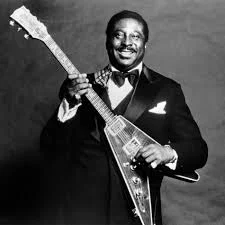
Albert King played left-handed but strung his Flying V like a right-handed guitar — the resulting string tension, angle, and technique produced bends unlike any other blues guitarist. Born Under a Bad Sign (1967) is the definitive document of his sound.
1953–1966: King / Bobbin Records
Early Albert King recordings are rare and show a competent but not yet distinctive blues player. He played a variety of guitars — at various times a Telecaster, a Les Paul, and eventually the Flying V that became his signature. Tone was standard blues: slightly overdriven, warm.
Signal Chain
1966–1975: Stax Records / Born Under a Bad Sign
↑ The Lab Series solid-state amp was counter-intuitive for blues but gave King exactly what he needed — clean headroom that let his technique, not distortion, create the emotion.
Stax was the making of Albert King. Born Under a Bad Sign (1967) — produced by Booker T & the MGs — captured his tone perfectly: Flying V reversed (left-handed player with strings not restrung) through a solid-state Lab Series L5 amp. The lab amp's clean headroom let King's aggressive bends dominate rather than distorting. String bends going in the opposite direction to most players (due to the reversed stringing) created unique intervals. Jimi Hendrix, Eric Clapton, and Stevie Ray Vaughan all studied this album obsessively.
Signal Chain
1976–1992: Utopia / I'm In a Phone Booth Baby
↑ No significant tonal evolution in later years — King had found his sound in the Stax era and maintained it with confidence.
Late King maintained the Flying V and Lab Series combination with minor variations. His live performances became the best argument for his legacy — slower, more deliberate, every note saturated with feeling. He died in 1992 but the Stax recordings remain his peak.
Signal Chain