Rig Builder
Budget Rig Breakdown
Signal Chain
AmpBlues Jr

Technique
Key Tone Tips
- Learn the clave rhythm — the "Bo Diddley beat" is a 3-2 clave: three strokes (1, the "and" of 2, and 4) followed by two strokes (the "and" of 3 and the "and" of 4)
- The tremolo effect is always on — the pulsing amplitude modulation of the amp vibrato is part of the rhythmic character. Set it to match the tempo of the song
- Bright pickup position — the rectangular guitar's bright, snappy single-coil character is fundamental. Neck pickup is too dark for this style
- The beat is the melody — Bo Diddley songs are built around the rhythm pattern, not around melodic interest. Every note choice serves the rhythmic purpose first
- Short, staccato chord stabs — not sustained chords. Each stroke is sharp and muted immediately afterward, creating the percussive dance-floor quality
- The maracas player locks to the same rhythm — in live performances, the second musician providing the maraca rhythm reinforces the clave pattern
- Study "Bo Diddley," "Who Do You Love" and "Mona" — these three songs contain the full vocabulary of the style
- Call-and-response playing between rhythm stabs and single-note fills — after each series of rhythm stabs, short single-note fills answer
- This is fundamentally African-American folk music transformed by electricity — understanding the cultural and rhythmic lineage deepens the interpretation
Background
About Bo Diddley's Sound
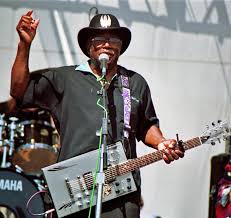
Bo Diddley invented the syncopated rhythm pattern that bears his name — the "Bo Diddley beat" (the clave rhythm from Afro-Cuban music) became the rhythmic DNA of rock and roll, inspiring Buddy Holly, the Rolling Stones and The Clash.