Rock and RollBlues-Rock1950s–2000s
Bo Diddley — £500 · Sweet Spot Rig
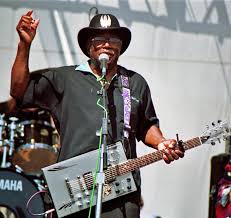
Custom rectangular guitar (Bo Diddley shape) or Gretsch alternative into a Fender amp with vibrato/tremolo engaged. The tone is bright and trebly with the tremolo effect creating the characteristic pulsing, dancing quality. The rhythm is everything — the note content is secondary to the relentless syncopated pattern.
Signal Path
Signal Chain
Full signal path
AmpBlues Jr
Full Gear List
£500 · Sweet Spot — Complete Rig
Tone Tips
Getting the Sound Right
- Learn the clave rhythm — the "Bo Diddley beat" is a 3-2 clave: three strokes (1, the "and" of 2, and 4) followed by two strokes (the "and" of 3 and the "and" of 4)
- The tremolo effect is always on — the pulsing amplitude modulation of the amp vibrato is part of the rhythmic character. Set it to match the tempo of the song
- Bright pickup position — the rectangular guitar's bright, snappy single-coil character is fundamental. Neck pickup is too dark for this style
- The beat is the melody — Bo Diddley songs are built around the rhythm pattern, not around melodic interest. Every note choice serves the rhythmic purpose first
- Short, staccato chord stabs — not sustained chords. Each stroke is sharp and muted immediately afterward, creating the percussive dance-floor quality
- The maracas player locks to the same rhythm — in live performances, the second musician providing the maraca rhythm reinforces the clave pattern
- Study "Bo Diddley," "Who Do You Love" and "Mona" — these three songs contain the full vocabulary of the style
- Call-and-response playing between rhythm stabs and single-note fills — after each series of rhythm stabs, short single-note fills answer
Avoid These Pitfalls
Common Mistakes When Chasing This Tone
- Using high-gain distortion — hollowbody guitars are designed for clean and light-drive use. High gain causes uncontrollable acoustic resonance that the pickup amplifies as noise.
- Playing a vintage-voiced amp at low volume — the warmth and bloom of these amps comes from the power tubes working. At low volume the tone is flat and uninspiring compared to the amp's potential.
- Playing at bedroom volume expecting amp-driven tone — the power-tube saturation that defines this gain structure only occurs when the amp is working at substantial output. This is not replicable at low volumes.
- Choosing a pick that is too heavy — thin to medium picks give edge noise and articulation that heavier picks smooth away. That edge is part of the sound.
- Setting amp gain at 5 or higher — blues tone lives at the edge of breakup (gain 3-4), not in full saturation. High gain compresses away all the dynamic feel.
Tone Profile
Bo Diddley's Sound
Custom rectangular guitar (Bo Diddley shape) or Gretsch alternative into a Fender amp with vibrato/tremolo engaged. The tone is bright and trebly with the tremolo effect creating the characteristic pulsing, dancing quality. The rhythm is everything — the note content is secondary to the relentless syncopated pattern.