Song Rig
Mona (I Need You Baby)
Bo Diddley · Bo Diddley · 1957
Tone Overview
What Makes This Sound Unique
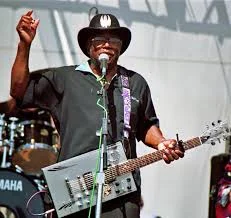
The Bo Diddley beat in its most explicit form — the rectangular Gretsch guitar through the Jupiter amplifier with maracas providing the syncopated rhythm that defines rock and roll percussion. The guitar tone is trebly and slightly distorted, with natural amp breakup at the volume level required for Chess Records sessions.
Signal Chain
- 1Gretsch G6138 Bo Diddley (rectangular body, DeArmond pickup)
- 2Jupiter amplifier (early 1950s, small)
- 3Tremolo (from the Gretsch Vibrola or amp tremolo)
Amp Settings
Bo Diddley's characteristic trebly tone comes from the DeArmond pickup in the rectangular Gretsch combined with a small, slightly overdriven amp. The bright setting cuts through the Chess Records room sound.
Technique
How to Play It
The Bo Diddley beat — a syncopated clave rhythm (long-long-short, long-short) that Bo borrowed from Cuban Afro-Cuban music and applied to electric guitar. The left hand damps strings while the right hand strums, creating the percussive quality.
Budget Alternative
Achievable With
Any bright single-coil guitar (Telecaster, Stratocaster) → small, slightly overdriven amp → practice the clave rhythm (|♩ ♩ ♪ ♩ ♪|) until it becomes automatic. The rhythm is the entire point of the song.
Your Gear
Adapt to My Amp
More from Bo Diddley
Other Song Rigs
Bo Diddley
Bo Diddley · 1955
The Bo Diddley beat — one of the most influential rhythmic patterns in popular m…
View rig →Who Do You Love
Bo Diddley · 1956
More raw and aggressive than the Bo Diddley single — the amp is pushed harder he…
View rig →Road Runner
Have Guitar, Will Travel · 1960
Bo Diddley at his most stripped-down — the Road Runner riff is a single open E n…
View rig →Hey! Bo Diddley
Bo Diddley · 1957
A more uptempo application of the Bo Diddley beat — slightly faster and more agg…
View rig →Pretty Thing
Go Bo Diddley · 1959
A slight variation from the core Bo Diddley sound — Pretty Thing uses a more con…
View rig →