Rig Builder
Budget Rig Breakdown
Signal Chain
GuitarGitane DG-255

Technique
Key Tone Tips
- Rest stroke technique: the pick follows through and rests on the next string after plucking. This produces the sharp, percussive attack characteristic of Gypsy jazz
- A very heavy pick (1.5mm or thicker) is used — the thick pick and rest stroke combine for the snappy attack
- Two-finger fretting: Django used only his first finger and third finger (his second and fourth fingers were paralysed). Practise with only these two fingers to understand how his vocabulary was shaped by this constraint
- The Gypsy jazz rhythm ("la pompe") is a specific staccato rhythm pattern — downstroke on beat 1 followed by a silent muted upstroke on the "and," then a chord stab on beats 2 and 4
- Sweep arpeggios are fundamental — Django's fast arpeggios use economy picking (sweeping in one direction) across multiple strings
- Chromatic passing notes between chord tones — minor second approach notes before landing on a chord tone produce the bebop-flavoured chromatic runs
- The Selmer guitar sound is specific and distinct from a standard acoustic — for recordings, use an archtop acoustic or semi-hollow rather than a flat-top folk guitar
- Vibrato along the string (lengthwise) rather than across — Django's vibrato is a back-and-forth along the length of the string, producing a more subtle pitch variation
- Listen to "Minor Swing," "Django," and "Nuages" — these three tracks represent the definitive introduction to his compositional and improvisational vocabulary
Background
About Django Reinhardt's Sound
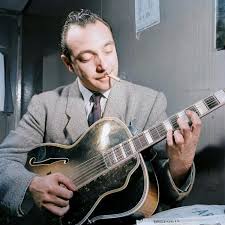
Django Reinhardt was the first European jazz master — his Gypsy jazz style, developed after losing the use of two fingers in a caravan fire, combined virtuoso speed with a deeply swinging feel that transcended his physical limitation.