Tone Timeline
Django Reinhardt — Tone Evolution
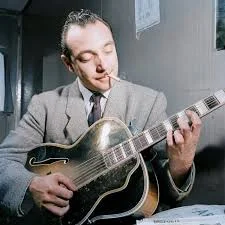
Django Reinhardt invented jazz guitar as it is understood today — his Selmer Maccaferri guitars through acoustic amplification defined a genre. Despite losing the use of two fingers on his fretting hand in a fire, he developed a technique of unprecedented sophistication and speed.
1934–1939: Quintette du Hot Club de France
Django's peak creative period used a Selmer Maccaferri guitar — a distinctive archtop with a resonator chamber and D-shaped soundhole. All acoustic, no amplification in this era. The tone was warm, full, and projecting — the Maccaferri's design gave extraordinary volume and projection for an acoustic instrument. Minor Swing and Nuages were recorded in this period.
Signal Chain
1940–1946: Wartime Paris
↑ The shift to oval-hole Selmer and early Stimer amplification gave Django access to new sustain and projection — the bridge to his electric experiments.
During the Nazi occupation of Paris, Django continued playing — gypsy jazz kept him relatively safe as entertainment. He moved to an oval-hole Selmer and began experimenting with amplification as American music (bebop) reached him. Tone became slightly warmer and more sustained with the oval-hole body.
Signal Chain
1946–1953: Electric Experiments
↑ Electric Django was a work in progress — he never fully resolved the tension between his acoustic gypsy jazz vocabulary and the American electric idiom he admired.
Post-war Django was fascinated by Charlie Parker and bebop — he acquired an electric guitar (various models) and experimented with a more American sound. These recordings are polarising: some hear a great musician struggling with new technology, others hear genuine development. He died of a stroke in 1953. His gypsy jazz legacy enormously outlived his electric period.
Signal Chain