Rig Builder
Budget Rig Breakdown
Signal Chain

Essentials
Complete Your Rig
The accessories every serious guitarist needs — cables, strings, and the rest.
Ernie Ball Regular Slinky Strings (10-46)
The balance between bending ease and tone — standard gauge for blues and classic rock.
Dunlop Tortex Standard Pick 0.73mm (Pack of 12)
Medium-gauge picks used by blues and rock guitarists for attack and warmth.
Planet Waves American Stage Guitar Cable 10ft
Solderless ends and lifetime warranty. The cable most session guitarists trust.
Boss TU-3 Chromatic Tuner Pedal
The professional standard for live tuning. True bypass, powers other pedals, ultra-accurate.
Levy's M8 Guitar Strap
Quality leather strap used by touring guitarists. Genuine comfort for 3-hour sets.
Technique
Key Tone Tips
- Use the neck pickup for leads — Frusciante rarely used the bridge
- The DS-2 in Turbo mode adds Marshall-like sustain at lower volumes
- Small Clone chorus at full depth and moderate rate for RHCP cleans
- Light pick attack, lots of vibrato — the expression is in the fingertips
- Marshall at bedroom volumes with the DS-2 pushing it is key
- Park the wah pedal at mid-position (around 50% toe) as a fixed filter for a nasal, vocal quality on funk rhythm parts — don't sweep it
- The RHCP clean funk tone has no overdrive at all: neck pickup, light compression, chorus — the rhythm feel comes from muting and attack, not gain
- Add a short slapback delay (160–200ms, single repeat, level at 3) under dirty lead lines — barely audible on its own but adds dimension to the DS-2 sound
- Vibrato starts on pitch and then deviates — Frusciante's classical guitar training means his vibrato begins from the target note and oscillates away from it, unlike most rock players whose vibrato starts below pitch and rises to the note
- Study "Under the Bridge" for the contrast between the acoustic-influenced verse picking and the electric lead tone — Frusciante demonstrates in a single track how to move from understated, clean fingerpicking to expressive pentatonic lead phrasing without any jarring tonal shift
- The RHCP funk-rock rhythm tone depends on playing ghost notes between every chord hit — muted "chk" strokes on the 8th and 16th note subdivisions between the actual chord stabs are what create the groove; the ghost notes are rhythmically as important as the musical notes
- Running a clean amp with the DS-2 in turbo mode at moderate settings gives more tonal control than using a high-gain amp setting — the pedal provides the saturation character while the amp provides the EQ shaping, which is why Frusciante can go from clean to saturated by switching one pedal rather than changing amp settings
Background
About Frusciante's Sound
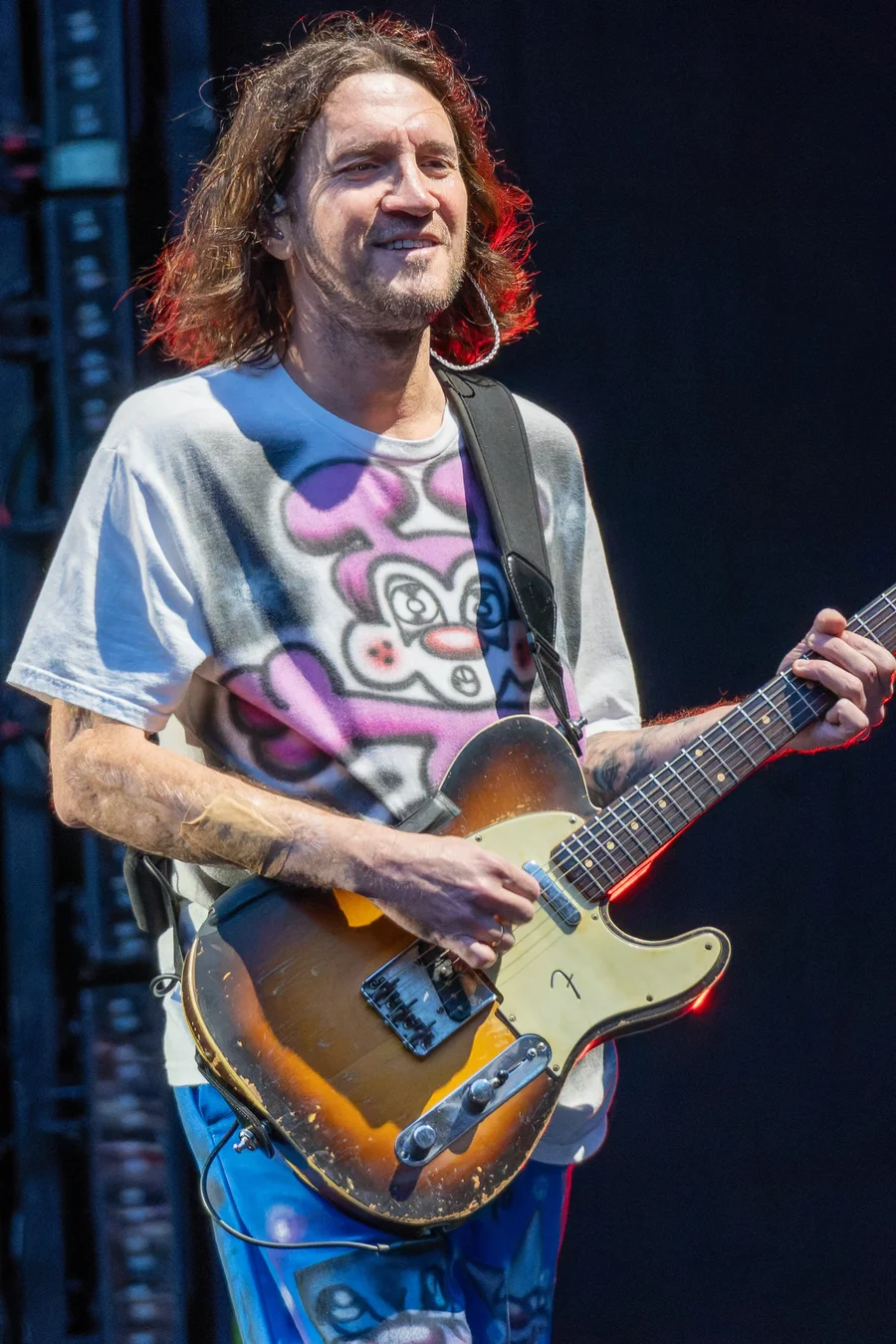
John Frusciante's tone spans clean funk rhythm playing to raw, overdriven leads — all on a Stratocaster through a Marshall. His approach is musical and varied, drawing from Hendrix, Mayer and Gilmour.
Tone History
Frusciante's Tone Evolution
Frusciante's tone tracks his sobriety cycle and the band's music almost perfectly — from the raw Californication lo-fi to the complex By the Way orchestration to the dark Stadium Arcadium crunch. His experimental solo records run completely parallel in sonic approach.
Full timeline: 3 eras →Song Breakdowns
Frusciante Song Rigs
Under the Bridge
Blood Sugar Sex Magik · 1991
Dual-toned track — the intro uses a clean, open-chord electric tone played …
Californication
Californication · 1999
Melodic clean tone with rich harmonic content — the song's guitar part live…
Can't Stop
By the Way · 2002
Frusciante's most rhythmically complex studio work — layered funky rhythm p…