Rig Builder
Budget Rig Breakdown
Signal Chain

Essentials
Complete Your Rig
The accessories every serious guitarist needs — cables, strings, and the rest.
Ernie Ball Power Slinky Strings (11-48)
Heavier gauge for drop tunings and tighter pick attack — standard for modern metal.
ISP Decimator II Noise Gate
Essential for high-gain amps and extended-range guitars. No noise gate — no clean metal tone.
Planet Waves American Stage Guitar Cable 10ft
Solderless ends and lifetime warranty. The cable most session guitarists trust.
Boss TU-3 Chromatic Tuner Pedal
The professional standard for live tuning. True bypass, powers other pedals, ultra-accurate.
Levy's M8 Guitar Strap
Quality leather strap used by touring guitarists. Genuine comfort for 3-hour sets.
Technique
Key Tone Tips
- Classical vibrato: uniform, even oscillation — practise with a metronome until it's consistent
- MXR Distortion+ before the Marshall: adds saturation and tightens the low end
- String bends are precise — Rhoads always bent exactly in tune, practise with a tuner
- Legato passages (hammer-ons / pull-offs) from classical influence — smooth, even velocity
- Flying V bridge humbucker: focused, tight low end ideal for precise metal riffing
- Arpeggios and scalar runs from classical modes — Dorian and Harmonic Minor feature heavily
- Marshall gain channel at 7, presence at 7 — present and cutting without flabbiness
- Study "Crazy Train" intro and "Mr. Crowley" solo — both are essentially composed pieces
- Upstroke picking on single notes gives a brighter, more percussive attack
- Transcribe and learn the "Crazy Train" intro riff note-for-note before attempting any other Rhoads material — the riff uses alternating single-note runs with muted rhythmic accents, and getting the muted "chunk" between phrases is as important as the melodic notes themselves
- Study Harmonic Minor scale runs in every position across the fretboard — Rhoads built his neoclassical vocabulary from the Harmonic Minor mode (particularly A Harmonic Minor), and a fluent command of the scale across all five CAGED positions is a prerequisite for the solos
- MXR Distortion+ drive control between 5 and 7 is the sweet spot — above 7 the pedal gets woolly and loses the defined note attack; below 5 it doesn't push the Marshall hard enough for the characteristic compressed sustain on held notes in solos
Background
About Randy Rhoads's Sound
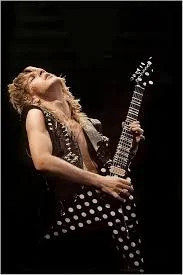
Randy Rhoads fused classical music training with heavy metal technique in a career cut short at 25. His polka-dot Flying V and precise, technically exacting vibrato brought a new vocabulary to rock guitar — every solo was composed, not improvised, with controlled aggression and melodic intent.
Tone History
Randy Rhoads's Tone Evolution
Randy Rhoads fused classical composition with rock guitar in a way that redefined what hard rock lead playing could be. In two albums with Ozzy Osbourne before his death at 25, he established neoclassical metal guitar as a genre and influenced every shred player who followed. His tone — a Marshall JMP through a combination of cabinets — remains one of the most studied in rock history.
Full timeline: 2 eras →Song Breakdowns
Randy Rhoads Song Rigs
Crazy Train
Blizzard of Ozz · 1980
The riff that defined NWOBHM-influenced American metal. Randy's polka-dot F…
Mr. Crowley
Blizzard of Ozz · 1980
The ballad side of Rhoads — the clean tone is surprisingly warm, using the …
Dee
Blizzard of Ozz · 1980
A solo acoustic guitar piece — Rhoads recorded this intimate classical guit…