MetalHard Rock1980s
Randy Rhoads — £500 · Sweet Spot Rig
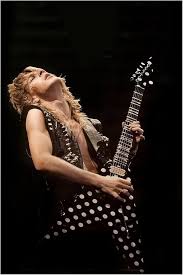
Karl Sandoval polka-dot Flying V or Les Paul Custom into a Marshall JMP (100W) with an MXR Distortion+ pushing the front end. High gain but not sloppy — Rhoads' technical precision comes through even at high volumes. An Electro-Harmonix flanger adds movement on some solos.
Signal Path
Signal Chain
Full signal path
GuitarEpiphone Explorer
DistDS-1
AmpKatana 50
Full Gear List
£500 · Sweet Spot — Complete Rig

££ Mid-Range£299
£ Budget£49
Tone Tips
Getting the Sound Right
- Classical vibrato: uniform, even oscillation — practise with a metronome until it's consistent
- MXR Distortion+ before the Marshall: adds saturation and tightens the low end
- String bends are precise — Rhoads always bent exactly in tune, practise with a tuner
- Legato passages (hammer-ons / pull-offs) from classical influence — smooth, even velocity
- Flying V bridge humbucker: focused, tight low end ideal for precise metal riffing
- Arpeggios and scalar runs from classical modes — Dorian and Harmonic Minor feature heavily
- Marshall gain channel at 7, presence at 7 — present and cutting without flabbiness
- Study "Crazy Train" intro and "Mr. Crowley" solo — both are essentially composed pieces
Avoid These Pitfalls
Common Mistakes When Chasing This Tone
- Not exploring the Marshall DSL alone before adding pedals — a Les Paul or humbucker guitar into a British amp is already a near-complete overdrive system. Adding drive pedals on top is often unnecessary and muddies the amp's natural character
- Leaving the wah pedal engaged but stationary between rocking it — a cocked wah (fixed position, not moving) acts as a midrange filter that changes the core tone. Either rock it expressively or bypass it completely; a cocked wah changes the sound in ways that are often unintended
- Setting the amp bass too high — the inherent warmth of mahogany means you need less bass EQ than with a Strat. Starting at 5 rather than 7 prevents low-end mud.
- Scooping the mids on a Marshall-style amp — the upper midrange emphasis is what makes British amps cut through. Mid-scoop EQ sounds good alone but disappears in a band mix.
- Using too much gain on the drive pedal — pedal-driven tone works best with the amp providing some character and the pedal adding focus and saturation, not replacing the amp entirely.
- Not using a noise gate — self-noise at metal gain levels is constant between notes. A gate is an essential functional tool, not an optional extra.
- Ignoring down-tuning — trying to achieve dropped-tuning riff character at standard pitch produces a thinner, less aggressive result regardless of EQ.
Tone Profile
Randy Rhoads's Sound
Karl Sandoval polka-dot Flying V or Les Paul Custom into a Marshall JMP (100W) with an MXR Distortion+ pushing the front end. High gain but not sloppy — Rhoads' technical precision comes through even at high volumes. An Electro-Harmonix flanger adds movement on some solos.