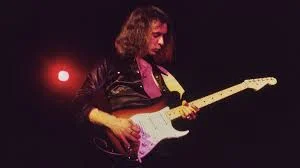
Tone Timeline
Ritchie Blackmore — Tone Evolution
Ritchie Blackmore pioneered the hard rock and early heavy metal guitar tone through his work with Deep Purple and Rainbow — his aggressive attack, classical influences, and preference for Fender Stratocasters through Marshall stacks created a blueprint that influenced generations of rock and metal guitarists.
1968–1972: Deep Purple Mk I / II
Early Deep Purple Blackmore used a Gibson ES-335 before switching permanently to Fender Stratocasters. The tone was aggressive but still rooted in late '60s blues-rock — heavy pick attack, treble-biased Stratocaster into a modified Marshall. Machine Head (1972) captured his tone at its most ferocious: Smoke on the Water's riff through a Marshall 1959 Super Lead with the EQ cranked.
Signal Chain
Songs from this era
Machine Head
The most famous four-note riff in rock history — performed in open fourths rather than the more comm…
Full rig →Deep Purple in Rock
The extended solo section on Child in Time features Blackmore's most dramatic dynamic range — from c…
Full rig →Machine Head
Blackmore's fastest and most technically demanding solo — a Bach-influenced sequence of 16th note ru…
Full rig →1973–1984: Burn / Rainbow
↑ Rainbow era tone gained warmth and sustain compared to the brittle early Purple sound — scalloped frets enabled his extreme vibrato style.
With Rainbow, Blackmore pushed into neoclassical territory — scales and modes from Bach and Vivaldi applied to hard rock. The tone became slightly warmer with more sustain; he used a purportedly modified Stratocaster with scalloped fretboard and higher action to facilitate vibrato. EQ shifted to more midrange presence for cut in mix with Cozy Powell's powerful drums.
Signal Chain
1993–present: Deep Purple Reunion / Blackmore's Night
↑ Late-period electric work retained the formula but lost the aggression — the treble booster was no longer central and the attack became more controlled.
Blackmore's Night shifted him to acoustic and Renaissance music from the late '90s. When playing electric with the Deep Purple reunions he retained his Stratocaster/Marshall combination but the approach was less aggressive — age and context mellowed the attack. His core tone remained unchanged but the ferocity of the early '70s was hard to recapture.
Signal Chain