Tone Timeline
Robin Trower — Tone Evolution
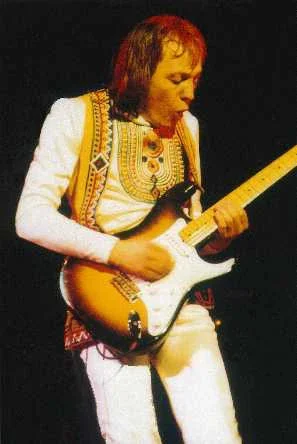
Robin Trower built a career on Jimi Hendrix-influenced tone — his Stratocaster through a Marshall, heavy vibrato use, and wah-drenched blues-rock made him one of the most distinctive post-Hendrix guitarists. Bridge of Sighs (1974) is his masterpiece.
1967–1972: Procol Harum
Trower was lead guitarist for Procol Harum — a band whose identity was rooted in Gary Brooker's piano and vocals rather than guitar. Trower played a Les Paul or SG through various amplifiers. His playing in this context was more restrained than his subsequent solo work. He left to pursue a more blues-rock direction.
Signal Chain
1973–1978: Twice Removed / Bridge of Sighs
↑ Bridge of Sighs represented the full synthesis of Hendrix influence into a personal voice — the Univibe/Stratocaster/Marshall Bass combination was distinctly Trower rather than imitation Hendrix.
Bridge of Sighs (1974) is Trower at his peak — a full commitment to Hendrix-influenced Stratocaster playing. He used a 1957 Stratocaster through a Marshall 100W Super Bass (bass heads, because he liked their EQ for guitar), and a Univibe for that slow, oscillating tone he's associated with. In This Place and Bridge of Sighs title track are the definitive Trower recordings. James Dewar's voice was perfectly complementary.
Signal Chain
Songs from this era
Bridge of Sighs
The defining Robin Trower tone — a Stratocaster through a Univox Uni-Vibe and a Marshall, creating t…
Full rig →Bridge of Sighs
The heavier, riff-based Trower tone — the Uni-Vibe is still present but less pronounced, and the Mar…
Full rig →Bridge of Sighs
A bluesier, more controlled Trower track — slower tempo and more space between phrases allows the su…
Full rig →Robin Trower Live
The live album captured Trower's tone at its rawest — the Stratocaster through the Marshall at much …
Full rig →1983–present: Beyond the Mist / Paige Cooper Sessions
↑ Late Trower is a master of consistency — 50 years of the same fundamental approach, each album refining rather than departing from the Stratocaster/Marshall/Univibe identity.
Trower continued recording and touring through the 1980s-2000s with consistent quality. His signature Fender Stratocaster model maintained the vintage spec he preferred. He also collaborated with Jack Bruce (former Cream bassist) on a series of albums. Late recordings show his tone unchanged — a guitarist who found his voice early and has maintained it with conviction.
Signal Chain