Rig Builder
Budget Rig Breakdown
Signal Chain

Essentials
Complete Your Rig
The accessories every serious guitarist needs — cables, strings, and the rest.
Ernie Ball Power Slinky Strings (11-48)
Heavier gauge for drop tunings and tighter pick attack — standard for modern metal.
ISP Decimator II Noise Gate
Essential for high-gain amps and extended-range guitars. No noise gate — no clean metal tone.
Planet Waves American Stage Guitar Cable 10ft
Solderless ends and lifetime warranty. The cable most session guitarists trust.
Boss TU-3 Chromatic Tuner Pedal
The professional standard for live tuning. True bypass, powers other pedals, ultra-accurate.
Levy's M8 Guitar Strap
Quality leather strap used by touring guitarists. Genuine comfort for 3-hour sets.
Technique
Key Tone Tips
- Master strict alternate picking — Morse's clean articulation comes from constant down-up motion, not economy picking. Practice scalar runs slowly with a metronome at 80bpm and only speed up when every note rings cleanly.
- Use the bridge humbucker for leads with amp gain at 5–6 — let your picking attack add aggression rather than cranking distortion, which kills the note separation he's famous for.
- Engage the inner single-coil positions for clean country and rhythm parts — roll tone back to around 7 for a glassy but not brittle chime.
- Add a slap-back to medium delay (around 300–400ms, 2–3 repeats, mix low) to thicken leads without losing definition — the TC 2290 was central to his rig.
- Apply subtle analogue chorus (rate slow, depth low) on clean passages for the wide Dixie Dregs shimmer — keep it subtle so it doesn't wash out fast picking.
- Practice banjo-style rolls and pedal-steel bends to capture his country crossover vocabulary — Morse often bends one note while holding a static high string.
- Set amp mids high (7–8) and scoop bass slightly to keep fast lines tight and present in a band mix.
- Use a hardtail or locked tremolo and keep action low but precise — his fluid legato-and-picking hybrid relies on a clean, fast-responding setup.
Background
About Morse's Sound
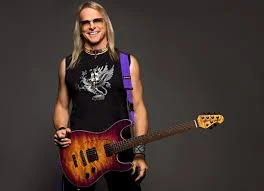
Steve Morse is a virtuoso whose hyper-precise alternate picking and genre-blending style spans the Dixie Dregs, Kansas, Flying Colors and decades fronting Deep Purple. His tone is articulate and dynamic — clean enough for country and classical lines, yet aggressive enough for stadium hard rock. Few players combine such surgical right-hand control with this much melodic warmth.
Tone History
Morse's Tone Evolution
Steve Morse is technically one of the most accomplished guitarists alive — capable of bluegrass picking, country chicken-picking, jazz chord-melody, and hard rock shredding in the same song. His own band (Dixie Dregs) showcased this range; Deep Purple (from 1994) focused his energy on hard rock. A Music Man Steve Morse signature is his primary vehicle.
Full timeline: 2 eras →