Rig Builder
Budget Rig Breakdown
Signal Chain

Essentials
Complete Your Rig
The accessories every serious guitarist needs — cables, strings, and the rest.
Ernie Ball Power Slinky Strings (11-48)
Heavier gauge for drop tunings and tighter pick attack — standard for modern metal.
ISP Decimator II Noise Gate
Essential for high-gain amps and extended-range guitars. No noise gate — no clean metal tone.
Planet Waves American Stage Guitar Cable 10ft
Solderless ends and lifetime warranty. The cable most session guitarists trust.
Boss TU-3 Chromatic Tuner Pedal
The professional standard for live tuning. True bypass, powers other pedals, ultra-accurate.
Levy's M8 Guitar Strap
Quality leather strap used by touring guitarists. Genuine comfort for 3-hour sets.
Technique
Key Tone Tips
- Use harmonic minor scale (raised 7th) for the classical Yngwie sound — it creates the Vivaldi/Bach character rather than standard pentatonic blues
- Keep tone control at full and treble on the amp high — his tone is sharp and bright, never warm
- The DOD 250 runs at minimum gain, maximum level — it's a clean push into the amp, not a distortion pedal
- Alternate pick every single note — Yngwie uses no legato. Every note is struck with the pick
- Scalloped fretboard vibrato cannot be perfectly replicated on a standard neck. Compensate with wrist-driven wide vibrato and very light fretting pressure
- Vibrato starts immediately and stays fast and wide throughout the note — unlike blues vibrato which is slow and deliberate
- Tune to Eb standard — half step down reduces string tension and enables his aggressive attack without going sharp
- Practise three-notes-per-string scale patterns at very slow tempos before building speed — the picking mechanics must be clean at any tempo
- The Marshall runs at medium gain — it's the DOD boost that saturates the input stage, not a high-gain amp setting
- Practice strict inside and outside picking mechanics separately before combining — Yngwie's alternate picking requires that both string-crossing directions (picking toward the guitar body and away from it) are equally clean; most players have a weaker direction that becomes apparent at high speeds
- Learn the Bachiana No. 5 by Heitor Villa-Lobos alongside Malmsteen's compositions — both draw from the same Baroque-influenced counterpoint tradition, and understanding the classical phrasing logic behind the notes makes Malmsteen's solos far easier to internalise and memorise
- Set the amp presence control high (7–8) for the characteristic bright, forward attack — presence controls the very top of the frequency spectrum above treble, and Yngwie's cutting tone depends on this "air" at the top of the EQ curve being fully open
Background
About Yngwie Malmsteen's Sound
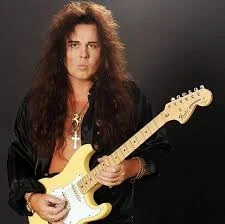
Yngwie Malmsteen brought Bach and Paganini to the electric guitar, creating neoclassical shred. His combination of extreme speed, scalloped-neck vibrato and harmonic minor vocabulary rewrote what was considered possible on the instrument.
Tone History
Yngwie Malmsteen's Tone Evolution
Yngwie assembled his rig in the early 1980s and has changed almost nothing since — scalloped-fretboard Stratocaster, custom-wound DiMarzio pickups, and a Marshall driven by a DOD overdrive. The tone was fully formed by Rising Force and has never been updated.
Full timeline: 3 eras →Song Breakdowns
Yngwie Malmsteen Song Rigs
Far Beyond the Sun
Rising Force · 1984
The neoclassical shred pinnacle — a scalloped Fender Stratocaster into a he…
Black Star
Rising Force · 1984
Malmsteen's most emotionally direct tone — a clean intro gives way to the s…
I Am a Viking
Marching Out · 1985
Malmsteen's most direct hard rock song tone — vocal-oriented structure with…