JazzFusion1970s–present
Pat Metheny — £500 · Sweet Spot Rig
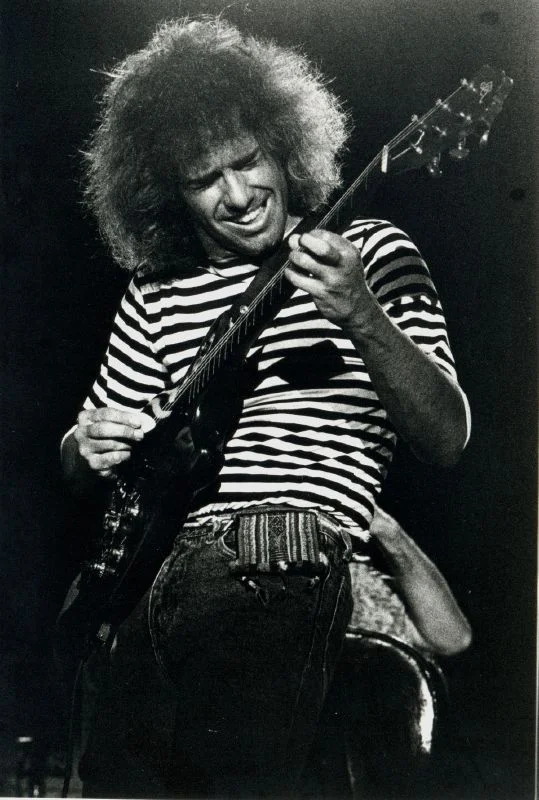
Ibanez PM100 or ES-175-style archtop into a Roland GR-300 guitar synthesizer and clean amp. The tone is warm, round and rich — pure jazz archtop character. For fusion work, the Roland GR-300 adds orchestral textures behind the acoustic guitar tone. The pick is a pick but the touch is always light.
Signal Path
Signal Chain
Full signal path
GuitarEpiphone SG
AmpBlues Jr
Full Gear List
£500 · Sweet Spot — Complete Rig


Tone Tips
Getting the Sound Right
- Wide chord voicings across all six strings — Metheny uses spread voicings that span the full width of the neck, creating a rich, piano-like harmonic texture
- Play in the space between notes — his phrasing leaves room for silence. Notes are events, not streams. The rests have as much meaning as the notes
- The guitar synthesizer adds textural colour, not lead lines — in Metheny's approach, the synth is orchestration. The guitar itself carries the melody
- Melodic development over improvisation — each solo builds a melodic argument. A phrase appears, develops, transforms and resolves. Study how each phrase relates to the previous
- Thumb-over-neck grip for some chord voicings — the thumb wraps over the neck to fret the low E string, enabling full six-string chord shapes
- Jazz harmony knowledge is essential — Metheny's improvisation uses complex jazz harmony (ii-V-I, modal, superimposition). Basic pentatonic vocabulary is insufficient
- The attack is gentle — his right-hand picking is light and controlled. The archtop responds to a gentle touch; heavy attack produces a harsh, un-jazz-like sound
- ECM reverb and delay for the atmospheric tone — the signature ECM records used significant natural reverb. A long hall reverb adds the ambient quality
Avoid These Pitfalls
Common Mistakes When Chasing This Tone
- Playing at high volume without managing feedback — hollow-body guitars are acoustically live and will feedback freely at stage volumes. Amp positioning and pickup height affect this dramatically.
- Running multiple pedals into the input — boutique amps are designed for the natural guitar signal. Too many pedals before the input changes the input impedance and alters the amp's response.
- Adding compression to fix flat clean tone — a flat, lifeless clean tone usually means the amp gain or presence is wrong, not that compression is needed. Compression on a flat tone just makes it louder.
- Not setting delay to song tempo — a delay that doesn't match the song tempo creates a rhythmic clash that builds and becomes increasingly obvious. Tap the tempo every time.
- Ignoring the dynamic interplay between volume knob and amp — fusion players often use the guitar volume knob as an additional tonal tool. Leaving it at 10 the whole time loses expressiveness.
- Excessive vibrato width — fusion vibrato should be controlled and musical. Wide, fast vibrato appropriate for rock feels out of place in jazz-influenced sections.
Tone Profile
Pat Metheny's Sound
Ibanez PM100 or ES-175-style archtop into a Roland GR-300 guitar synthesizer and clean amp. The tone is warm, round and rich — pure jazz archtop character. For fusion work, the Roland GR-300 adds orchestral textures behind the acoustic guitar tone. The pick is a pick but the touch is always light.