BluesTexas Blues1980s
Stevie Ray Vaughan — £2,500 · Premium Rig
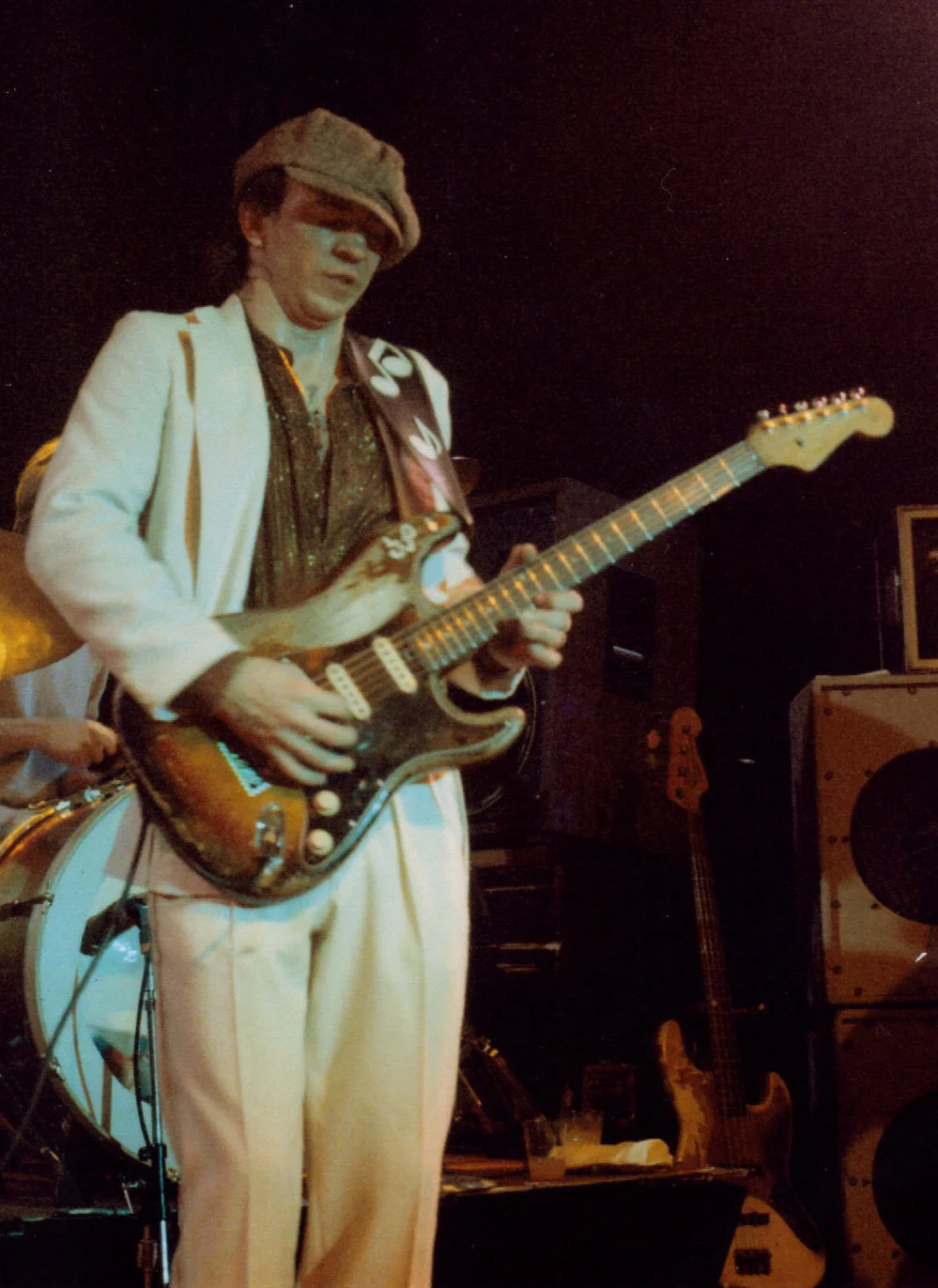
Heavy strings on a Strat (.13s) through a loud Fender Vibroverb or Super Reverb, with a Tube Screamer boosting the already-clean amp. The tone is thick, dynamic and full of character — because SRV's attack was so physical.
Signal Path
Signal Chain
Full signal path
GuitarPlayer Strat
WahWilson Effects
ODTS9
AmpFender Blues
ReverbElectro-Harmonix Holy
Full Gear List
£2,500 · Premium — Complete Rig
●●● Pro-Level$824


● Budget$126

Tone Tips
Getting the Sound Right
- The Tube Screamer is a boost, not a distortion — high volume, low gain
- SRV played heavy strings (.13s) for the thick tone — try .11s as a start
- Play with your full arm, not just your wrist — his attack was aggressive
- Clean amp is the foundation; let the speaker push for breakup
- Use string bends aggressively — SRV bent sharp deliberately
- Tune down to Eb standard — SRV played in Eb his entire career, which reduces string tension slightly even with .13s and adds harmonic depth
- Ride the volume knob constantly — between 7 and 10 for dynamic shaping; SRV never left it pegged at full
- Play behind the beat on slow 12-bar blues — SRV's rhythmic feel was relaxed and behind the kick drum, especially on ballads like "Lenny" and "Riviera Paradise"
Avoid These Pitfalls
Common Mistakes When Chasing This Tone
- Setting the TS808 gain above 5 into a clean amp — at high gain settings the TS becomes a distortion pedal that colours the tone heavily. Below 4, it's a boost and focus pedal. Single coils into a TS above 5 gets nasal and harsh
- Running the Octavia into an already-driven amp channel — fuzz into a driven amp creates uncontrolled intermodulation that sounds chaotic rather than musical. The Octavia works best into a clean or barely-clean amp
- Leaving the guitar volume at 10 — single coil brightness at full volume can be harsh. Rolling back to 8-9 tames the top end without killing output.
- Using a distortion pedal instead of pushing the amp — vintage-voiced amps create better overdrive by being pushed hard than by a pedal circuit. Let the amp do the work.
- Setting the boost level too high relative to the base tone — a boost for solos should raise the presence of the guitar, not cause a volume jump that overwhelms the mix. Level matching matters.
- Setting gain too high on the overdrive pedal — most overdrive pedals are most useful at gain settings of 2-5, where they add character without dominating the tone. High gain settings on an OD pedal become a distortion, not an overdrive.
- Using light strings (9s or 10s) — the reduced string tension and output produces a thinner sound that can't be EQ'd to match the heaviness of 11s or 13s.
- Setting the tube screamer gain above 5 — at high gain settings the TS becomes a distortion pedal. Below 4, it's a boost/focus pedal that works correctly in this context.
Tone Profile
SRV's Sound
Heavy strings on a Strat (.13s) through a loud Fender Vibroverb or Super Reverb, with a Tube Screamer boosting the already-clean amp. The tone is thick, dynamic and full of character — because SRV's attack was so physical.