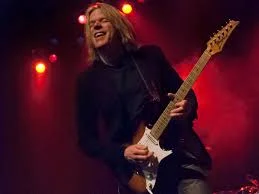
Andy Timmons — £200 · Beginner Rig
Andy Timmons' tone centres on a singing, full-bodied lead sound built from his Ibanez AT signature — a Les Paul-shaped guitar with DiMarzio pickups — running into a Mesa Boogie Mark IV or Soldano SLO. His lead tone has enormous sustain and warmth without becoming muddy, thanks to careful mid-scooping and a tubescreamer-style boost in front of the amp. Chorus and delay are used tastefully; his clean tone is percussive and soulful. The hallmark is lyrical, vocal-style phrasing: long sustained notes, wide vibrato, and melodic motifs that build gradually.
Signal Path
Signal Chain
Full signal path
Full Gear List
£200 · Beginner — Complete Rig
Tone Tips
Getting the Sound Right
- Use a light tubescreamer boost into a high-gain amp for singing sustain
- Keep bass and treble moderate — mids forward for cut
- Wide, slow vibrato is the signature of Andy's phrasing
- End phrases with a sustained bend held into the next bar
- Use delay with moderate feedback to add space without washing out
- The Ibanez AT-10P signature guitar's neck humbucker pickup provides warm, full sustain on the clean channel — combining a warm pickup with a clean amp creates the foundation tone. The amp's reverb is moderate, giving notes a warm surrounding space without the long tails that obscure note separation
- Delay and reverb at restrained settings create the atmospheric depth — Timmons uses delay (one repeat, 30% mix) and reverb (short room, 25%) to give notes a sense of space without washing out the clarity of each phrase. Too much delay creates muddiness; the correct amount creates dimensionality
- Study 'Electric Gypsy' and 'Resolution' for the full Timmons vocabulary — 'Electric Gypsy' demonstrates the lyrical, melody-centred lead playing and 'Resolution' shows the dynamic arc from restrained intro to full emotional climax within a single self-contained composition
Avoid These Pitfalls
Common Mistakes When Chasing This Tone
- Setting the TS9 gain above 5 into a clean amp — at high gain settings the TS becomes a distortion pedal that colours the tone heavily. Below 4, it's a boost and focus pedal. Single coils into a TS above 5 gets nasal and harsh
- Not using a gate on the Deluxe Reverb's high-gain channel — self-noise at this gain level is continuous and audible between notes. A noise gate is not a style choice; it is functional equipment for this gain level
- Leaving the guitar volume at 10 — single coil brightness at full volume can be harsh. Rolling back to 8-9 tames the top end without killing output.
- Running multiple pedals into the input — boutique amps are designed for the natural guitar signal. Too many pedals before the input changes the input impedance and alters the amp's response.
- Setting the boost level too high relative to the base tone — a boost for solos should raise the presence of the guitar, not cause a volume jump that overwhelms the mix. Level matching matters.
- Not setting delay to song tempo — a delay that doesn't match the song tempo creates a rhythmic clash that builds and becomes increasingly obvious. Tap the tempo every time.
- Using single-coil pickups — the lack of output and mid-frequency push makes it impossible to achieve the tightness needed for high-gain rhythm playing.
- Skipping the Tube Screamer-style boost — this pedal is not about adding gain. It focuses the low end before the amp sees the signal, which produces tighter palm mutes.
Tone Profile
Timmons's Sound
Andy Timmons' tone centres on a singing, full-bodied lead sound built from his Ibanez AT signature — a Les Paul-shaped guitar with DiMarzio pickups — running into a Mesa Boogie Mark IV or Soldano SLO. His lead tone has enormous sustain and warmth without becoming muddy, thanks to careful mid-scooping and a tubescreamer-style boost in front of the amp. Chorus and delay are used tastefully; his clean tone is percussive and soulful. The hallmark is lyrical, vocal-style phrasing: long sustained notes, wide vibrato, and melodic motifs that build gradually.