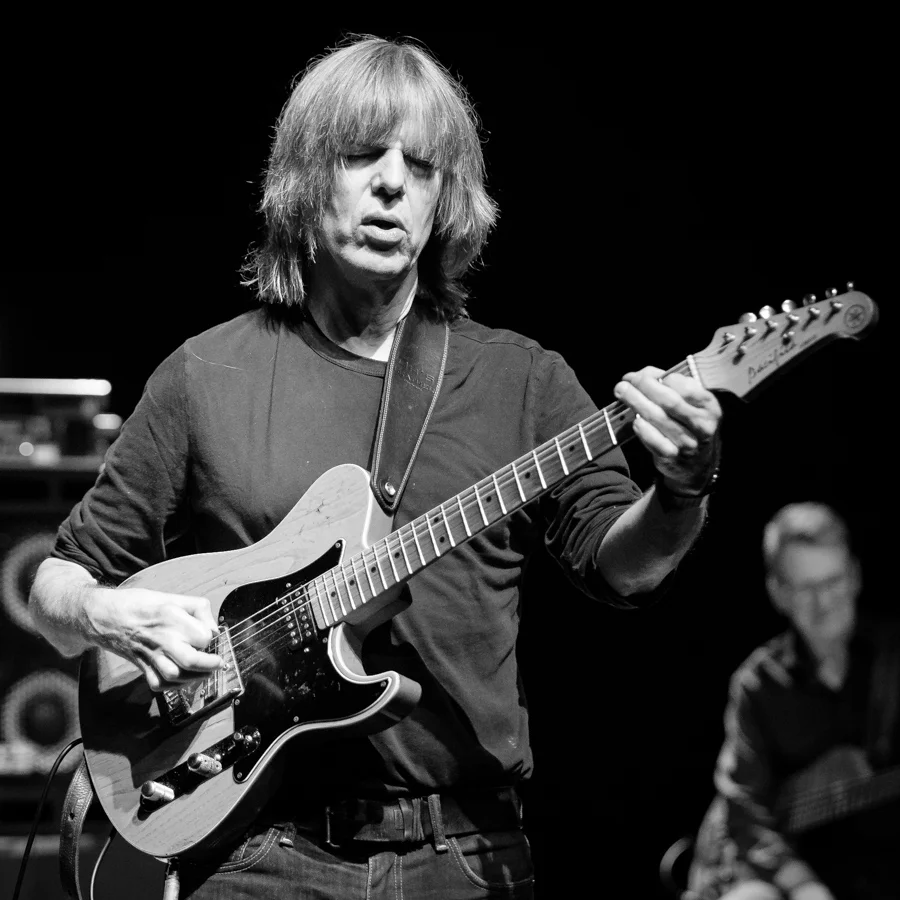
Mike Stern — £200 · Beginner Rig
Mike Stern's tone is immediately recognisable: a Yamaha SA2000 semi-hollow (or Fender Telecaster in later years) running through a Boss DS-1 distortion for his lead sound, adding grit and sustain on top of a clean Fender amp. He also uses a Boss CE-1 chorus for a shimmering clean rhythm tone. The combination gives him two distinct voices: a thick, slightly overdriven lead sound with jazz-scale runs flying over the top, and a warm, chorused clean tone for comping. His technique is completely jazz-derived — altered dominant runs, bebop clichés played at rock speed — but the tone is grittier than any jazz purist would allow.
Signal Path
Signal Chain
Full signal path
Full Gear List
£200 · Beginner — Complete Rig


Tone Tips
Getting the Sound Right
- Set the DS-1 with tone at 12 o'clock and drive at 10–11 o'clock for a crunchy but articulate jazz-rock tone
- Use a CE-1-style chorus on clean tones for the classic Stern shimmer
- Practice bebop lines (ii–V–I, altered dominants) then play them over rock rhythms
- Mute palm on the bridge between phrases for a percussive, tight feel
- Semi-hollow guitars (SA2000 or ES-335) give more warmth than a solidbody for this style
- The Telecaster or semi-hollow guitar through a clean amp with a mild overdrive pedal (Tube Screamer or Klon-type) is the foundational Stern tone — the pedal sits between guitar and amp, adding warm edge to clean notes that becomes full overdrive when pick attack increases
- John Scofield's influence is audible in the bluesy bending within jazz contexts — Stern developed alongside Scofield in Miles Davis's band and absorbed the technique of placing blues vocabulary within jazz-fusion harmony. Transcribing Scofield builds useful context for Stern's vocabulary
- Bebop scales (adding a chromatic passing tone between the 5th and 6th scale degrees) create the flowing, constantly-moving line quality — the additional chromatic note allows lines to land chord tones on strong beats consistently, which is why bebop lines sound harmonically clear despite their speed
Avoid These Pitfalls
Common Mistakes When Chasing This Tone
- Stacking a second overdrive after the TS9 with single coils — the combined mid emphasis of two stacked ODs into single-coil pickups produces a congested, nasal sound that struggles to sit in a mix
- Using a humbucker guitar as a substitute — the quack, string noise, and bright attack of single coils are irreplaceable. No amount of EQ on a humbucker produces the same result.
- Using a high-gain distortion pedal instead of amp gain — British crunch amps have a specific harmonic character when driven from their own gain stage. A pedal changes this character.
- Playing at bedroom volume expecting amp-driven tone — the power-tube saturation that defines this gain structure only occurs when the amp is working at substantial output. This is not replicable at low volumes.
- Setting gain too high on the overdrive pedal — most overdrive pedals are most useful at gain settings of 2-5, where they add character without dominating the tone. High gain settings on an OD pedal become a distortion, not an overdrive.
- Ignoring the guitar volume knob — rolling back to 6-7 is your rhythm setting; 10 is for leads. Most players leave it at 10 and miss the entire dynamic vocabulary.
- Using a humbucker where single coils are needed — the quack, string definition, and high-frequency air of single coils cannot be EQ'd into a humbucker
Tone Profile
Stern's Sound
Mike Stern's tone is immediately recognisable: a Yamaha SA2000 semi-hollow (or Fender Telecaster in later years) running through a Boss DS-1 distortion for his lead sound, adding grit and sustain on top of a clean Fender amp. He also uses a Boss CE-1 chorus for a shimmering clean rhythm tone. The combination gives him two distinct voices: a thick, slightly overdriven lead sound with jazz-scale runs flying over the top, and a warm, chorused clean tone for comping. His technique is completely jazz-derived — altered dominant runs, bebop clichés played at rock speed — but the tone is grittier than any jazz purist would allow.