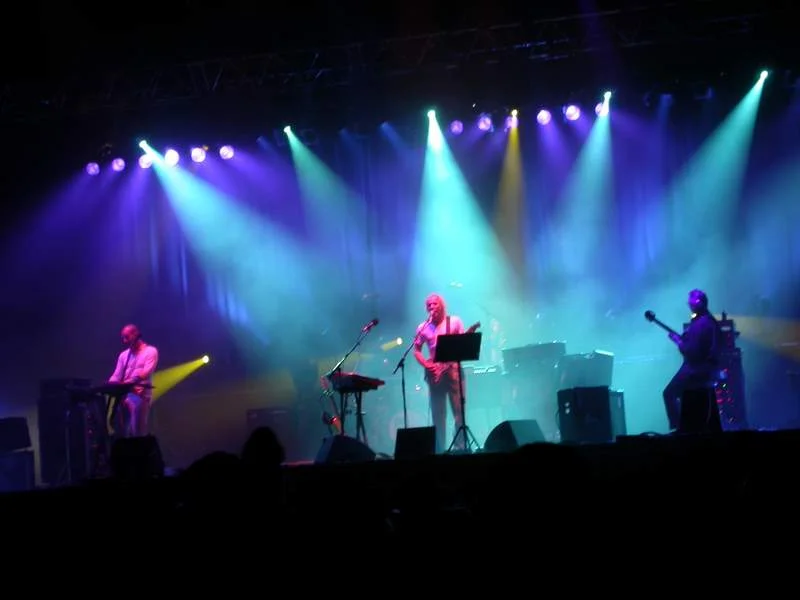
Robert Fripp — £200 · Beginner Rig
Robert Fripp's tone varies wildly across his career, but his signature sound is a massive, sustaining Gibson Les Paul through a bank of Fender amps into real-time tape delay loops. He plays seated in a strictly upright posture developed through Guitar Craft, using a very small pick held at the tip for precise articulation. His lead tone on King Crimson records — "21st Century Schizoid Man", "Starless" — is visceral and distorted, carved by amp drive rather than pedals. His ambient Frippertronics work uses long tape echoes to build evolving harmonic landscapes.
Signal Path
Signal Chain
Full signal path
Full Gear List
£200 · Beginner — Complete Rig


Tone Tips
Getting the Sound Right
- Sit upright and play with a relaxed, efficient technique — avoid shoulder and wrist tension
- Use real tape echo or a long delay pedal to build Frippertronics-style loop layers
- Play with a small, thin pick held near the tip for maximum right-hand articulation
- Use volume swells at the start of phrases to create ambient fade-ins
- Trust silence — Fripp leaves long gaps between phrases for dramatic effect
- Frippertronics (two tape decks feeding each other with guitar signal) is the origin of the sustained textural approach — modern equivalents use a looper pedal with a long delay time of 30 seconds or more. Fripp's technique requires the loop to build slowly over many passes, each phrase adding a layer to the accumulating texture
- The guitar volume is controlled almost entirely by pick pressure rather than the volume knob — very light picking produces barely-audible notes that build through the loop system; harder picking adds bright, clear notes on top. This dynamic control is the primary performance skill in Frippertronics practice
- Robert Craft conducting Stravinsky recordings shaped Fripp's understanding of rhythmic complexity — the polyrhythmic interlocking parts in 'Discipline' and 'Frame by Frame' are directly influenced by Stravinsky's orchestral rhythmic language applied to two electric guitars
Avoid These Pitfalls
Common Mistakes When Chasing This Tone
- Not exploring the Marshall DSL alone before adding pedals — a Les Paul or humbucker guitar into a British amp is already a near-complete overdrive system. Adding drive pedals on top is often unnecessary and muddies the amp's natural character
- Ignoring the individual pickup volume and tone controls — the two-pickup switching options on a Les Paul give you four distinct tones within a single setting. Most players only use two.
- Running multiple pedals into the input — boutique amps are designed for the natural guitar signal. Too many pedals before the input changes the input impedance and alters the amp's response.
- Setting the boost level too high relative to the base tone — a boost for solos should raise the presence of the guitar, not cause a volume jump that overwhelms the mix. Level matching matters.
- Not setting delay to song tempo — a delay that doesn't match the song tempo creates a rhythmic clash that builds and becomes increasingly obvious. Tap the tempo every time.
- Ignoring the room or PA system — prog guitar changes tone dramatically in different acoustic environments. Dialling in EQ in isolation gives a different result than through a full PA.
- Adding too many pedals — complex rigs with multiple switches require full attention to operate. Start with less and add only when a specific gap is identified.
Tone Profile
Fripp's Sound
Robert Fripp's tone varies wildly across his career, but his signature sound is a massive, sustaining Gibson Les Paul through a bank of Fender amps into real-time tape delay loops. He plays seated in a strictly upright posture developed through Guitar Craft, using a very small pick held at the tip for precise articulation. His lead tone on King Crimson records — "21st Century Schizoid Man", "Starless" — is visceral and distorted, carved by amp drive rather than pedals. His ambient Frippertronics work uses long tape echoes to build evolving harmonic landscapes.