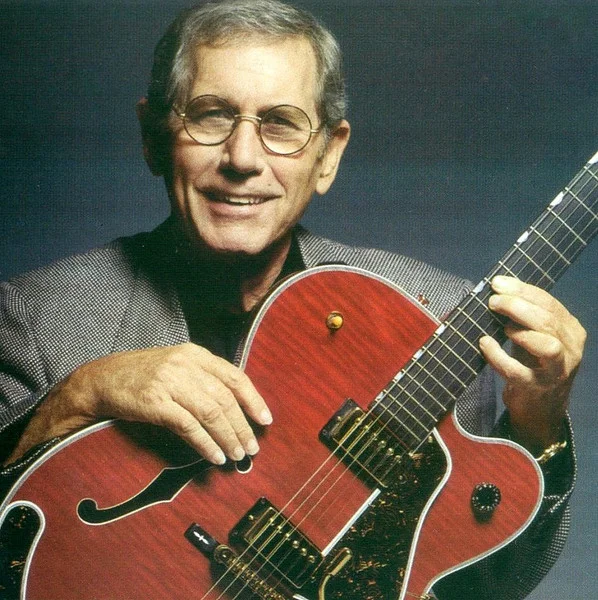
Chet Atkins
Chet Atkins was the architect of the Nashville Sound, a producer and guitarist who transformed country music from a regional genre into an international commercial phenomenon. As both an artist and head of RCA's Nashville division from 1960, he brought orchestral production to country — replacing fiddle and steel guitar with strings and background vocals — while simultaneously establishing himself as the most technically accomplished American fingerstyle guitarist of the 20th century. His thumb-and-fingers technique (influenced by Merle Travis's Travis picking) became the foundation for the country guitar canon. He was universally known as 'Mister Guitar' and received the Grammy Lifetime Achievement Award in 1993.
Immaculate, warm fingerstyle guitar on the Gretsch 6120 and Country Gentleman — the archtop's warm pickups through a clean, reverb-enhanced amplifier produce a sound simultaneously jazz-warm and country-bright. The signature Travis-picking pattern (alternating bass thumb with melody fingers) creates the illusion of two guitarists: bass line and melody simultaneously. The tone is always clean — Atkins is fundamentally a clean player whose dynamics come from touch.
Signal Chain Order
Why Chet Atkins's Rig Works
Using a dedicated thumbpick for bass strings while bare fingers or fingerpicks handle melody gives Atkins genuinely independent control over two simultaneous musical lines — the thumbpick's harder, more percussive attack suits the rhythmic bass part, while the softer fingertip attack on the melody strings keeps that line singing and legato, creating the illusion of two guitarists that's the entire foundation of Travis-picking technique.
The Gretsch 6120's FilterTron humbuckers, developed in direct collaboration with Atkins specifically to address hum problems in Gretsch's earlier DeArmond single coils, produce a warmth closer to a full humbucker while retaining more top-end clarity than a typical humbucker — that balance suits fingerstyle playing where both the punchy bass thumb part and the delicate melody fingers need to come through clearly without either being over-emphasized.
Keeping the Fender Twin completely clean, never approaching distortion, is essential groundwork for the illusion of multiple simultaneous parts to hold together — any amp saturation would blur the separation between the independently moving bass and melody lines, collapsing what's meant to sound like two distinct voices into an undifferentiated wash, which would undermine the entire technical achievement the style depends on.
Guitars
Gretsch 6120 Country Gentleman
1955–2001Atkins's most associated guitar — the Gretsch Country Gentleman, developed in collaboration with him from 1957, features dual humbuckers, a double cutaway body, and the FilterTron pickups that produce the warm, slightly bright archtop sound. The instrument is so identified with Atkins that Gretsch markets it as a signature model to this day.
Gretsch 6120 Chet Atkins Hollowbody
1954–1960The earlier single-cutaway 6120 used through the mid-1950s peak recordings — a fully hollow archtop with DeArmond single-coil pickups before the FilterTron humbucker development.
Gibson CES
1960–1980Various Gibson archtops used for specific recordings and touring — the CES series provides a warmer, fuller sound compared to the Gretsch's brighter FilterTron character.
Amplifiers
Fender Twin Reverb
1963–2001Atkins's primary amplifier for the majority of his career — the Twin's pristine clean headroom and spring reverb provide the clean platform that lets the Gretsch's natural character speak without coloration.
Amp guide →Standel Custom 25L15
1955–1963Standel amplifier used through the early Nashville period — a boutique custom amp providing clean, warm output for recording.
Effects Pedals
Fender Reverb Unit
1963–1975External reverb tank for recordings where the Twin's built-in spring reverb was insufficient — adds the characteristic splashing reverb tail to sustained chords.
Key Albums & Tone
"Yakety Axe", "Boo Boo Stick Beat" — the Gretsch 6120 Country Gentleman through the Fender Twin at pristine clean settings. The Travis-picking pattern on show throughout: alternating bass thumb and melody fingers creating the simultaneous bass-line-and-melody effect.
Solo guitar album — Atkins unaccompanied. The Gretsch's acoustic character projects through the clean amp with no band to mask it. The fingerpicking technique is fully exposed: the illusion of multiple players from one guitar and two hands.
Later career album demonstrating the full maturity of his technique — deeper, more sophisticated arrangements, the Country Gentleman now through modern amplification but the fundamental fingerstyle approach unchanged from his 1950s peak.
Frequently Asked Questions
What guitar does Chet Atkins use?
Gretsch 6120 Country Gentleman and Gretsch 6120 Chet Atkins Hollowbody. Atkins's most associated guitar — the Gretsch Country Gentleman, developed in collaboration with him from 1957, features dual humbuckers, a double cutaway body, and the FilterTron pickups that produce the warm, slightly bright archtop sound. The instrument is so identified with Atkins that Gretsch markets it as a signature model to this day.
What amp does Chet Atkins use?
Fender Twin Reverb and Standel Custom 25L15. Atkins's primary amplifier for the majority of his career — the Twin's pristine clean headroom and spring reverb provide the clean platform that lets the Gretsch's natural character speak without coloration.
What pedals does Chet Atkins use?
Chet Atkins uses Fender Reverb Unit.
What is Chet Atkins's signature sound?
Immaculate, warm fingerstyle guitar on the Gretsch 6120 and Country Gentleman — the archtop's warm pickups through a clean, reverb-enhanced amplifier produce a sound simultaneously jazz-warm and country-bright. The signature Travis-picking pattern (alternating bass thumb with melody fingers) creates the illusion of two guitarists: bass line and melody simultaneously. The tone is always clean — Atkins is fundamentally a clean player whose dynamics come from touch.
About This Data
Gear information for Chet Atkins is compiled from live performance footage, rig-rundown interviews, manufacturer and signature-model documentation, and cross-referenced guitar press coverage — not a single source. Where accounts conflict (a common issue with decades-old gear history), we favour the version corroborated by the most independent sources and note genuine ambiguity in the text rather than presenting a guess as settled fact.
This page is maintained by Alex Hall, last reviewed July 2026. Spotted something out of date or inaccurate? Let us know — corrections are usually made within a few days.