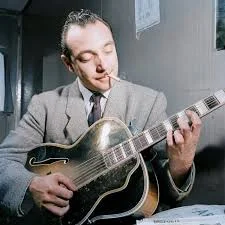
Django Reinhardt
Jean Reinhardt — Django — is one of the most remarkable instrumentalists in the history of recorded music. A Romani guitarist from Belgium who developed his extraordinary technique after a fire in his caravan destroyed the third and fourth fingers of his left hand at age 18, leaving him with full mobility only in his index and middle fingers. What resulted was a completely idiosyncratic technique — two-finger fretting on lead lines, the disabled fingers used for support on chord voicings — that produced an improvisational vocabulary of unmatched sophistication and speed. His recordings with violinist Stéphane Grappelli and the Quintet of the Hot Club of France from 1934 to 1948 define the Gypsy jazz genre entirely. His influence reaches forward to every subsequent acoustic jazz guitarist and backward to no one — he created his style whole.
Fast, fluid, rhythmically alive acoustic jazz guitar on a Selmer Maccaferri — the guitar's small soundhole and ladder bracing produce a cutting, projecting tone quite different from the American archtop tradition. The plectrum attack is hard and precise; the sustain is shorter than an archtop. The characteristic gypsy jazz sound is rhythmically percussive on comping (the la pompe technique — a strong downstroke on beats 2 and 4) and melodically virtuosic on lead.
Signal Chain Order
Why Django Reinhardt's Rig Works
The Selmer Maccaferri's oval soundhole and ladder-braced construction are what let an unamplified acoustic guitar cut through a full ensemble with bass and multiple rhythm guitars — that soundhole shape and internal bracing focus the guitar's projection more directionally than a conventional round soundhole, which spreads sound more diffusely. For a lead instrument that had to be heard clearly over rhythm guitars playing the percussive la pompe technique, that focused, cutting projection wasn't a stylistic preference, it was a functional necessity in the era before reliable amplification.
Django's technique — full fretting-hand facility limited to two fingers after his hand injury — forced an entirely idiosyncratic fingering logic where his disabled third and fourth fingers provided support on chord shapes while his index and middle fingers handled the actual fretting on lead lines. This wasn't a limitation he worked around quietly; it produced genuinely unique voicings and phrasing patterns that a fully able-handed player, defaulting to conventional fingerings, likely wouldn't have discovered.
The la pompe rhythm technique (a strong, percussive downstroke emphasized on beats 2 and 4) functions almost like a drummer's backbeat within a genre that traditionally had no drum kit — that percussive rhythmic emphasis from the accompanying guitars is what gives gypsy jazz its forward propulsion and danceable energy despite the ensemble's otherwise entirely acoustic, string-only instrumentation.
Guitars
Selmer Maccaferri (oval soundhole)
1932–1940The definitive Django instrument — the Selmer Maccaferri's distinctive oval soundhole and ladder-braced construction produce the cutting, nasal tone that defines gypsy jazz. The guitar's small body projects powerfully without amplification in a small-ensemble jazz context. Django's example created an entire guitar-building tradition now centred in Paris.
Selmer Maccaferri (D-hole)
1940–1953The later D-hole model (after Maccaferri left the Selmer company) — slightly different internal construction producing a somewhat warmer, less cutting tone than the oval soundhole version. Used through the Hot Club late period and post-war recordings.
Gibson ES-300
1946–1953Django used amplified Gibson archtops during his 1946 American tour with Duke Ellington — the ES-300's full archtop amplified tone represents the only period of his career where he deviated from the Selmer acoustic approach.
Amplifiers
Effects Pedals
Key Albums & Tone
"Minor Swing", "Stompin' at Decca", "Djangology" — the essential Hot Club recordings. Oval-soundhole Selmer Maccaferri, acoustically recorded in Paris. The lead guitar cuts through the two rhythm guitars and bass entirely through acoustic projection and picking velocity. The tone is bright, nasal, and rhythmically alive.
Post-war recordings demonstrating Django's electric experimentation — amplified guitar alongside the acoustic material. The bebop influence is audible in the harmonic language of the later recordings.
1947 New York concert recordings — Django with American swing musicians. The Selmer acoustic in an American jazz context: his technique unchanged but the harmonic language adapting to the bebop vocabulary then dominant in New York.
Frequently Asked Questions
What guitar does Django Reinhardt use?
Selmer Maccaferri (oval soundhole) and Selmer Maccaferri (D-hole). The definitive Django instrument — the Selmer Maccaferri's distinctive oval soundhole and ladder-braced construction produce the cutting, nasal tone that defines gypsy jazz. The guitar's small body projects powerfully without amplification in a small-ensemble jazz context. Django's example created an entire guitar-building tradition now centred in Paris.
What amp does Django Reinhardt use?
.
What pedals does Django Reinhardt use?
Django Reinhardt does not use effects pedals.
What is Django Reinhardt's signature sound?
Fast, fluid, rhythmically alive acoustic jazz guitar on a Selmer Maccaferri — the guitar's small soundhole and ladder bracing produce a cutting, projecting tone quite different from the American archtop tradition. The plectrum attack is hard and precise; the sustain is shorter than an archtop. The characteristic gypsy jazz sound is rhythmically percussive on comping (the la pompe technique — a strong downstroke on beats 2 and 4) and melodically virtuosic on lead.
About This Data
Gear information for Django Reinhardt is compiled from live performance footage, rig-rundown interviews, manufacturer and signature-model documentation, and cross-referenced guitar press coverage — not a single source. Where accounts conflict (a common issue with decades-old gear history), we favour the version corroborated by the most independent sources and note genuine ambiguity in the text rather than presenting a guess as settled fact.
This page is maintained by Alex Hall, last reviewed July 2026. Spotted something out of date or inaccurate? Let us know — corrections are usually made within a few days.