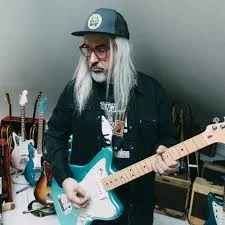
J Mascis
J Mascis is the guitarist, singer, and primary creative force behind Dinosaur Jr, one of the defining American alternative rock bands since their debut in 1985. His guitar approach sits at a unique intersection: Neil Young's melodic sensibility and lyrical lead phrasing combined with a volume level and gain density more typically associated with extreme metal. Mascis plays multiple Marshall stacks at concert volume levels considered excessive even by hard rock standards — the sheer physical volume is part of the composition. His lead work on albums like You're Living All Over Me (1987) and Where You Been (1993) set the template for the indie rock guitar solo: emotional, melodic, and backed by near-painful loudness.
Massive, wall-of-guitars fuzz-rock through multiple Marshall stacks at extreme volume — the Jazzmaster's offset body and floating tremolo into cranked Marshall produces a distinctive, slightly loose, organic distortion different from Les Paul or Strat alternatives. Lead lines are Neil Young-inflected: melodic, vibrato-heavy, and bending toward emotional directness rather than technical display. The sheer volume creates natural compression and sustain that shapes the tone as much as any pedal.
Signal Chain Order
Why J Mascis's Rig Works
Mascis's extreme stage volume isn't simply loudness for its own sake — at the levels multiple dimed Marshall stacks reach, the room itself starts to resonate and contribute to the sound, adding a natural compression and sustain that no pedal or studio effect fully replicates. That physical, room-driven saturation is treated as compositional, which is why recreating his tone at bedroom or small-club volume inherently loses something no amount of gain-pedal substitution can fully restore.
The ProCo Rat stacked on top of an already-dimed Marshall, rather than replacing the amp's own saturation, adds a layer of compression and harmonic density on top of the amp's breakup — its relatively open-voiced, non-mid-scooped clipping (unlike a Big Muff) works well layered over existing amp distortion rather than competing with it for the same frequency range.
The Jazzmaster's floating vibrato tailpiece, left un-locked and used loosely rather than in a fixed position, contributes a subtle, uncontrolled pitch wobble to sustained notes purely from the guitar's own mechanical resonance and the vibrations of extreme stage volume — that slight looseness and unpredictability is part of why his tone reads as more organic and less mechanically precise than a similarly loud metal rig, fitting his melodic, Neil Young-inflected lead vocabulary rather than technical metal precision.
Guitars
Fender Jazzmaster
1985–presentMascis's defining instrument — multiple vintage and reissue Jazzmasters are his primary guitars. The offset body, floating vibrato tailpiece, and rhythm/lead circuit switching give the Jazzmaster a distinctive, slightly loose character compared to a Les Paul or Strat. He uses the lead circuit almost exclusively, often with the vibrato arm floating rather than locked.
Fender J Mascis Jazzmaster
2011–presentFender Squier and standard Jazzmaster signature models built to his specification — vintage-style tailpiece, specific neck profile, and pickup configuration matching his modified vintage examples.
Gibson SG
1987–1995Used alongside Jazzmasters on specific songs — the SG's warmer, denser humbucker tone contrasts with the Jazzmaster for specific passages requiring more low-mid weight.
Amplifiers
Marshall Super Lead 100W "Plexi"
1985–presentMultiple Marshall Plexis run simultaneously at full volume — this is non-negotiable for Mascis's sound. The sheer volume level (significantly beyond conventional rock concert levels) creates natural power-amp saturation and room resonance that is compositional rather than simply loud. Three to four stacks on stage is typical.
Fender Twin Reverb
1993–presentUsed for some clean or semi-clean studio passages — the Twin provides a reference clean tone against which the full-stack Marshall volume is measured.
Amp guide →Effects Pedals
ProCo Rat
1987–presentMascis's most-used pedal — the Rat's filter control and relatively open-voiced distortion works well on top of an already-driven Marshall, adding compression and harmonic density without the mid-scoop of a Big Muff. Set for maximum distortion, moderate filter (not fully bright).
Boss DS-1 Distortion
1985–1995Early-career primary distortion — the DS-1 before the Rat became dominant. The DS-1's harder clipping and brighter character defined the earliest Dinosaur Jr recordings.
Pedal guide →Dunlop Cry Baby
1987–presentWah for expressive lead passages — Mascis uses wah as a vocal-inflection tool in the Hendrix/Vaughan tradition, deployed for specific melodic phrases rather than constant use.
Boss DD-3 Delay
1988–presentDelay for sustaining lead passages — adds dimension to the already-massive Marshall wall of sound. Set for moderate single repeat at relatively long delay time.
Key Albums & Tone
"The Lung", "Sludgefeast", "Little Fury Things" — Dinosaur Jr's defining album. Mascis's multiple-stack Marshall approach at full volume captures the core sonic identity: massive, distorted guitar with melodic Neil Young-inflected lead lines floating above the noise. The Jazzmaster's floating vibrato adds subtle pitch wobble to sustained notes.
"Freak Scene", "No Bones" — tighter production than You're Living All Over Me but same core approach. "Freak Scene" is the Dinosaur Jr anthem: melodic hook, massive guitar volume, emotive lead.
Major-label debut with more polished production — 'Start Choppin' and 'Out There' demonstrate that Mascis's core sound translates to commercial context without compromise.
Frequently Asked Questions
What guitar does J Mascis use?
Fender Jazzmaster and Fender J Mascis Jazzmaster. Mascis's defining instrument — multiple vintage and reissue Jazzmasters are his primary guitars. The offset body, floating vibrato tailpiece, and rhythm/lead circuit switching give the Jazzmaster a distinctive, slightly loose character compared to a Les Paul or Strat. He uses the lead circuit almost exclusively, often with the vibrato arm floating rather than locked.
What amp does J Mascis use?
Marshall Super Lead 100W "Plexi" and Fender Twin Reverb. Multiple Marshall Plexis run simultaneously at full volume — this is non-negotiable for Mascis's sound. The sheer volume level (significantly beyond conventional rock concert levels) creates natural power-amp saturation and room resonance that is compositional rather than simply loud. Three to four stacks on stage is typical.
What pedals does J Mascis use?
J Mascis uses ProCo Rat, Boss DS-1 Distortion, Dunlop Cry Baby and more.
What is J Mascis's signature sound?
Massive, wall-of-guitars fuzz-rock through multiple Marshall stacks at extreme volume — the Jazzmaster's offset body and floating tremolo into cranked Marshall produces a distinctive, slightly loose, organic distortion different from Les Paul or Strat alternatives. Lead lines are Neil Young-inflected: melodic, vibrato-heavy, and bending toward emotional directness rather than technical display. The sheer volume creates natural compression and sustain that shapes the tone as much as any pedal.
About This Data
Gear information for J Mascis is compiled from live performance footage, rig-rundown interviews, manufacturer and signature-model documentation, and cross-referenced guitar press coverage — not a single source. Where accounts conflict (a common issue with decades-old gear history), we favour the version corroborated by the most independent sources and note genuine ambiguity in the text rather than presenting a guess as settled fact.
This page is maintained by Alex Hall, last reviewed July 2026. Spotted something out of date or inaccurate? Let us know — corrections are usually made within a few days.