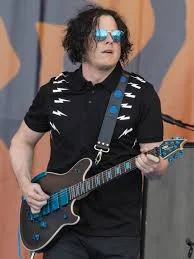
Jack White
Jack White brought blues-based guitar back to rock radio with The White Stripes' raw, minimal two-piece format. A fierce advocate for analog recording and intentional technical limitation, he deliberately handicaps himself to spark creativity — strange chord voicings, distorted slide on open tunings, and a confrontational playing style unlike anything in mainstream rock.
Kay/Silvertone/Airline guitar through a Digitech Whammy into an overdriven amp — raw, buzzy, almost lo-fi distortion. Open G or A tuning. The junk shop guitar aesthetic is intentional — limitation forces creativity.
Why Jack White's Rig Works
The cheap, primitive Airline and Silvertone guitars White favors aren't a limitation his tone survives despite — they're doing real tonal work. These guitars typically carry low-output, unevenly wound single-coil or lipstick-style pickups with a rougher, less polished frequency response than a well-made Fender or Gibson pickup, and that unevenness interacts with heavy fuzz and an already-driven amp to produce the raw, slightly chaotic top end that's central to the White Stripes sound — a higher-fidelity guitar into the same fuzz and amp settings would sound comparatively too controlled and polished.
Running the fuzz at extreme settings and using the guitar's own volume knob to "clean up" mid-song, rather than switching pedals on and off, keeps the tonal palette shifting within the same basic distorted character rather than moving between genuinely different, disconnected sounds. This is a similar technique to Hendrix's volume-knob approach, but here it's paired with cruder gear and pushed to a rawer, buzzier extreme that suits garage rock rather than the more controlled psychedelic blues Hendrix was working within.
The DigiTech Whammy's role here is structurally different from Morello's or Vai's use of the same pedal — on "Seven Nation Army," it's shifting the guitar's pitch down an octave to simulate a bass line the two-piece White Stripes format otherwise lacks. That's a practical necessity as much as an effect: without a bassist, the Whammy becomes a functional substitute instrument, not just a texture, which is why it's used so differently here than in a full-band context with its own dedicated bass player.
Guitars
Kay/Silvertone Sears Guitar
Early White Stripes — deliberately cheap guitars for aesthetic reasons.
Airline Guitar (Res-O-Glas)
Resonant plastic body — the White Stripes touring and recording guitar from 2001 onwards.
Gretsch G6129T "Jet"
Used on later White Stripes material and solo work.
Amplifiers
Fender Bassman
Primary amp — pushed hard for natural tube saturation.
Silvertone 1484 "Twin Twelve"
Vintage junk-shop amp used for early White Stripes recordings.
Marshall JCM800
2001–presentHeavier amp for touring.
Effects Pedals
DigiTech Whammy
Pitch shifting for dramatic effect — "Seven Nation Army" uses it an octave up.
Electro-Harmonix Big Muff Pi
Primary fuzz — extreme settings for "Ball and Biscuit" and solo material.
Pedal guide →Key Albums & Tone
"Hotel Yorba" and "Fell in Love with a Girl" — raw, minimal, essential.
"Seven Nation Army" — bass-via-Whammy line, the most recognised riff of the 2000s.
More marimba and piano — raw guitar moments hit harder for the contrast.
Mature solo debut — White Stripes energy with broader instrumentation.
Frequently Asked Questions
What guitar does Jack White use?
Kay/Silvertone Sears Guitar and Airline Guitar (Res-O-Glas). Early White Stripes — deliberately cheap guitars for aesthetic reasons.
What amp does Jack White use?
Fender Bassman and Silvertone 1484 "Twin Twelve". Primary amp — pushed hard for natural tube saturation.
What pedals does Jack White use?
Jack White uses DigiTech Whammy, Electro-Harmonix Big Muff Pi, ZVex Fuzz Factory.
What is Jack White's signature sound?
Kay/Silvertone/Airline guitar through a Digitech Whammy into an overdriven amp — raw, buzzy, almost lo-fi distortion. Open G or A tuning. The junk shop guitar aesthetic is intentional — limitation forces creativity.
About This Data
Gear information for Jack White is compiled from live performance footage, rig-rundown interviews, manufacturer and signature-model documentation, and cross-referenced guitar press coverage — not a single source. Where accounts conflict (a common issue with decades-old gear history), we favour the version corroborated by the most independent sources and note genuine ambiguity in the text rather than presenting a guess as settled fact.
This page is maintained by Alex Hall, last reviewed July 2026. Spotted something out of date or inaccurate? Let us know — corrections are usually made within a few days.