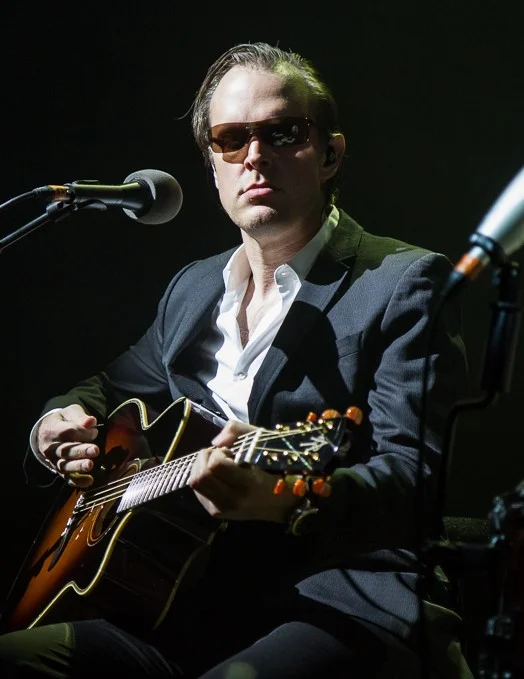
Joe Bonamassa
Joe Bonamassa is the most commercially successful blues guitarist of his generation — a child prodigy who opened for B.B. King at age 12, he has released over 40 albums and built the biggest blues-rock touring business in the world through his own label KTBA Records. His playing draws from the British blues tradition (Eric Clapton's Bluesbreakers era, Peter Green) as much as Chicago and Texas blues. He is also an obsessive vintage gear collector with one of the most valuable personal guitar and amp collections in private ownership.
Rich, warm, violin-like sustain from a late-1950s Les Paul through a Dumble or Two-Rock at the edge of breakup — the definitive American boutique blues-rock clean/crunch tone. Bonamassa excels at slow blues with long sustaining notes that have the vocal quality of BB King combined with the harmonic density of Clapton's Bluesbreakers tone.
Signal Chain Order
Why Joe Bonamassa's Rig Works
Running both a Dumble and a vintage Marshall Plexi in a wet/dry rig, rather than choosing one, lets Bonamassa access two genuinely different breakup characters within a single performance — the Dumble's warm, three-dimensional American bloom for singing sustain, and the Plexi's more aggressive, mid-forward British crunch for harder-edged passages. Splitting them across a wet/dry setup rather than switching channels on one amp means both characters are available simultaneously and can be blended in real time by the mix engineer or through stage volume balance.
The Klon Centaur set with Drive near zero and Volume boosted is functioning purely as a clean-boost stage into the Dumble's own front end — the same "transparent boost" principle found in John Mayer's rig, but here it's specifically tightening and focusing an already excellent amp's input rather than adding the Klon's own gain character. This preserves the Dumble's expensive, carefully voiced breakup rather than overriding it with the pedal's own clipping.
The late-1950s Les Paul Bursts at the foundation of this rig aren't simply valuable collectibles — PAF-era humbuckers of that specific vintage are frequently described as having a particular clarity and complexity under high gain that reissue pickups approach but don't fully replicate, and that clarity matters enormously for slow blues playing, where every harmonic overtone of a long sustained note is audible and part of the emotional effect.
Guitars
1959 Gibson Les Paul Standard (Burst)
2000–presentBonamassa owns multiple original 1958–1960 Bursts — the single most important factor in his tone. The combination of PAF humbuckers, aged mahogany body, and maple top produces a warmth and sustain that modern Les Pauls approach but rarely match.
1951 Fender No-Caster / Nocaster
2005–presentVintage Telecaster-era Fender — used for specific blues rock tones where the twang of a single-coil through a Dumble produces a distinctive, cutting clean character.
Gibson ES-335 (vintage 1961)
2010–presentSemi-hollow for select recordings — the 335's semi-hollow body resonance through a slightly overdriven amp produces an unusually complex, warm harmonic character.
Amplifiers
Dumble ODS (Overdrive Special)
1999–presentThe Dumble is Bonamassa's signature amp — a handmade boutique American amplifier of which fewer than 300 exist. The ODS's clean channel has a uniquely musical quality: warmth, bloom, and harmonic complexity that no production amp reproduces. Used at near-breakup Volume for his core blues tone.
Two-Rock Custom Reverb Signature
2010–presentTwo-Rock built Bonamassa a custom signature version — used alongside the Dumble in a wet/dry rig. Two-Rock's Dumble-inspired circuit produces a similar warmth and bloom at a fraction of the Dumble's price and with greater reliability on tour.
Marshall 1959 Plexi (vintage)
2000–presentBritish side of his wet/dry rig — the 1959 Plexi's aggressive mid-forward British character contrasts with the Dumble's warmth. Used primarily for lead tones and harder-edged blues rock passages.
Effects Pedals
Klon Centaur
2000–presentAs a lead boost into the Dumble — Klon at Drive minimum, Volume at noon or above. The Klon's low-gain boost character tightens and focuses the Dumble's input without altering the fundamental amp voicing. Bonamassa owns multiple original Klon units.
Pedal guide →Ibanez Tube Screamer TS808
1999–presentVintage TS808 as a mid-boost and drive enhancer — the Tube Screamer's mid-hump character works exceptionally well into the Dumble, pushing the amp into a more saturated zone while maintaining the amp's fundamental character.
Pedal guide →Strymon Timeline
2012–presentIn the effects loop — dotted-eighth delay for leads, standard quarter-note delays for atmosphere. The Timeline's transparent digital engine does not color the Dumble's natural tone character.
Pedal guide →Strymon Flint
2012–presentSpring reverb for acoustic dimension — modest reverb that adds air without washing the tone. Bonamassa keeps reverb minimal to preserve the presence and attack of the Dumble's dry character.
Pedal guide →Key Albums & Tone
Early Bonamassa — Les Paul into vintage Marshall Plexi, raw and British-influenced. "Mountain Time" showcases the bridge humbucker into a cranked Plexi.
The album that established his Dumble-plus-Marshall wet/dry rig as his signature setup. Warmer and more nuanced than Blues Deluxe.
Mediterranean influence on blues rock — the Dumble's warmth suits the melodic, expressive playing on this record. "Oh Beautiful" shows his violin-like sustain approach.
Modern production — the rig remains unchanged but the recording quality lets the Dumble's nuance breathe. "This Train" is quintessential Bonamassa tone.
Frequently Asked Questions
What guitar does Joe Bonamassa use?
1959 Gibson Les Paul Standard (Burst) and 1951 Fender No-Caster / Nocaster. Bonamassa owns multiple original 1958–1960 Bursts — the single most important factor in his tone. The combination of PAF humbuckers, aged mahogany body, and maple top produces a warmth and sustain that modern Les Pauls approach but rarely match.
What amp does Joe Bonamassa use?
Dumble ODS (Overdrive Special) and Two-Rock Custom Reverb Signature. The Dumble is Bonamassa's signature amp — a handmade boutique American amplifier of which fewer than 300 exist. The ODS's clean channel has a uniquely musical quality: warmth, bloom, and harmonic complexity that no production amp reproduces. Used at near-breakup Volume for his core blues tone.
What pedals does Joe Bonamassa use?
Joe Bonamassa uses Klon Centaur, Ibanez Tube Screamer TS808, Strymon Timeline and more.
What is Joe Bonamassa's signature sound?
Rich, warm, violin-like sustain from a late-1950s Les Paul through a Dumble or Two-Rock at the edge of breakup — the definitive American boutique blues-rock clean/crunch tone. Bonamassa excels at slow blues with long sustaining notes that have the vocal quality of BB King combined with the harmonic density of Clapton's Bluesbreakers tone.
About This Data
Gear information for Joe Bonamassa is compiled from live performance footage, rig-rundown interviews, manufacturer and signature-model documentation, and cross-referenced guitar press coverage — not a single source. Where accounts conflict (a common issue with decades-old gear history), we favour the version corroborated by the most independent sources and note genuine ambiguity in the text rather than presenting a guess as settled fact.
This page is maintained by Alex Hall, last reviewed July 2026. Spotted something out of date or inaccurate? Let us know — corrections are usually made within a few days.