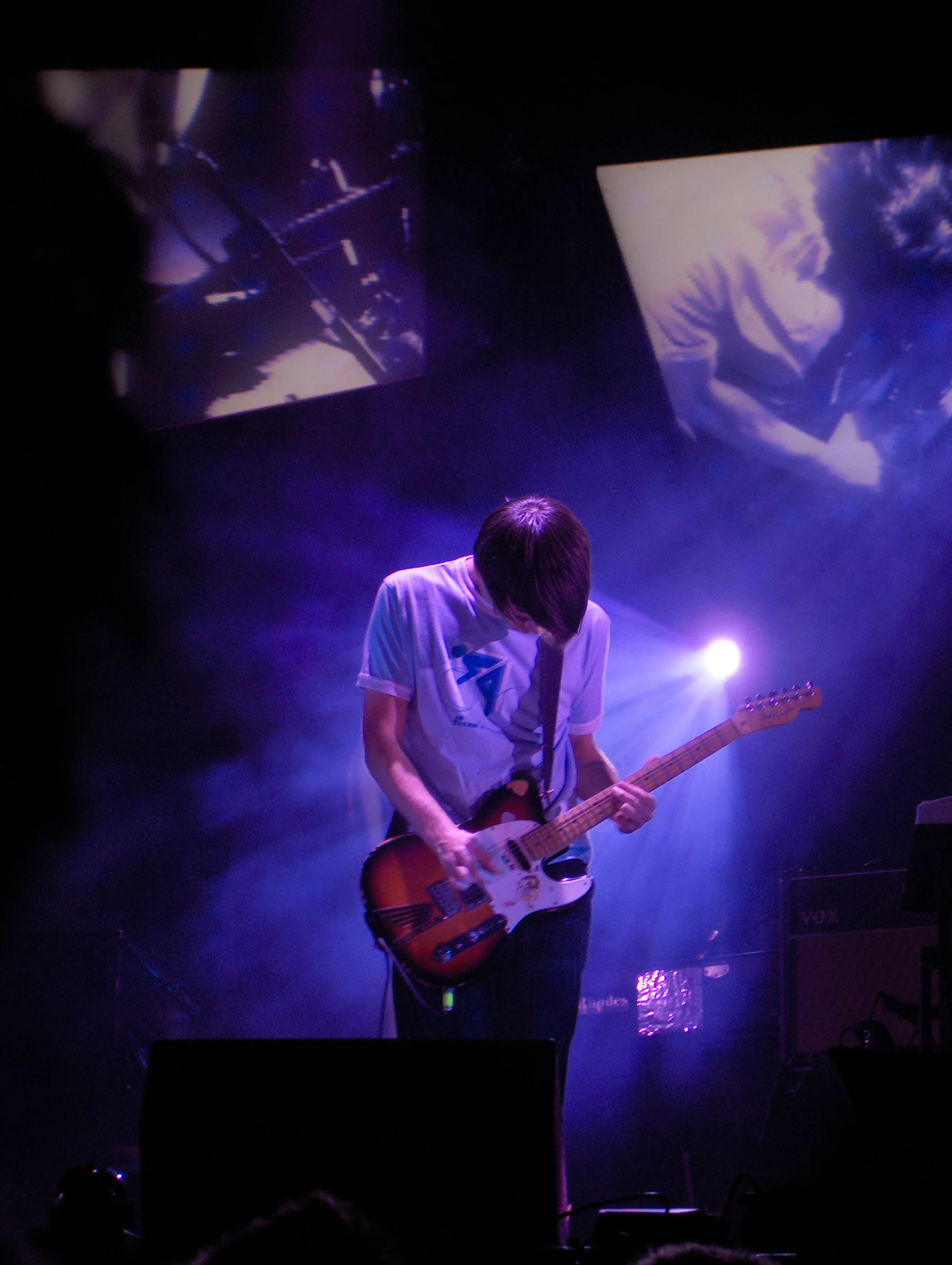
Jonny Greenwood
Jonny Greenwood is Radiohead's lead guitarist, keyboardist, and primary orchestral composer — a musician whose contributions to the band go far beyond conventional guitar playing. His guitar work on OK Computer (1997) and In Rainbows (2007) is defined by unconventional technique, non-standard tunings, and an approach to texture and noise that treats the guitar as a sound design tool rather than a melodic vehicle. He has composed film scores for director Paul Thomas Anderson (There Will Be Blood, The Master, Phantom Thread), won BAFTA awards for orchestral composition, and is a commissioned composer for the BBC Philharmonic. His guitar playing is inseparable from his interest in spectral music and electronic texture.
Fender Telecaster Plus through a Fender Twin Reverb or Hi-Watt Custom 100 — but the specific amp matters less than the processing. Greenwood's guitar sound relies heavily on unconventional technique: rapid strumming of partial chords, prepared guitar techniques (objects on strings), the Korg Kaoss Pad for real-time processing, and Ondes Martenot influence in his melodic phrasing. His clean tone is crystalline and present; his experimental sections use signal processing to obscure the guitar's identity entirely.
Signal Chain Order
Why Jonny Greenwood's Rig Works
Keeping the Twin Reverb genuinely clean rather than driven is a deliberate structural choice, not a stylistic default — Greenwood's guitar sound depends on downstream processing (the Shredmaster, the Kaoss Pad) transforming a neutral starting signal into specific textures. A pre-colored or saturated amp tone would fight with or muddy whatever processing comes after it, so the clean platform functions as raw material rather than a finished sound in its own right, which is a fundamentally different relationship to the amp than most guitarists on this site have.
The Marshall Shredmaster's harsh, compressed, slightly unrefined distortion character (a discontinued, somewhat crude pedal by hi-fi standards) is precisely why it suits Radiohead's angular material — a smoother, more polished modern distortion pedal would sound too controlled and conventional for the deliberately harsh, compressed riff on "Just" or the aggressive middle section of "Paranoid Android." The Shredmaster's rawness is functioning as a specific texture choice, similar to how Jack White or Kurt Cobain lean into deliberately unrefined gear.
The Korg Kaoss Pad's real-time X-Y touchpad control matters because it lets Greenwood apply processing gesturally and unpredictably during live performance, rather than through fixed pedal settings — this suits his treatment of the guitar as a sound-design tool rather than a conventional melodic instrument, since it allows the same starting guitar signal to be transformed differently each performance depending on how he physically moves across the pad, which a standard effects chain with static settings can't replicate.
Guitars
Fender Telecaster Plus (1988)
1992–presentGreenwood's primary guitar — a Fender Telecaster Plus with Lace Sensor pickups in red (bridge)/blue (neck) configuration. The Lace Sensor pickups are noiseless and have a compressed, even response that suits Greenwood's aggressive partial-chord strumming technique. The Telecaster Plus was Fender's late-1980s modernisation of the Telecaster and it appears on essentially every Radiohead record.
Fender Starcaster
2000–2010A semi-hollow Fender from the 1970s used for specific studio textures — the Starcaster's wide, resonant body produces a different character from the Telecaster, suitable for the more experimental harmonic content of the Kid A and Amnesiac era.
Amplifiers
Fender Twin Reverb
1992–presentGreenwood's primary clean amp — the Twin Reverb's crystal-clear transistor-like clean response at volume provides the neutral platform for his guitar processing. The clean tone is not the destination; it is the starting material that effects processing transforms.
Amp guide →Hi-Watt Custom 100
1995–2005Used for louder, more aggressive sections — the Hi-Watt's clean headroom at high volume produces a powerful, present clean tone that projects over Radiohead's dense arrangements. The Hi-Watt is less warm than the Twin Reverb; it has a slightly more aggressive presence in the upper frequencies.
Effects Pedals
Marshall Shredmaster
1993–presentGreenwood's primary distortion pedal — a late-1980s Marshall distortion unit that produces a harsh, compressed distortion character. Used on "Just" (The Bends), "Paranoid Android" (OK Computer), and many subsequent recordings. The Shredmaster has been discontinued and is now sought-after specifically because of Greenwood's use.
Korg Kaoss Pad
1998–presentReal-time X-Y touchpad controller for live signal processing — used to apply reverb, pitch shifting, and loop effects to guitar signal in real-time during live performance. The Kaoss Pad allows Greenwood to create the textural guitar sounds of Kid A and Amnesiac in a live context without pre-recording.
Electro-Harmonix POG
2005–presentUsed for organ-like chordal texture on In Rainbows and The King of Limbs — the POG's polyphonic octave generation adds a synthesiser-like quality to sustained chord passages. Applied subtly as a harmonic thickener rather than an obvious effect.
Key Albums & Tone
"Just" — Greenwood's Marshall Shredmaster at full aggression, producing the angular, compressed riff that defines the track. "Fake Plastic Trees" shows the contrast: acoustic-influenced clean guitar playing in the same album.
"Paranoid Android" — three distinct sections including the Shredmaster-driven middle section. "Lucky" demonstrates Greenwood's clean tone at its most expressive. The guitar on OK Computer is more diverse and surprising than on any subsequent Radiohead album.
"Bodysnatchers" — aggressive, non-standard strumming technique on partial chord shapes. "Nude" demonstrates the opposite: glassy, restrained, orchestrally integrated guitar playing. Greenwood's range on this record is the fullest expression of what makes his guitar playing distinct.
Greenwood's BAFTA-winning film score demonstrates that his musical thinking extends far beyond guitar playing — the orchestral language he applies to Paul Thomas Anderson's films is consistent with his approach to Radiohead's arrangements.
Frequently Asked Questions
What guitar does Jonny Greenwood use?
Fender Telecaster Plus (1988) and Fender Starcaster. Greenwood's primary guitar — a Fender Telecaster Plus with Lace Sensor pickups in red (bridge)/blue (neck) configuration. The Lace Sensor pickups are noiseless and have a compressed, even response that suits Greenwood's aggressive partial-chord strumming technique. The Telecaster Plus was Fender's late-1980s modernisation of the Telecaster and it appears on essentially every Radiohead record.
What amp does Jonny Greenwood use?
Fender Twin Reverb and Hi-Watt Custom 100. Greenwood's primary clean amp — the Twin Reverb's crystal-clear transistor-like clean response at volume provides the neutral platform for his guitar processing. The clean tone is not the destination; it is the starting material that effects processing transforms.
What pedals does Jonny Greenwood use?
Jonny Greenwood uses Marshall Shredmaster, Korg Kaoss Pad, Electro-Harmonix POG.
What is Jonny Greenwood's signature sound?
Fender Telecaster Plus through a Fender Twin Reverb or Hi-Watt Custom 100 — but the specific amp matters less than the processing. Greenwood's guitar sound relies heavily on unconventional technique: rapid strumming of partial chords, prepared guitar techniques (objects on strings), the Korg Kaoss Pad for real-time processing, and Ondes Martenot influence in his melodic phrasing. His clean tone is crystalline and present; his experimental sections use signal processing to obscure the guitar's identity entirely.
About This Data
Gear information for Jonny Greenwood is compiled from live performance footage, rig-rundown interviews, manufacturer and signature-model documentation, and cross-referenced guitar press coverage — not a single source. Where accounts conflict (a common issue with decades-old gear history), we favour the version corroborated by the most independent sources and note genuine ambiguity in the text rather than presenting a guess as settled fact.
This page is maintained by Alex Hall, last reviewed July 2026. Spotted something out of date or inaccurate? Let us know — corrections are usually made within a few days.