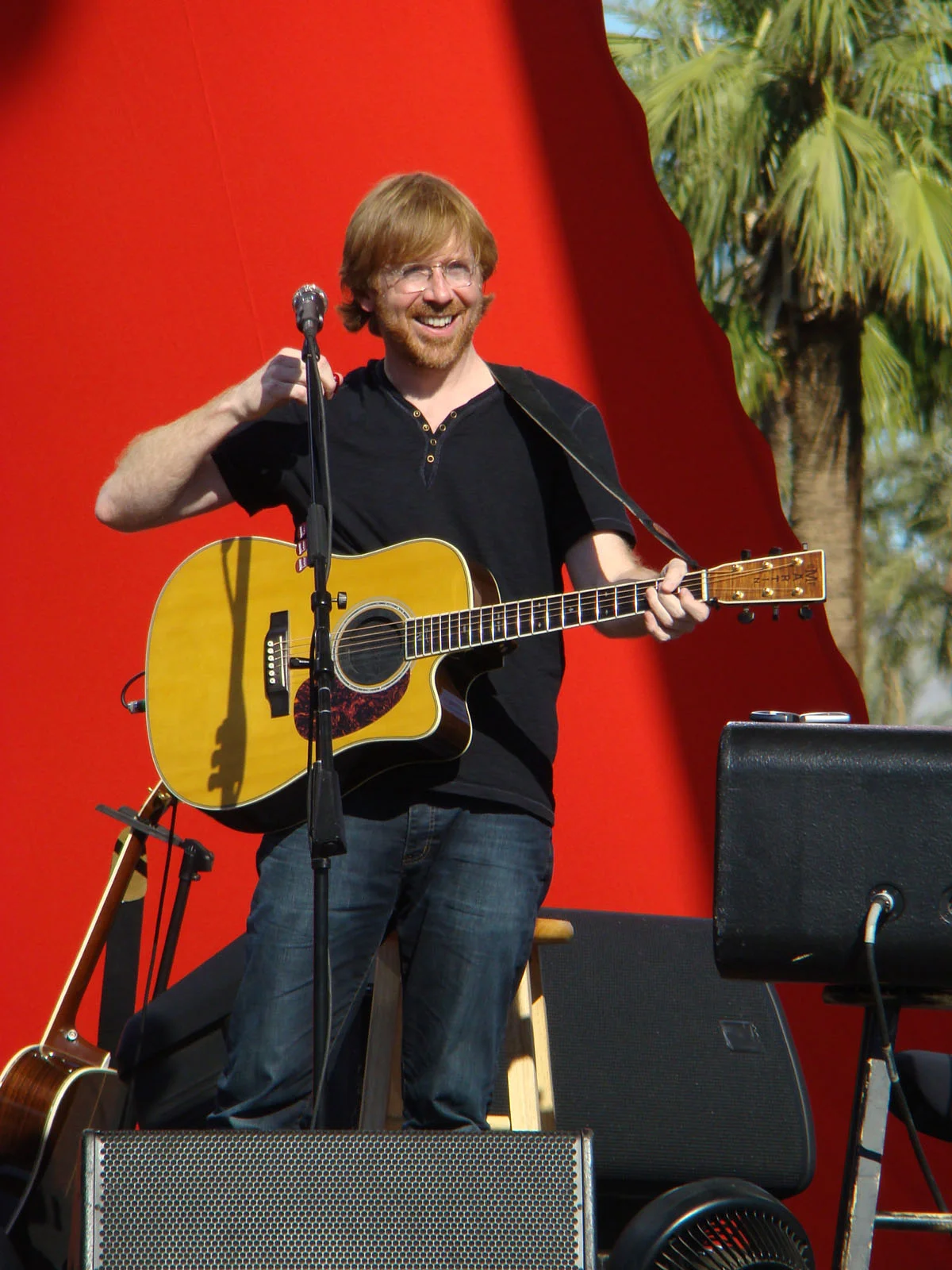
Trey Anastasio
Trey Anastasio has been the lead guitarist and co-primary songwriter of Phish since 1983. His approach is fundamentally improvisational — Phish live shows regularly feature 20-30 minute jams in which Anastasio develops ideas across jazz harmony, rock rhythm, reggae, funk, and bluegrass, often within a single continuous improvisation. His lead vocabulary is built on modal jazz concepts, pentatonic blues, and angular chromatic phrases, all delivered with the relaxed, fluid legato of a guitarist who has spent decades playing in an interactive group improvisation context. The custom Languedoc guitar is central to his identity — handbuilt, visually distinctive, and tonally unique.
Warm, singing lead tone from the custom Languedoc through Mesa/Boogie — the guitar's unusual construction produces a characteristically full, midrange-forward warmth quite different from production guitar alternatives. The gain level is moderate — sustaining and responsive without heavy saturation. The tone changes dramatically with playing dynamics: clean on light picking, overdriving naturally under harder attack. Delay and octave effects are used compositionally in extended jams.
Signal Chain Order
Why Trey Anastasio's Rig Works
The Languedoc's hollow internal chamber resonating even while amplified is a genuinely unusual construction choice — most solid-body electrics are designed to minimize acoustic resonance in favor of pure pickup output, but Languedoc's design deliberately lets the body's own vibration contribute to the amplified tone. That extra acoustic complexity is a large part of why Anastasio's tone reads as warmer and more three-dimensional than a comparable production superstrat would through the identical Mesa amp.
Keeping the Mesa Mark III at moderate rather than high gain matters specifically for extended improvisation — Anastasio's hours-long jams move fluidly between quiet, exploratory passages and full-intensity peaks, and a moderate gain setting lets pick attack and dynamics do most of the tonal shifting in real time, similar to the touch-driven approach found in blues-rock rigs, but stretched across far longer, more harmonically varied improvised forms.
The Boomerang looper's role in his live vocabulary is structurally different from a studio overdub tool — building a live loop and improvising against it in real time lets a single guitarist generate the kind of call-and-response, multi-part interplay that would otherwise require a second musician, which fits naturally into Phish's broader culture of spontaneous, unrehearsed musical conversation during live improvisation.
Guitars
Paul Languedoc Custom
1990–presentTrey's iconic instrument — built by luthier and Phish soundman Paul Languedoc, who has made multiple versions of this custom solid-body. The guitar features a distinctive hollow chamber, custom pickups, and a through-neck construction. The Languedoc's unusual acoustic properties (the hollow chamber resonates even when amplified) produce a warm, three-dimensional quality unlike production guitars. Anastasio has used multiple Languedoc builds over the decades.
Gibson Les Paul
1985–1993Used through early Phish before the Languedoc relationship was established — Les Paul humbuckers into the Mesa produce the warmer, more conventional rock tone heard on early recordings.
Fender Stratocaster
1983–1990Very early Phish — the Strat before Les Pauls and eventually the Languedoc. Anastasio's Strat-era recordings are relatively rare compared to the later instrument-specific identity.
Amplifiers
Mesa/Boogie Mark III
1990–presentThe Mesa Mark III is Trey's consistent amp choice — its warmth, gain range, and note separation suit the diverse harmonic demands of extended improvisation. The graphic EQ allows in-show adjustment. He typically runs it with moderate gain — pushing the Languedoc's output into natural amp saturation rather than using pedals for distortion.
Languedoc Custom Cabinet
1993–presentPaul Languedoc also built custom speaker cabinets matched to the Mesa amp's output characteristics — the speaker cabinet is considered part of the Trey Anastasio tone system rather than a generic component.
Effects Pedals
Fulltone Full-Drive 2
1998–presentAnastasio's primary overdrive pedal — the Full-Drive 2's MOSFET clipping mode produces a warm, amp-like overdrive that pushes the Mesa further without hardening the tone. Set for moderate gain and full output.
Pedal guide →DigiTech Whammy
1993–presentThe Whammy is central to Anastasio's extended jam vocabulary — used for octave-up and pitch-shifting effects during improvisations. He deploys it for dramatic one-octave lifts and for creating artificial harmonics that sit above the main melodic line.
Boomerang Phrase Sampler
1995–presentLooper pedal used in live performance to create layered guitar textures during extended jams — Anastasio will record a melodic loop and then improvise over it, creating a one-man-band effect.
Electro-Harmonix Micro Synthesizer
1993–2000Synth-guitar effect used for specific textural passages — the Micro Synth's envelope-controlled filter and sub-octave circuit adds synthesizer-like sweeps beneath conventional guitar signal.
Boss DD-6 Delay
1995–presentDelay for lead passages and jam-building — Anastasio uses delay both as a simple dimension tool and as a compositional element, setting long delays and playing against their echo for rhythmic interplay.
Key Albums & Tone
"Bathtub Gin", "You Enjoy Myself", "Stash" — the definitive live Phish document of the mid-1990s peak period. Extended jams across jazz, rock, funk, and bluegrass. The Languedoc/Mesa combination is fully established: warm, singing, improvisationally fluid.
Studio album capturing the polished studio side of the Phish sound. Shorter, more song-focused than live recordings but demonstrating Anastasio's melodic lead writing.
Compositionally ambitious concept album — more complex arrangements and studio layering than later Phish. The guitar tone is brighter and more Les Paul-adjacent than the Languedoc-heavy later period.
Frequently Asked Questions
What guitar does Trey Anastasio use?
Paul Languedoc Custom and Gibson Les Paul. Trey's iconic instrument — built by luthier and Phish soundman Paul Languedoc, who has made multiple versions of this custom solid-body. The guitar features a distinctive hollow chamber, custom pickups, and a through-neck construction. The Languedoc's unusual acoustic properties (the hollow chamber resonates even when amplified) produce a warm, three-dimensional quality unlike production guitars. Anastasio has used multiple Languedoc builds over the decades.
What amp does Trey Anastasio use?
Mesa/Boogie Mark III and Languedoc Custom Cabinet. The Mesa Mark III is Trey's consistent amp choice — its warmth, gain range, and note separation suit the diverse harmonic demands of extended improvisation. The graphic EQ allows in-show adjustment. He typically runs it with moderate gain — pushing the Languedoc's output into natural amp saturation rather than using pedals for distortion.
What pedals does Trey Anastasio use?
Trey Anastasio uses Fulltone Full-Drive 2, DigiTech Whammy, Boomerang Phrase Sampler and more.
What is Trey Anastasio's signature sound?
Warm, singing lead tone from the custom Languedoc through Mesa/Boogie — the guitar's unusual construction produces a characteristically full, midrange-forward warmth quite different from production guitar alternatives. The gain level is moderate — sustaining and responsive without heavy saturation. The tone changes dramatically with playing dynamics: clean on light picking, overdriving naturally under harder attack. Delay and octave effects are used compositionally in extended jams.
About This Data
Gear information for Trey Anastasio is compiled from live performance footage, rig-rundown interviews, manufacturer and signature-model documentation, and cross-referenced guitar press coverage — not a single source. Where accounts conflict (a common issue with decades-old gear history), we favour the version corroborated by the most independent sources and note genuine ambiguity in the text rather than presenting a guess as settled fact.
This page is maintained by Alex Hall, last reviewed July 2026. Spotted something out of date or inaccurate? Let us know — corrections are usually made within a few days.