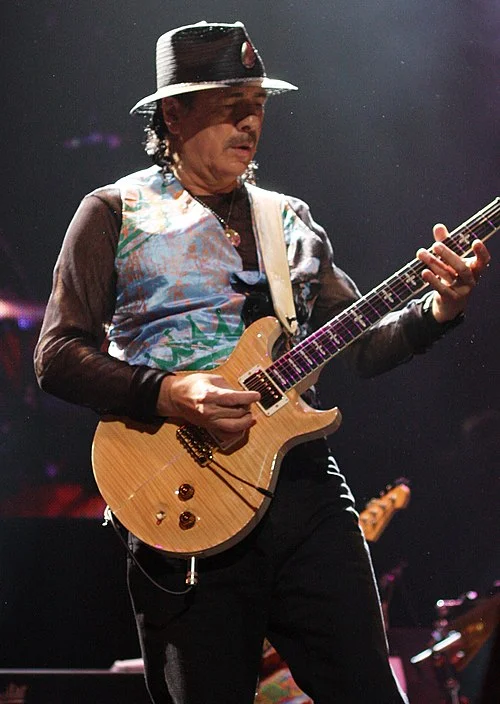
Carlos Santana
Carlos Santana brought a uniquely hybrid sound — Mexican folk, Afro-Cuban rhythms and blues guitar — to the Woodstock stage in 1969 and has built one of the most recognisable guitar sounds in music history. His partnership with PRS guitars produced one of the most successful artist signature collaborations in the industry.
PRS guitar with covered humbuckers into Mesa/Boogie — warm, slightly compressed, supremely sustaining tone. The notes bloom and decay with a vocal quality that makes his playing immediately distinctive. Mesa/Boogie was partly designed around his ideal tone.
Why Carlos Santana's Rig Works
Santana's tone is a genuinely rare case of the amp being co-designed around a guitarist's ear rather than adapted to it after the fact — his early input to Randall Smith's hot-rodded Fender circuits directly shaped what became the Mesa/Boogie sound, particularly its cascading gain stages that produce a smooth, compressed sustain rather than a harsh or fizzy one. That history matters practically: the amp's breakup character is voiced from the ground up for exactly the sustained, vocal lead lines his playing depends on, rather than being a general-purpose high-gain design he's adapting to.
PRS's covered humbuckers (as opposed to the more common exposed-pole-piece humbucker) contribute a slightly warmer, less aggressive top end that suits this amp's already-compressed character — an uncovered, hotter-output humbucker into the same Mesa channel would push further into a harder, more aggressive breakup than the smooth bloom his tone is known for.
Running the guitar signal essentially clean into the amp and letting the Mesa's own channel-2 breakup provide the gain — rather than stacking a distortion pedal in front — means the compression and sustain characteristics come from the amp's actual tube behavior at volume, which produces a more natural note decay (notes blooming and swelling rather than instantly hitting full sustain) than a pedal-driven distortion typically achieves.
Guitars
PRS Santana II
Single cutaway with covered humbuckers. Bird inlays. Primary touring guitar.
Full specs & buy →Gibson L6-S
1973–1975Used on "Welcome" and mid-1970s recordings.
Yamaha SG-175
1976–1984Santana used Yamaha during his mid-period. Excellent sustain characteristics.
Amplifiers
Mesa/Boogie MkI (Prototype)
1970–1985Santana's discovery of Randall Smith's hot-rodded Fender helped launch Mesa/Boogie as a company. He is credited with naming the brand.
Mesa/Boogie Dual Rectifier
1990–presentModern primary amp — high-gain channel for sustaining lead tones.
Amp guide →Effects Pedals
Ibanez Tube Screamer
Moderate drive, level at unity — warms and sustains the Mesa/Boogie tone.
Boss CE-1 Chorus
Subtle chorus for depth on slower passages.
MXR Digital Delay
Moderate delay for sustain and depth on solos.
Key Albums & Tone
"Evil Ways" and Woodstock performance — SG into Mesa, warm Latin rock fusion.
"Oye Como Va" and "Black Magic Woman" — perfectly captured warm sustaining SG/Mesa tone.
"Smooth" — PRS into Mesa, refined, warm and commercial. Biggest-selling album of the year.
Frequently Asked Questions
What guitar does Carlos Santana use?
PRS Santana II and Gibson SG. Single cutaway with covered humbuckers. Bird inlays. Primary touring guitar.
What amp does Carlos Santana use?
Mesa/Boogie MkI (Prototype) and Mesa/Boogie Dual Rectifier. Santana's discovery of Randall Smith's hot-rodded Fender helped launch Mesa/Boogie as a company. He is credited with naming the brand.
What pedals does Carlos Santana use?
Carlos Santana uses Ibanez Tube Screamer, Boss CE-1 Chorus, MXR Digital Delay.
What is Carlos Santana's signature sound?
PRS guitar with covered humbuckers into Mesa/Boogie — warm, slightly compressed, supremely sustaining tone. The notes bloom and decay with a vocal quality that makes his playing immediately distinctive. Mesa/Boogie was partly designed around his ideal tone.
About This Data
Gear information for Carlos Santana is compiled from live performance footage, rig-rundown interviews, manufacturer and signature-model documentation, and cross-referenced guitar press coverage — not a single source. Where accounts conflict (a common issue with decades-old gear history), we favour the version corroborated by the most independent sources and note genuine ambiguity in the text rather than presenting a guess as settled fact.
This page is maintained by Alex Hall, last reviewed July 2026. Spotted something out of date or inaccurate? Let us know — corrections are usually made within a few days.